Author name: Admin

expanding single brackets online tutoring the smart learners mathematics
Mathematics

Expanding & Simplifying Single Brackets

Expanding & Simplifying Single Brackets - GCSE Mathematics | The Smart Learners

Expanding & Simplifying Single Brackets

GCSE Mathematics

📦 What is Expanding Brackets?

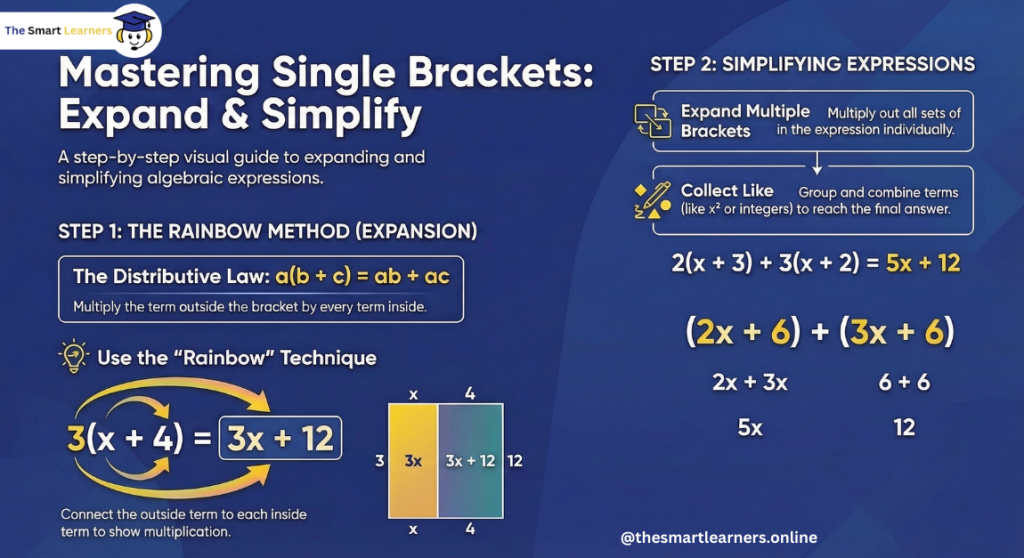
Expanding brackets (or multiplying out) means removing the brackets by multiplying everything inside the brackets by the term outside. It's like distributing items from a box to everyone - each term inside gets multiplied by the term outside.

Rule: a(b + c) = a × b + a × c = ab + ac
Example: 3(x + 4) = 3 × x + 3 × 4 = 3x + 12

🎨 Visualizing Expansion

3 ( x + 4 )

↓ Multiply each term inside by 3 ↓

3 × x = 3x
+
3 × 4 = 12
3x + 12

📚 Types of Brackets

➕ Positive Number Outside

Multiply the positive number by each term inside.

Example 1

4(x + 3)

= 4 × x + 4 × 3

= 4x + 12

Example 2

5(2x + 4)

= 5 × 2x + 5 × 4

= 10x + 20

Example 3

3(3x + 2y)

= 3 × 3x + 3 × 2y

= 9x + 6y

➖ Negative Number Outside

Be careful with signs! Negative × positive = negative, Negative × negative = positive.

Example 1

-3(x + 4)

= (-3) × x + (-3) × 4

= -3x - 12

Example 2

-2(3x - 5)

= (-2) × 3x + (-2) × (-5)

= -6x + 10

Example 3

-4(2x + 3y)

= (-4) × 2x + (-4) × 3y

= -8x - 12y

🔤 Variable Outside

Multiply the variable by each term inside (remember laws of indices).

Example 1

x(x + 5)

= x × x + x × 5

= x² + 5x

Example 2

2x(3x - 4)

= 2x × 3x + 2x × (-4)

= 6x² - 8x

Example 3

3y(2y + 4z)

= 3y × 2y + 3y × 4z

= 6y² + 12yz

🔢 Both Number & Variable

Multiply both the number and variable parts separately.

Example 1

3x(2x + 5)

= 3x × 2x + 3x × 5

= 6x² + 15x

Example 2

-2x(3x - 4y)

= (-2x) × 3x + (-2x) × (-4y)

= -6x² + 8xy

Example 3

4xy(2x + 3y)

= 4xy × 2x + 4xy × 3y

= 8x²y + 12xy²

🧮 Interactive Bracket Expander

Enter your own expression and see it expand step-by-step!

✏️ Practice Expanding Brackets

Expand and simplify: 3(x + 4)

Correct: 0 Attempted: 0

🔄 Expanding and Then Simplifying

Sometimes after expanding, you need to collect like terms:

Example 1

2(x + 3) + 3(x + 2)

Step 1: Expand both brackets

= 2x + 6 + 3x + 6

Step 2: Collect like terms

= (2x + 3x) + (6 + 6)

= 5x + 12

Example 2

4(x - 2) - 2(x + 1)

Step 1: Expand both brackets

= 4x - 8 - 2x - 2

Step 2: Collect like terms

= (4x - 2x) + (-8 - 2)

= 2x - 10

Example 3

3x(2x + 1) - 2x(x - 4)

Step 1: Expand both brackets

= 6x² + 3x - 2x² + 8x

Step 2: Collect like terms

= (6x² - 2x²) + (3x + 8x)

= 4x² + 11x

⚠️ Common Mistakes

❌ Wrong: Only multiplying the first term

3(x + 4) = 3x + 4 ❌

Correct: 3(x + 4) = 3x + 12

✅ Correct: Multiply every term inside

3(x + 4) = 3 × x + 3 × 4 = 3x + 12

❌ Wrong: Sign errors with negatives

-2(x - 3) = -2x - 6 ❌

Correct: -2(x - 3) = -2x + 6

⚠️ Remember: Negative × Negative = Positive

(-3) × (-4) = +12

❌ Wrong: Forgetting to multiply coefficients

2x(3x + 4) = 2x² + 8x ❌

Correct: 2x(3x + 4) = 6x² + 8x

🌍 Where Bracket Expansion is Used

📏 Area Calculation

Rectangle with length (x+3) and width 4:

Area = 4(x + 3) = 4x + 12

💰 Perimeter Problems

Rectangle with sides (x+2) and (x+1):

Perimeter = 2(x+2) + 2(x+1)

= 2x+4 + 2x+2 = 4x+6

📊 Cost Calculations

Buying x items at price (p+2) each:

Total = x(p+2) = xp + 2x

Exponents and Indices and powers the smart learners mathematics online tutoring
Mathematics

Algebraic Roots and indices

Algebraic Roots and Indices - GCSE Mathematics | The Smart Learners

Algebraic Roots and Indices

GCSE Mathematics

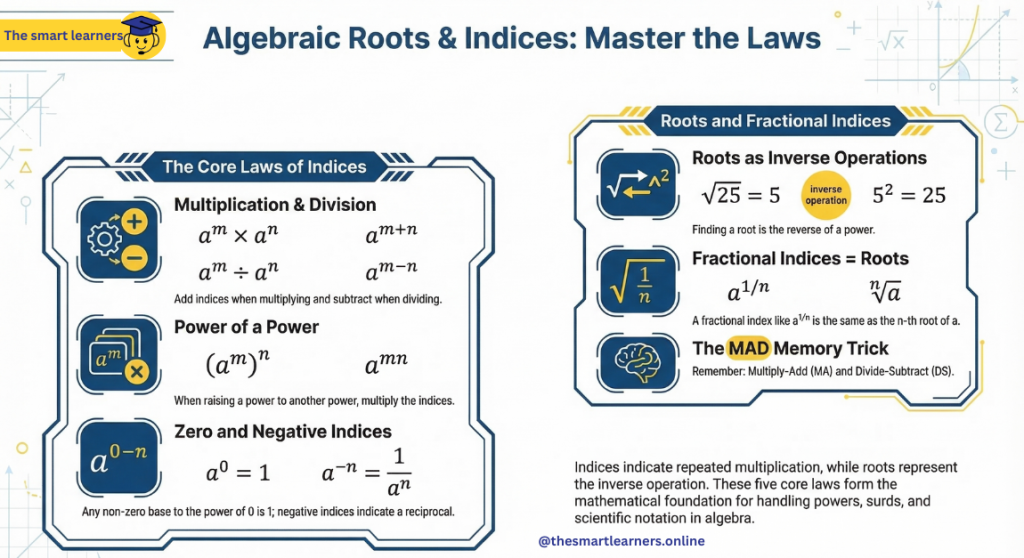
📐 What are Roots and Indices?

Indices (or exponents) show how many times a number is multiplied by itself. Roots are the inverse operation - finding which number multiplied by itself gives the original number. Together, they form the foundation of powers and surds in algebra.

Index (Power): 5³ = 5 × 5 × 5 = 125
Root: √25 = 5 (because 5 × 5 = 25)
Algebraic: x⁴ × x³ = x⁷

📏 Laws of Indices

✖️ Law 1: Multiplication (Add indices)

aᵐ × aⁿ = aᵐ⁺ⁿ

Example 1

x³ × x⁴ = x³⁺⁴ = x⁷

Example 2

y² × y⁵ = y²⁺⁵ = y⁷

Example 3

3x² × 2x⁴ = (3×2)x²⁺⁴ = 6x⁶

➗ Law 2: Division (Subtract indices)

aᵐ ÷ aⁿ = aᵐ⁻ⁿ

Example 1

x⁷ ÷ x³ = x⁷⁻³ = x⁴

Example 2

y⁶ ÷ y² = y⁶⁻² = y⁴

Example 3

12x⁵ ÷ 3x² = (12÷3)x⁵⁻² = 4x³

⬆️ Law 3: Power of a Power (Multiply indices)

(aᵐ)ⁿ = aᵐ×ⁿ

Example 1

(x³)² = x³×² = x⁶

Example 2

(y⁴)³ = y⁴׳ = y¹²

Example 3

(2x²)³ = 2³ × (x²)³ = 8x⁶

➖ Law 4: Negative Indices

a⁻ⁿ = 1/aⁿ

Example 1

x⁻³ = 1/x³

Example 2

2y⁻⁴ = 2/y⁴

Example 3

(2x)⁻² = 1/(2x)² = 1/(4x²)

0️⃣ Law 5: Zero Index

a⁰ = 1 (where a ≠ 0)

Example 1

x⁰ = 1

Example 2

5⁰ = 1

Example 3

(2x³)⁰ = 1

√ Roots and Surds

🔲 Square Roots

√a × √a = a

√16 = 4 (because 4² = 16)

√x⁶ = x³ (because (x³)² = x⁶)

📦 Cube Roots

∛a × ∛a × ∛a = a

∛27 = 3 (because 3³ = 27)

∛x⁹ = x³ (because (x³)³ = x⁹)

🔄 Fractional Indices

a^(1/n) = ⁿ√a

x^(1/2) = √x

x^(1/3) = ∛x

🧮 Interactive Indices Calculator

Enter expressions and see how indices laws work!

✏️ Practice Questions

Simplify: x³ × x⁴

Score: 0 Attempted: 0

🌟 Challenge Problems

Simplify: (2x³y²)⁴

Simplify: (8x⁶)^(1/3)

Simplify: (4x⁴)^(1/2) × x³

⚠️ Common Mistakes

❌ Wrong: Adding when multiplying powers

x³ × x⁴ = x¹² ❌

Correct: x³ × x⁴ = x⁷ (add indices)

✅ Correct: Remember the laws

Multiplication → Add indices

Division → Subtract indices

Power of power → Multiply indices

❌ Wrong: Forgetting about coefficients

2x³ × 3x⁴ = 5x⁷ ❌

Correct: 2x³ × 3x⁴ = 6x⁷

⚠️ Negative indices are reciprocals

x⁻³ = 1/x³, not -x³

🌍 Where Indices Are Used

💰 Compound Interest

A = P(1 + r)ⁿ

Where n is the number of years (index)

📏 Scientific Notation

3.2 × 10⁶ = 3,200,000

Powers of 10 make big numbers manageable

📊 Area and Volume

Area = length² (square units)

Volume = length³ (cubic units)

🧬 Exponential Growth

Bacteria growth: N = N₀ × 2ᵗ

Population doubles each hour

Collecting like terms The smart learners Online tutoring mathematics
Mathematics

collecting like terms

Collecting Like Terms - GCSE Mathematics | The Smart Learners

Collecting Like Terms

GCSE Mathematics

🧩 What are Like Terms?

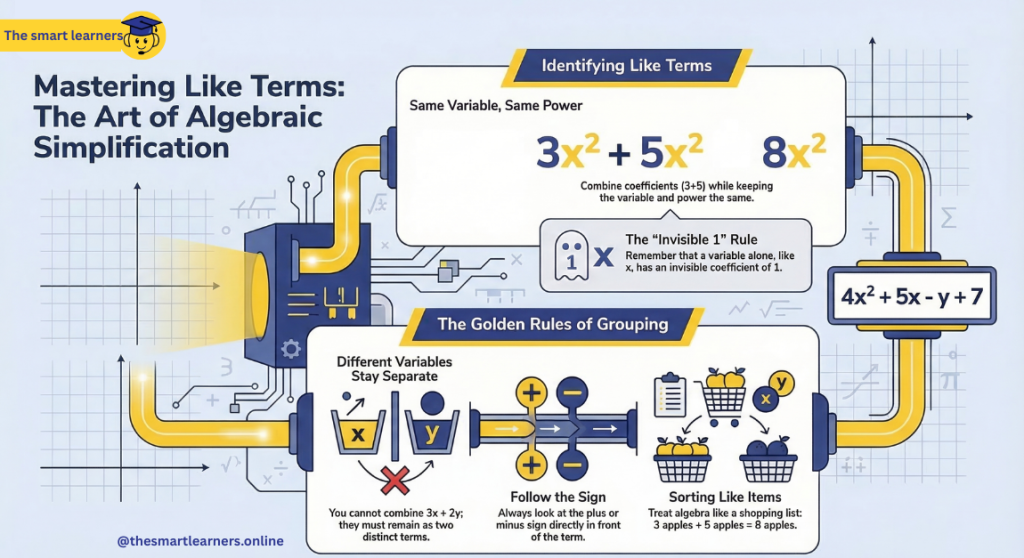
Like terms are terms that have exactly the same variables raised to the same powers. Collecting (or combining) like terms means adding or subtracting terms that are the same to simplify expressions. Think of it as grouping identical items together - like counting all the apples separately from oranges.

Example: 3x + 2y + 5x - y = (3x + 5x) + (2y - y) = 8x + y

🎨 Visual Representation

x x x y y

3x + 2y (3 x's and 2 y's)

+
x x y

2x + y (2 x's and 1 y)

=
x x x x x y y y

5x + 3y (5 x's and 3 y's)

📚 How to Collect Like Terms

🔹 Basic Like Terms (Same Variable)

Combine terms with the same variable by adding or subtracting their coefficients.

Example 1

3x + 5x

= (3 + 5)x

= 8x

Example 2

7y - 2y

= (7 - 2)y

= 5y

Example 3

4a + a

= 4a + 1a

= 5a

➕➖ With Positive and Negative Signs

Pay attention to the signs before each term.

Example 1

4x - 2x + 3x

= (4 - 2 + 3)x

= 5x

Example 2

-3y + 7y - 2y

= (-3 + 7 - 2)y

= 2y

Example 3

5a - 3a - a + 4a

= (5 - 3 - 1 + 4)a

= 5a

⬆️ Terms with Powers (Exponents)

Terms are only like if they have the same variable AND the same power.

Example 1

3x² + 5x²

= (3 + 5)x²

= 8x²

Example 2

7y³ - 2y³

= (7 - 2)y³

= 5y³

Example 3

4x² + 3x - 2x² + x

= (4x² - 2x²) + (3x + x)

= 2x² + 4x

🔄 Mixed Terms with Multiple Variables

Group terms with the same variable combinations.

Example 1

3x + 2y + 5x - y

= (3x + 5x) + (2y - y)

= 8x + y

Example 2

4a + 3b - 2a + 5b - a

= (4a - 2a - a) + (3b + 5b)

= a + 8b

Example 3

2x² + 3xy - x² + 4xy

= (2x² - x²) + (3xy + 4xy)

= x² + 7xy

🔄 Interactive Like Terms Sorter

Drag and drop (or click) to sort terms into groups:

3x 5y -2x 4x² 3y 7x -y 2x² 4xy -3xy

x terms

y terms

x² terms

xy terms

✏️ Practice Collecting Like Terms

Simplify: 4x + 3y - 2x + 5y

Correct: 0 Attempted: 0

⚠️ Common Mistakes to Avoid

❌ Wrong: Combining unlike terms

3x + 2y = 5xy

Correct: 3x + 2y (cannot combine - different variables)

✅ Correct: Only combine like terms

3x + 2x = 5x

4y - y = 3y

❌ Wrong: Forgetting the invisible 1

x + 2x = 2x ❌ (forgot x is 1x)

Correct: x + 2x = 3x

⚠️ Careful with signs!

3x - 5x + 2x

= (3 - 5 + 2)x = 0x = 0

🌍 Real-World Connection

Collecting like terms is like organizing items in real life:

🛒 Shopping List

3 apples + 2 oranges + 5 apples - 1 orange

= (3 + 5) apples + (2 - 1) oranges

= 8 apples + 1 orange

💰 Money

£5 + €3 + £2 - €1

= (£5 + £2) + (€3 - €1)

= £7 + €2

📦 Inventory

4 boxes + 3 crates + 2 boxes - 1 crate

= (4 + 2) boxes + (3 - 1) crates

= 6 boxes + 2 crates

Mathematics

substitution

Substitution - GCSE Mathematics | The Smart Learners

Substitution

GCSE Mathematics

🔄 What is Substitution?

Substitution means replacing variables (letters) with given numerical values to evaluate an expression. It's like following a recipe - when you know the actual ingredients (numbers), you replace the placeholders (variables) to get the final result.

Example: If x = 3 and y = 4, then 2x + y = 2(3) + 4 = 6 + 4 = 10

📝 How Substitution Works

🔢 Simple Substitution

Replace each variable with its given value and calculate.

Example 1

Expression: 3x + 5

Given: x = 7

Solution: 3(7) + 5 = 21 + 5 = 26

Example 2

Expression: 4y - 3

Given: y = 6

Solution: 4(6) - 3 = 24 - 3 = 21

Example 3

Expression: 2a + 7

Given: a = 4

Solution: 2(4) + 7 = 8 + 7 = 15

📦 Substitution with Brackets

Remember BIDMAS/BODMAS - calculate brackets first!

Example 1

Expression: 2(x + 3)

Given: x = 5

Solution: 2(5 + 3) = 2(8) = 16

Example 2

Expression: 3(2y - 1)

Given: y = 4

Solution: 3(2×4 - 1) = 3(8 - 1) = 3(7) = 21

Example 3

Expression: 5(2a + 3b)

Given: a = 2, b = 3

Solution: 5(2×2 + 3×3) = 5(4 + 9) = 5(13) = 65

⬆️ Substitution with Powers

Calculate powers before multiplication and addition.

Example 1

Expression: x² + 4

Given: x = 3

Solution: 3² + 4 = 9 + 4 = 13

Example 2

Expression: 2y² - 5

Given: y = 4

Solution: 2(16) - 5 = 32 - 5 = 27

Example 3

Expression: a³ + 2a

Given: a = 3

Solution: 27 + 6 = 33

🔀 Multiple Variables

Substitute all variables with their given values.

Example 1

Expression: 2x + 3y - z

Given: x = 4, y = 5, z = 2

Solution: 2(4) + 3(5) - 2 = 8 + 15 - 2 = 21

Example 2

Expression: 3a² - 2b + c

Given: a = 3, b = 4, c = 7

Solution: 3(9) - 2(4) + 7 = 27 - 8 + 7 = 26

🧮 Interactive Substitution Calculator

Enter values for variables and see the result instantly!

✏️ Practice Substitution

If x = 4 and y = 3, find the value of 2x + 5y

Given values:

x = 4, y = 3

Expression:

2x + 5y

Your Progress: 0/0 correct

🌍 Real-World Applications

💰 Salary Calculation

Formula: Weekly wage = 15h + 100

Where: h = hours worked

Example: If h = 35, wage = 15(35) + 100 = £625

📏 Area of Rectangle

Formula: A = l × w

Where: l = length, w = width

Example: l = 8cm, w = 5cm, A = 40cm²

🌡️ Temperature Conversion

Formula: F = (C × 9/5) + 32

Example: C = 20°C, F = (20 × 9/5) + 32 = 68°F

🏃 Distance Formula

Formula: d = rt

Where: r = rate, t = time

Example: r = 60 mph, t = 2.5h, d = 150 miles

⚠️ Common Mistakes to Avoid

❌ Wrong Order

Expression: 2 + 3x when x = 4

Wrong: 2 + 3 = 5, then 5 × 4 = 20

Correct: 2 + 3(4) = 2 + 12 = 14

✅ BIDMAS/BODMAS Rule

Always follow the order:

Brackets → Indices → Division → Multiplication → Addition → Subtraction

❌ Sign Errors

Expression: -3x when x = -2

Wrong: -3 × -2 = -6

Correct: -3 × -2 = +6

💡 Remember

Negative × Negative = Positive

Negative × Positive = Negative

🌟 Challenge Questions

If a = 3, b = -2, and c = 4, evaluate: 2a² - 3b + c

If x = 5, evaluate: 3(x + 2)² - 4x

If p = -3, q = 4, evaluate: p³ + 2pq - q²

Mathematics

Algebra vocabulary

Algebra Vocabulary - GCSE Mathematics | The Smart Learners

Algebra Vocabulary

GCSE Mathematics

📚 What is Algebra Vocabulary?

Algebra has its own special language. Understanding the key terms and vocabulary is essential for solving problems and communicating mathematical ideas effectively. Just like learning any new language, mastering algebra vocabulary is the first step to success.

Think of it as: Learning the words before reading the story

🔤 Key Algebra Terms

📖 Foundational Vocabulary

Variable (click to hear)

Definition: A letter or symbol that represents an unknown number

Example: In x + 5 = 12, x is the variable

Memory Tip: Variables can "vary" or change

Constant (click to hear)

Definition: A fixed value that does not change

Example: In 2x + 7, 7 is the constant

Memory Tip: Constants stay "constant"

Coefficient (click to hear)

Definition: A number multiplied by a variable

Example: In 4y, 4 is the coefficient

Memory Tip: Co-efficient = with the variable

➗ Operation Vocabulary

Sum

Definition: The result of addition

Example: The sum of 3 and 5 is 8

Difference

Definition: The result of subtraction

Example: The difference between 10 and 4 is 6

Product

Definition: The result of multiplication

Example: The product of 3 and 4 is 12

Quotient

Definition: The result of division

Example: The quotient of 15 and 3 is 5

📊 Expression Vocabulary

Term

Definition: A single number, variable, or product of numbers and variables

Example: In 3x + 2y - 5, there are three terms

Like Terms

Definition: Terms with the same variables raised to the same powers

Example: 3x and 5x are like terms; 3x and 3y are not

Expression

Definition: A combination of terms without an equals sign

Example: 2x + 5 is an expression

⚖️ Equation Vocabulary

Equation

Definition: A statement that two expressions are equal

Example: 2x + 3 = 7 is an equation

Inequality

Definition: A statement that compares expressions using <, >, ≤, or ≥

Example: x + 2 > 5 is an inequality

Solution

Definition: The value that makes an equation true

Example: In x + 3 = 7, the solution is x = 4

✏️ Vocabulary Quiz

Match the term with its correct definition:

Loading question...

Your Score: 0/5

📝 Vocabulary in Real Sentences

How to use algebra vocabulary correctly:

✅ Correct: "Combine the like terms 3x and 5x to get 8x."

❌ Incorrect: "Add the 3x and 5x together to get 8x²."

✅ Correct: "Solve the equation 2x + 3 = 7."

❌ Incorrect: "Solve the expression 2x + 3 = 7."

✅ Correct: "The coefficient of x is 4 in the term 4x."

❌ Incorrect: "The number 4 is the variable."

🎴 Vocabulary Flashcards

Variable
A letter representing an unknown number
Coefficient
Number multiplied by a variable
Constant
A fixed value that doesn't change
Mathematics

Algebra notations

Algebra Notations - GCSE Mathematics | The Smart Learners

Algebra Notations

GCSE Mathematics

📝 What are Algebra Notations?

Algebra notations are the symbols and conventions used to write mathematical expressions and equations. They form the language of algebra, allowing us to represent unknown values, operations, and relationships in a concise way.

Example: 3x + 2y = 10

Basic Algebraic Symbols

Variables (x, y, z, a, b, c...)

Variables are letters that represent unknown or changing values. They are the foundation of algebra.

Example 1

x + 5 = 12

Here, x is the variable we need to find.

Example 2

2y - 3 = 7

y represents the unknown number.

Operation Symbols (+, -, ×, ÷)

These symbols tell us what to do with the numbers and variables.

Addition

a + b (sum of a and b)

Subtraction

p - q (difference between p and q)

Multiplication

3x or x·y (product)

Division

x ÷ 2 or x/2 (quotient)

Coefficients (Numbers before variables)

Coefficients are the numerical factors that multiply variables.

Example 1

5x (5 is the coefficient)

Example 2

-3y (-3 is the coefficient)

Example 3

½z (½ is the coefficient)

Constants (Fixed numbers)

Constants are fixed values that don't change.

Example 1

2x + 7 (7 is constant)

Example 2

y - 3 (3 is constant)

Special Algebraic Notations

📌 Exponents and Powers

Exponents show repeated multiplication:

= x × x

= y × y × y

a⁴ = a × a × a × a

📌 Like Terms

Terms with the same variable and exponent:

3x + 2x = 5x (like terms)
4y² + y² = 5y² (like terms)
2x + 3y (cannot combine - unlike terms)

✏️ Practice: Identify the Notations

In the expression 5x² + 3y - 7, identify the coefficient of x²:

Score: 0/5 correct

⚠️ Common Mistakes to Avoid

❌ Wrong

Writing 2x + 3x = 5x²

✅ Correct

2x + 3x = 5x (add coefficients, keep variable same)

❌ Wrong

Confusing 2x with x²

✅ Correct

2x = x + x, while x² = x × x

the smart learners power physics smart learners
Physics

power

Power

Understanding the rate of energy transfer - from light bulbs to power plants

P = E/t = W/t = VI

What is Power?

Definition

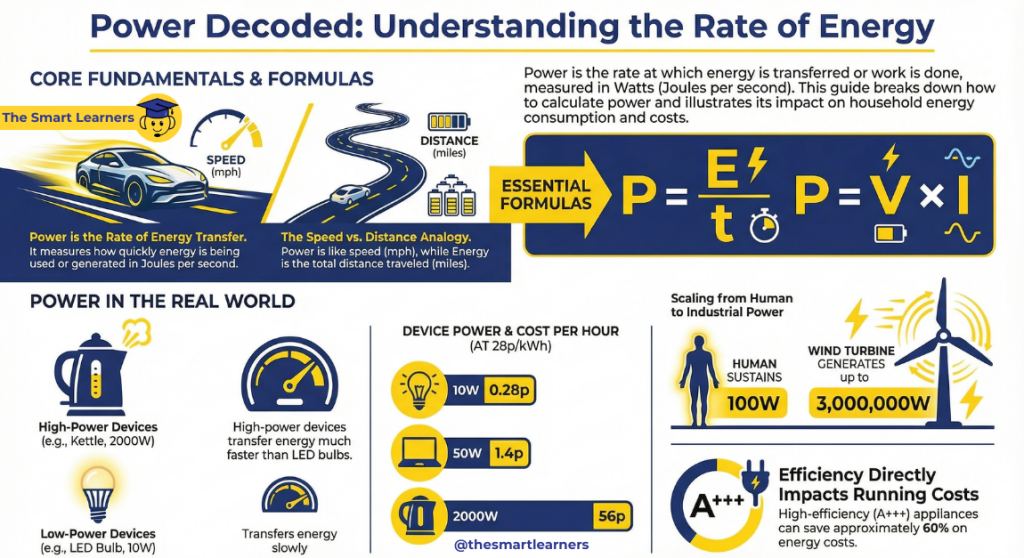
Power is the rate at which energy is transferred or work is done. It tells us how quickly energy is being used or generated.

Key Concept

A high power device transfers energy quickly, while a low power device transfers energy slowly.

Unit

Power is measured in watts (W). 1 watt = 1 joule per second (1 W = 1 J/s)

Real-World Understanding

A 100W light bulb converts 100 joules of electrical energy into light and heat every second. A 2000W kettle converts 2000 joules per second - that's why it heats water much faster!

Power Formulas

Basic Power Formula

P = E / t
P
Power (W)
E
Energy (J)
t
Time (s)

Work Formula

P = W / t
P
Power (W)
W
Work (J)
t
Time (s)

Electrical Power

P = V × I
P
Power (W)
V
Voltage (V)
I
Current (A)

Alternative Electrical

P = I²R
P
Power (W)
I
Current (A)
R
Resistance (Ω)

Formula Rearrangements

Find Energy
E = P × t
Find Time
t = E ÷ P
Find Current
I = P ÷ V
Find Voltage
V = P ÷ I

Interactive Power Calculator

Adjust the sliders to see how power, energy, and time are related:

Energy Transfer Simulator

Power (Watts)

100 W

Time (seconds)

60 s

Energy Used

6000 J
E = P × t

Energy Transfer Rate

100 J/s

Your device transfers 100 joules of energy every second

In 60 seconds, total energy = 6000 J

Household Appliance Power Ratings

Different appliances have different power ratings - see how they compare:

LED Light Bulb

10W
  • Uses 10 J/s
  • Cost: ~£0.03 per day
  • 100 hours on 1 kWh

Laptop

50W
  • Uses 50 J/s
  • Cost: ~£0.15 per day
  • 20 hours on 1 kWh

LED TV (50")

100W
  • Uses 100 J/s
  • Cost: ~£0.30 per day
  • 10 hours on 1 kWh

Refrigerator

150W
  • Uses 150 J/s (avg)
  • Cost: ~£0.45 per day
  • Runs 30% of time

Kettle

2000W
  • Uses 2000 J/s
  • Cost: ~£0.10 per boil
  • 30 minutes on 1 kWh

Electric Shower

9000W
  • Uses 9000 J/s
  • Cost: ~£0.45 per 10 mins
  • 6.7 minutes on 1 kWh

Key Point: High power appliances (like kettles and showers) transfer energy very quickly, which is why they heat things rapidly but also cost more to run.

Real-World Power Examples

Solar Panel

Typical residential solar panel produces about 300W of power in full sunlight.

300W
Peak Power
1.5kWh
Daily Energy
Car Engine

A typical family car engine produces around 100,000W (100kW) of power.

100kW
Engine Power
134hp
Horsepower
Wind Turbine

Modern wind turbines can generate up to 3,000,000W (3MW) of power.

3MW
Peak Power
2000 homes
Can Power
Human Power

An average healthy human can sustain about 100W of mechanical power output.

100W
Sustained
400W
Peak (short)

Energy Efficiency & Cost

Appliance Energy Cost Calculator

Efficiency Ratings (A+++ to G)

A+++ D G
A+++
Most Efficient
Saves ~60% energy
D
Average
Standard efficiency
G
Least Efficient
Costs 3x more to run

Solved Examples

GCSE Foundation

Example 1: Energy Transfer

Question: A 2.5kW kettle is used for 3 minutes. How much energy does it transfer?

GCSE Higher

Example 2: Electrical Power

Question: A hairdryer operates at 230V and draws a current of 4.35A. Calculate its power and the energy used in 5 minutes.

Grade 10 Challenge

Example 3: Cost Calculation

Question: A 2kW electric heater runs for 4 hours daily. If electricity costs 28p per kWh, calculate the weekly running cost.

Power Calculator

Solve Power Problems

Result:

0

Power Rating Comparison

Device Typical Power Energy in 1 hour Cost per hour*
LED Light Bulb 10W 0.01 kWh 0.28p
Laptop 50W 0.05 kWh 1.4p
LED TV (50") 100W 0.1 kWh 2.8p
Fridge Freezer 150W 0.15 kWh 4.2p
Desktop Computer 300W 0.3 kWh 8.4p
Microwave 800W 0.8 kWh 22.4p
Kettle 2000W 2.0 kWh 56p
Electric Shower 9000W 9.0 kWh £2.52

*Based on 28p per kWh electricity rate

Power Resources

Quick Facts

1 kW 1000 watts
1 MW 1,000,000 watts
1 GW 1,000,000,000 watts
1 hp 746 watts
1 kWh 3.6 million J

Related Topics

Quick Tip

Remember: Power is the RATE of energy transfer. A 100W bulb uses energy 10 times faster than a 10W LED, which is why it's brighter but costs more to run!

Handy Formula

P = V × I

Power = Voltage × Current

Common Power Ratings

LED Bulb 5-15W
Phone Charger 5-20W
Laptop 30-100W
TV 50-250W
Kettle 2000-3000W

Common Mistake

Don't confuse power (watts) with energy (joules or kWh)! Power is how FAST you use energy, energy is HOW MUCH you use.

Analogy: Power is like speed (mph), Energy is like distance (miles).

the smart learners specific heat capacity physics
Physics

Specific Heat Capacity

Specific Heat Capacity

Understanding why different materials heat up at different rates - essential for GCSE Physics

What is Specific Heat Capacity?

Specific heat capacity (c) is the amount of energy required to raise the temperature of 1 kg of a substance by 1°C. It's a measure of how much energy a material can store.

High c

Lots of energy needed to change temperature. Material heats slowly, cools slowly. Example: Water (4180 J/kg°C)

Low c

Little energy needed to change temperature. Material heats quickly, cools quickly. Example: Copper (385 J/kg°C)

Key Formula

Q = m × c × ΔT
Energy = mass × specific heat capacity × temperature change

Real-World Analogy

Think of specific heat capacity as a material's "thermal inertia." Water has high thermal inertia (like a heavy object that's hard to push) - it resists temperature changes. Metals have low thermal inertia (like a light object that's easy to push) - their temperature changes easily.

The Specific Heat Capacity Formula

Specific Heat Capacity Formula

Q = m × c × ΔT

Where energy transferred (Q) equals mass (m) times specific heat capacity (c) times temperature change (ΔT)

Q
Energy (joules, J)
m
Mass (kilograms, kg)
c
Specific Heat Capacity (J/kg°C)
ΔT
Temperature Change (°C)

Rearranging the Formula

We can rearrange the formula to solve for any variable:

Find Energy (Q)
Q = m × c × ΔT
Find Mass (m)
m = Q ÷ (c × ΔT)
Find c
c = Q ÷ (m × ΔT)
Find ΔT
ΔT = Q ÷ (m × c)

Interactive Heating Simulation

Watch how different materials heat up at different rates due to their specific heat capacities.

1.0 kg
1000 W
60 s

Heating Calculations

Energy Supplied
60,000 J
Q = Power × Time
Temperature Rise
15.6 °C
ΔT = Q ÷ (m × c)
Final Temperature
35.6 °C
Starting at 20°C

ΔT = Q ÷ (m × c) = 60,000 J ÷ (1.0 kg × 385 J/kg°C) = 15.6 °C

Notice how materials with lower specific heat capacity (like copper) heat up much faster than water with the same energy input!

Comparing Specific Heat Capacities

Different materials have very different specific heat capacities. Here's how they compare:

Material Specific Heat Capacity (J/kg°C) Heating Rate* Practical Significance
Water 4180 Very Slow Excellent heat store, moderates climate
Wood 1700 Slow Good insulator, feels warm to touch
Aluminum 900 Moderate Cooking pans, heats evenly
Iron 450 Fast Radiators, heats quickly
Copper 385 Very Fast Electrical wires, heat exchangers
Lead 130 Extremely Fast Lowest common metal, feels cold

*Heating rate comparison assumes same mass and energy input

Temperature Rise vs. Specific Heat Capacity

For the same energy input, materials with lower specific heat capacity experience greater temperature increases.

Practical Applications

Specific heat capacity has important real-world applications:

Central Heating Systems

Water is used in radiators because its high specific heat capacity means it can carry lots of heat around a building without cooling down too quickly.

Comparison: 1 kg of water cooling 1°C releases 4180 J, while 1 kg of iron cooling 1°C releases only 450 J.

Cooking & Food

Different materials in cookware heat differently. Copper-bottom pans heat quickly (low c), while cast iron retains heat well (moderate c but high density).

Example: Water in food prevents burning - it absorbs heat without getting too hot (high c).

Climate Moderation

Oceans and large lakes moderate coastal climates because water's high c means it heats and cools slowly, preventing extreme temperature changes.

Fact: Coastal areas have milder winters and cooler summers than inland areas at the same latitude.

Experiment: Comparing Water and Oil

A common GCSE experiment compares the specific heat capacity of water and oil by heating equal masses with identical heaters and measuring temperature rise.

Water Beaker

Specific Heat: 4180 J/kg°C

Temperature Rise: 5.0 °C

Observation: Heats slowly

Oil Beaker

Specific Heat: ~2000 J/kg°C

Temperature Rise: 10.5 °C

Observation: Heats quickly

With the same heater and same time, oil heats about twice as much as water because it has about half the specific heat capacity.

Solved Example Problems

Example 1: Heating Water

GCSE Foundation

Calculate the energy required to heat 2.5 kg of water from 20°C to 80°C. The specific heat capacity of water is 4200 J/kg°C.

Step 1: Write the formula

Q = m × c × ΔT

Step 2: Identify known values

m = 2.5 kg, c = 4200 J/kg°C, T₁ = 20°C, T₂ = 80°C

Step 3: Calculate temperature change

ΔT = T₂ - T₁ = 80°C - 20°C = 60°C

Step 4: Substitute values into formula

Q = 2.5 × 4200 × 60

Step 5: Perform multiplication

2.5 × 4200 = 10,500

10,500 × 60 = 630,000

Step 6: State the answer with units

Q = 630,000 J or 630 kJ

Step 7: Interpretation

It takes 630 kJ of energy to heat 2.5 kg of water by 60°C. Water's high specific heat capacity means it requires a lot of energy to heat up.

Example 2: Finding Specific Heat Capacity

GCSE Higher

In an experiment, a 0.8 kg block of metal is heated using a 500 W heater for 3 minutes. Its temperature increases from 25°C to 85°C. Calculate the specific heat capacity of the metal.

Step 1: Calculate energy supplied

Power = 500 W, Time = 3 minutes = 180 seconds

Energy = Power × Time = 500 × 180 = 90,000 J

Step 2: Write the specific heat capacity formula

Q = m × c × ΔT

Step 3: Rearrange to solve for c

c = Q ÷ (m × ΔT)

Step 4: Identify known values

Q = 90,000 J, m = 0.8 kg, ΔT = 85°C - 25°C = 60°C

Step 5: Substitute values into formula

c = 90,000 ÷ (0.8 × 60)

Step 6: Calculate denominator

0.8 × 60 = 48

c = 90,000 ÷ 48

Step 7: Perform division

90,000 ÷ 48 = 1,875

Step 8: State the answer with units

c = 1875 J/kg°C

Step 9: Interpretation

The metal has a specific heat capacity of 1875 J/kg°C, which is moderately high (between aluminum and wood).

Example 3: Cooling Problem

Grade 10

A 0.5 kg copper kettle (c = 385 J/kg°C) containing 1.2 kg of water (c = 4200 J/kg°C) cools from 95°C to 25°C. Calculate the total energy released to the surroundings.

Step 1: Calculate energy released by copper kettle

Qcopper = m × c × ΔT = 0.5 × 385 × (95 - 25)

Qcopper = 0.5 × 385 × 70 = 13,475 J

Step 2: Calculate energy released by water

Qwater = m × c × ΔT = 1.2 × 4200 × (95 - 25)

Qwater = 1.2 × 4200 × 70 = 352,800 J

Step 3: Calculate total energy released

Qtotal = Qcopper + Qwater

Qtotal = 13,475 + 352,800 = 366,275 J

Step 4: Convert to kJ and round appropriately

366,275 J = 366.275 kJ ≈ 366 kJ

Step 5: State the answer with units

Total energy released = 366 kJ

Step 6: Interpretation

Notice that although the copper has lower specific heat capacity, the water releases much more energy because it has more mass and much higher c. The water accounts for 96% of the total energy released!

Practice Problems

Test your understanding with these specific heat capacity problems:

Problem 1: Heating Aluminum

GCSE Foundation

A 1.2 kg aluminum pan (c = 900 J/kg°C) is heated from 20°C to 180°C. Calculate the thermal energy required.

Problem 2: Finding Temperature Change

GCSE Higher

When 75,000 J of energy is supplied to 3 kg of iron (c = 450 J/kg°C), calculate the temperature increase.

Problem 3: Mixed Materials

Grade 10 Challenge

A 0.25 kg copper container (c = 385 J/kg°C) holds 0.8 kg of water (c = 4200 J/kg°C). The system is heated from 15°C to 85°C.

  1. Calculate the energy needed to heat the water.
  2. Calculate the energy needed to heat the copper container.
  3. Calculate the total energy required.

Specific Heat Capacity Calculator

Use this calculator to solve for any variable in the specific heat capacity equation (Q = m × c × ΔT).

Solve Specific Heat Problems

Result:

0

Specific Heat Resources

Related Topics

Practical Applications

Free Demo Class

Master specific heat capacity calculations and applications with our expert tutors in an interactive online session

Book Free Demo

Limited spots available for Year 9-10 students

Quick Tip: Water's Special Property

Water has an unusually high specific heat capacity (4180 J/kg°C) compared to most common materials. This makes it excellent for storing heat, which is why it's used in central heating systems and why large bodies of water moderate climate.

Units Check

Always ensure your units are consistent: mass in kg, specific heat in J/kg°C, temperature change in °C, and energy in joules (J). 1 kJ = 1000 J.

Common Mistake

Don't confuse specific heat capacity with thermal conductivity! Specific heat capacity tells us how much energy is needed to change temperature. Thermal conductivity tells us how quickly heat travels through a material.

Quick Reference

Water: 4180 J/kg°C
Ice: 2100 J/kg°C
Aluminum: 900 J/kg°C
Iron: 450 J/kg°C
Copper: 385 J/kg°C
Lead: 130 J/kg°C

Study Tips

IGCSE Preparation guide

IGCSE Final Term Exams: Your Ultimate Preparation Guide

A Comprehensive 3-Phase Strategy for Academic Excellence

Introduction

Preparing for IGCSE final term exams can feel overwhelming, but with the right strategy and systematic approach, you can maximize your performance and achieve your academic goals. This comprehensive guide breaks down the preparation process into three strategic phases, each designed to build upon the last and ensure you're fully prepared for exam day.

Whether you're targeting top grades or looking to improve your understanding across multiple subjects, this evidence-based approach will help you study smarter, not just harder.

What You'll Learn

The 3-phase preparation framework for IGCSE success
Strategic planning techniques to maximize study efficiency
Subject-specific revision strategies for Math, Sciences, English, and Humanities
Active recall techniques proven to boost retention
Exam day essentials and common pitfalls to avoid

Phase 1: Strategize & Plan 📋

Success in IGCSE exams begins long before you open your textbooks. The foundation of effective preparation lies in strategic planning and understanding what you're working toward.

1. Understand the Exam Format

Before diving into content revision, invest time in thoroughly understanding your exam format. This foundational knowledge shapes how you prepare and what you prioritize.

Command words: Understand the difference between 'describe,' 'explain,' 'evaluate,' and 'analyze.'
Paper structures: Know exactly how many papers you'll sit, their duration, total marks, and weight.
Question types: Identify whether you'll face multiple-choice, short-answer, or extended response.
Mark schemes: Study mark schemes alongside past papers to understand what examiners look for.

2. Create a Revision Timetable

A well-structured revision timetable is your roadmap to success. It ensures comprehensive coverage of all subjects while preventing last-minute cramming and burnout.

Start early: Begin at least 8-12 weeks before your first exam.
Balance subjects: Allocate more time to challenging subjects.
Build in breaks: Use the Pomodoro Technique (25 min study, 5 min break).
Be realistic: Plan for 4-6 hours of effective study per day, not 12.

3. Use Active Recall Techniques

Research consistently shows that active recall—actively retrieving information from memory—is far more effective than passive reading or highlighting.

Flashcards: Create physical or digital flashcards for key concepts.
Mind maps: Visually organize information by topic, showing connections.
Past paper practice: Complete full papers under timed conditions.
Teach others: Explain concepts to a friend or family member.

Phase 2: Targeted Revision 🎯

With your foundation in place, Phase 2 focuses on deep, subject-specific revision. Different subjects require different approaches—what works for Mathematics won't necessarily work for English Literature.

Mathematics: Practice, Practice, Practice

Mathematics is fundamentally a skill-based subject. Understanding concepts is important, but the ability to apply formulas quickly and accurately under exam conditions comes only through extensive practice.

Master the formula sheet
Work through diverse problem types
Show your working clearly
Complete past papers under timed conditions

Sciences: Diagrams, Definitions, and Experimental Procedures

IGCSE Sciences (Biology, Chemistry, Physics) require a blend of factual knowledge, conceptual understanding, and practical application. Success comes from mastering all three components.

Practice drawing and labeling essential diagrams
Learn exact definitions for key terms
Memorize standard procedures for common experiments
Link concepts across different topics

English: Essay Structures and Text Analysis

English requires strong analytical skills, clear communication, and the ability to construct well-organized arguments. Whether tackling literature analysis or persuasive writing, structure is key.

Master standard essay structures
Practice identifying themes and analyzing language
Expand your academic vocabulary
Practice writing across different formats

Humanities: Timelines, Source Analysis, and Historical Context

Humanities subjects like History and Geography demand strong recall of facts, dates, and events, combined with the ability to analyze sources, evaluate arguments, and understand complex causal relationships.

Create visual timelines for key periods
Practice analyzing primary and secondary sources
Memorize detailed case studies with specific statistics
Master subject-specific vocabulary

Phase 3: Execute & Succeed 🏆

The final phase brings everything together. No matter how well you've prepared, exam day performance depends on physical readiness, mental preparation, and avoiding common mistakes.

Master Your Exam Day Essentials

Exam performance isn't just about knowledge—it's also about being in optimal physical and mental condition when it matters most.

Sleep 7-9 hours the night before
Prepare materials the evening before
Eat a balanced breakfast with protein and complex carbs
Arrive early to the exam venue

Avoid Common Pitfalls

Even well-prepared students lose marks through avoidable mistakes. Being aware of these pitfalls helps you navigate exams more successfully.

Don't cram last minute
Don't misread questions
Don't neglect weaker subjects
Don't ignore time management
Don't leave questions blank
Don't panic during the exam

Quick Reference: Your IGCSE Success Formula

Phase Key Actions
Phase 1: Strategize & Plan Understand exam formats, create revision timetable, establish active recall systems
Phase 2: Targeted Revision Subject-specific deep study: practice problems (Math), master diagrams (Sciences), essay structures (English), source analysis (Humanities)
Phase 3: Execute & Succeed Prioritize sleep and nutrition, prepare materials, manage exam day anxiety, avoid common pitfalls

Your Path to IGCSE Success

Success in IGCSE exams is not about innate talent or luck—it's about strategic preparation, consistent effort, and smart study techniques. By following this three-phase framework, you're equipping yourself with the same methods used by top-performing students worldwide.

Remember: Start early, stay organized, and practice actively. Balance intensive study with adequate rest. Target your weaker areas while maintaining your strengths. Most importantly, believe in your preparation—you've put in the work, and you're ready to succeed.

Consistent effort combined with smart strategies equals IGCSE success. Stay motivated, trust the process, and remember that your hard work will pay off.

Ready to Transform Your IGCSE Preparation?

Share this guide with fellow students preparing for their IGCSE exams. Connect with me to discuss study strategies, exam tips, and academic success techniques.

Physics

Change in Energy

Energy Conversion & Conservation | SmartLearners

Energy Conversion & Conservation

Understanding how energy transforms between different forms while following the Law of Conservation of Energy

The Law of Conservation of Energy

Energy Cannot Be Created or Destroyed

Total Energyinitial = Total Energyfinal

Energy can be transferred from one object to another, or transformed from one form to another, but the total amount of energy in a closed system remains constant.

Key Concept

When energy changes form, some energy may appear to be "lost" but it's actually transferred to the surroundings as thermal energy (heat). In real systems, energy conversions are never 100% efficient due to friction, air resistance, sound, and other factors.

Forms of Energy

Energy exists in many different forms. Here are the main types we'll focus on:

Gravitational Potential Energy (GPE)

Energy stored due to height: GPE = mgh

Example: Water at top of a dam, roller coaster at highest point

Kinetic Energy (KE)

Energy of motion: KE = ½mv²

Example: Moving car, falling object, flowing water

Elastic Potential Energy (EPE)

Energy stored in stretched/compressed objects: EPE = ½kx²

Example: Stretched spring, drawn bow, compressed trampoline

Thermal Energy

Energy due to particle motion: Q = mcΔT

Example: Heat from friction, warm objects, steam

Common Energy Conversions

Energy constantly changes form in everyday situations. Here are some important conversions:

GPE → KE

Falling Objects & Roller Coasters

Description: As an object falls, its height decreases (GPE decreases) and its speed increases (KE increases).

GPE

High, slow

KE

Low, fast

Formula: mgh = ½mv² (assuming 100% efficiency, no air resistance)

EPE → KE

Springs & Elastic Objects

Description: When a stretched spring is released, stored elastic energy converts to kinetic energy.

EPE

Stretched spring

KE

Moving object

Formula: ½kx² = ½mv² (assuming 100% efficiency)

KE → Thermal

Friction & Air Resistance

Description: When objects slide or move through air, friction converts kinetic energy to thermal energy (heat).

KE

Moving object

Thermal

Heat energy

Example: Brakes get hot when stopping a car. Rubbing hands together generates heat.

Interactive Roller Coaster Simulation

Watch how gravitational potential energy converts to kinetic energy and back again in a roller coaster!

50 m
200 kg
90%

Energy Calculations

Initial GPE
98,000 J
GPE = mgh
Max KE
88,200 J
KE = ½mv²
Energy "Lost"
9,800 J
As heat & sound

At bottom: v = √(2gh × efficiency) = 29.7 m/s

The roller coaster shows energy conservation: GPE at top converts to KE at bottom, then back to GPE as it climbs again (minus losses to friction and air resistance).

Pendulum Energy Conversion

A pendulum demonstrates continuous conversion between GPE and KE:

At Highest Point

Maximum GPE

Minimum KE (v = 0)

All energy is gravitational potential

At Lowest Point

Maximum KE

Minimum GPE (h = 0)

All energy is kinetic

Energy Efficiency

In real systems, energy conversions are never 100% efficient. Some energy is always transferred to the surroundings as:

  • Thermal energy (heat from friction)
  • Sound energy (vibrations in air)
  • Light energy (sparks, glowing)

Efficiency Formula: Efficiency = (Useful Energy Output ÷ Total Energy Input) × 100%

Example: A car engine might be 25-30% efficient. Most of the fuel's chemical energy becomes waste heat!

Sankey Diagram: Energy Flow

Sankey diagrams show how energy is transformed and transferred in a system:

The width of each arrow represents the amount of energy. Notice how most energy becomes waste heat in real systems.

Solved Example Problems

Example 1: Falling Object

GCSE Foundation

A 2 kg object is dropped from a height of 20 m. Calculate its speed just before it hits the ground, assuming no air resistance. (Use g = 10 N/kg)

Step 1: Apply conservation of energy

GPE at top = KE at bottom (assuming 100% conversion)

mgh = ½mv²

Step 2: Cancel mass from both sides

Since mass appears on both sides, it cancels out:

gh = ½v²

Step 3: Rearrange to solve for v²

v² = 2gh

Step 4: Substitute values

v² = 2 × 10 × 20 = 400

Step 5: Take square root

v = √400 = 20

Step 6: State the answer with units

Speed = 20 m/s

Step 7: Interpretation

All gravitational potential energy converts to kinetic energy. The speed doesn't depend on mass!

Example 2: Spring Launch

GCSE Higher

A spring with constant 200 N/m is compressed 0.1 m and used to launch a 0.05 kg ball horizontally. Calculate the ball's speed as it leaves the spring, assuming 80% of the elastic energy converts to kinetic energy.

Step 1: Calculate elastic potential energy

EPE = ½kx² = ½ × 200 × (0.1)²

EPE = ½ × 200 × 0.01 = 1 J

Step 2: Account for efficiency

Only 80% converts to KE:

KE = 80% of EPE = 0.8 × 1 = 0.8 J

Step 3: Use kinetic energy formula

KE = ½mv²

0.8 = ½ × 0.05 × v²

Step 4: Rearrange to solve for v²

v² = (2 × KE) ÷ m = (2 × 0.8) ÷ 0.05

v² = 1.6 ÷ 0.05 = 32

Step 5: Take square root

v = √32 ≈ 5.66

Step 6: State the answer with units

Speed = 5.7 m/s (to 2 significant figures)

Step 7: Interpretation

20% of the spring's energy was "lost" as heat and sound during the launch.

Example 3: Energy Conservation with Friction

Grade 10

A 10 kg box slides down a 5 m high frictionless ramp, then travels 20 m along a horizontal surface with friction before stopping. If the frictional force is 20 N, calculate the box's speed at the bottom of the ramp.

Step 1: Calculate initial GPE

GPE = mgh = 10 × 10 × 5 = 500 J (using g = 10 N/kg)

Step 2: Calculate work done against friction

Work = Force × Distance = 20 N × 20 m = 400 J

Step 3: Apply energy conservation

Initial GPE = KE at bottom + Work against friction

500 = KE + 400

KE at bottom = 500 - 400 = 100 J

Step 4: Use kinetic energy formula

KE = ½mv²

100 = ½ × 10 × v²

100 = 5 × v²

Step 5: Solve for v²

v² = 100 ÷ 5 = 20

Step 6: Take square root

v = √20 ≈ 4.47

Step 7: State the answer with units

Speed = 4.5 m/s (to 2 significant figures)

Step 8: Interpretation

Only 100 J of the initial 500 J became kinetic energy. 400 J converted to thermal energy due to friction.

Practice Problems

Test your understanding with these energy conversion problems:

Problem 1: Simple Pendulum

GCSE Foundation

A 0.5 kg pendulum bob is lifted to a height of 0.8 m and released. Calculate its maximum speed at the lowest point, assuming no energy losses. (Use g = 10 N/kg)

Problem 2: Spring Efficiency

GCSE Higher

A spring (k = 500 N/m) is compressed 0.2 m and launches a 0.1 kg ball vertically. If the ball rises to a height of 8 m, calculate the efficiency of the energy conversion.

Problem 3: Energy Transformation Chain

Grade 10 Challenge

A hydroelectric power station uses water falling from 50 m height. The water flows at 100 kg/s. The turbine-generator system is 80% efficient.

  1. Calculate the electrical power output in watts.
  2. If this electricity powers 20 W light bulbs, how many bulbs can it power?

Energy Conversion Calculator

Use this calculator to solve energy conversion problems:

Solve Energy Conversion Problems

Result:

0

Energy Conversion Resources

Related Topics

Real-World Examples

Free Demo Class

Master energy conservation problems and calculations with our expert tutors in an interactive online session

Book Free Demo

Limited spots available for Year 9-10 students

Quick Tip: Mass Cancels Out

In GPE to KE conversions for falling objects, mass cancels from the equation: mgh = ½mv² → gh = ½v². This means all objects fall at the same rate (in vacuum)!

Energy Flow Tips

Always track where energy goes. Draw energy flow diagrams for complex problems. Remember: Total Energy In = Total Energy Out (including "waste" energy).

Common Mistake

Don't forget efficiency! Real systems are never 100% efficient. Always check if the problem mentions friction, air resistance, or efficiency percentages.

Energy Chains

Many processes involve multiple energy conversions:
Hydroelectric: GPE → KE → Electrical
Car: Chemical → Thermal → KE
Human: Chemical → KE + Thermal

Scroll to Top