Deciding the Factorization Method
Deciding the Factorization Method
GCSE Mathematics🧩 How to Choose the Right Method
Not all expressions factorize the same way. The method you choose depends on the number of terms, the signs, and the coefficients. This page will help you decide which factorization method to use for any given expression.
1. How many terms?
2. Is there a common factor?
3. Is it a difference of squares?
4. Is it a quadratic?
5. Is the coefficient of x² greater than 1?
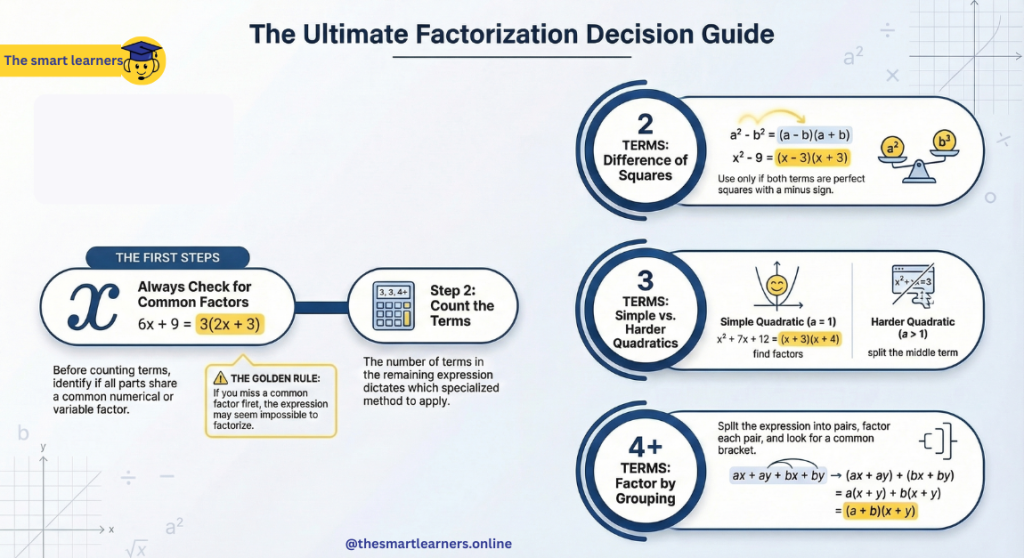
🌳 Factorization Decision Tree
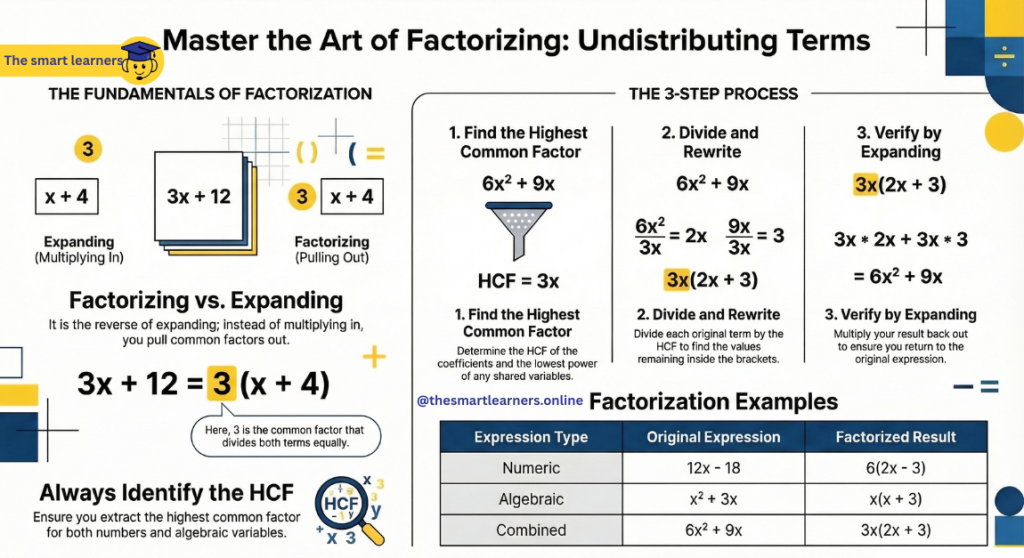
Example: 6x + 9 = 3(2x + 3)
Example: 4x² - 8x = 4x(x - 2)
Always check for common factors FIRST!
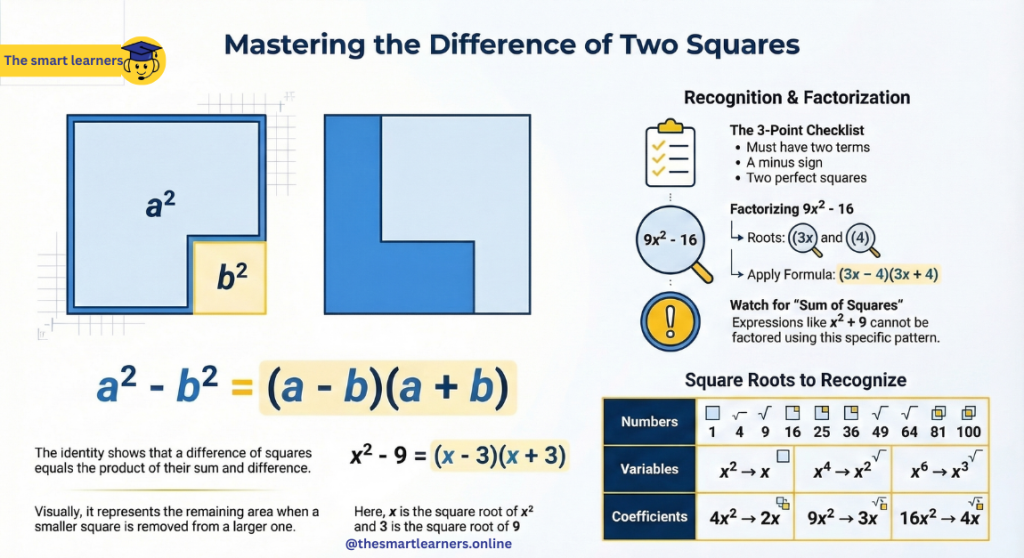
Difference of squares: a² - b² = (a-b)(a+b)
Example: x² - 9 = (x-3)(x+3)
Sum of squares: a² + b² does NOT factorize
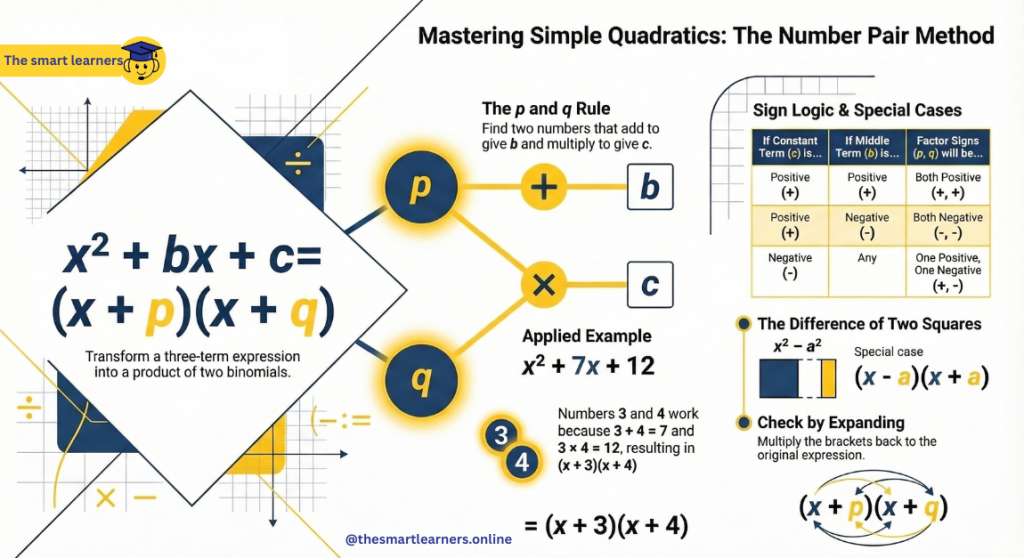
Simple quadratic (a=1): Find factors of c that add to b
Example: x² + 7x + 12 = (x+3)(x+4)
Harder quadratic (a>1): Split middle term
Example: 2x² + 7x + 3 = (x+3)(2x+1)
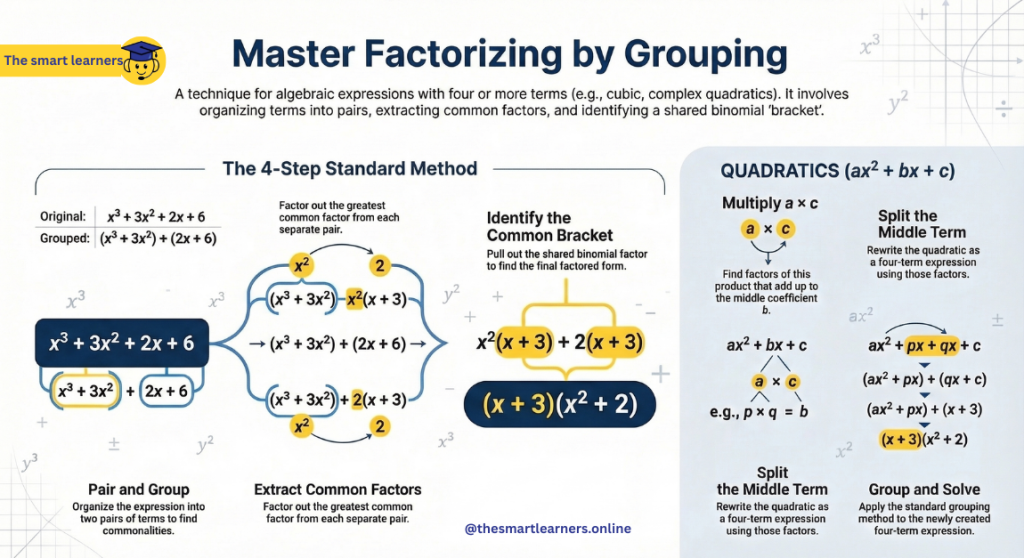
Factor by grouping: Group in pairs, factor each pair, look for common bracket
Example: x³ + 3x² + 2x + 6 = (x+3)(x²+2)
📋 Summary of Factorization Methods
1️⃣ Common Factor
When to use: All terms share a common factor
12x² + 18x = 6x(2x + 3)
15x³ - 10x² = 5x²(3x - 2)
-3x - 6 = -3(x + 2)
2️⃣ Difference of Squares
When to use: Two terms, minus sign, both perfect squares
16x² - 49y² = (4x - 7y)(4x + 7y)
x⁴ - 16 = (x² - 4)(x² + 4) = (x-2)(x+2)(x²+4)
9x² - 1/4 = (3x - ½)(3x + ½)
3️⃣ Simple Quadratics (a = 1)
When to use: x² + bx + c form
x² + 8x + 15 = (x + 3)(x + 5)
x² - 7x + 12 = (x - 3)(x - 4)
x² + 2x - 15 = (x - 3)(x + 5)
4️⃣ Harder Quadratics (a > 1)
When to use: ax² + bx + c with a > 1
6x² + 13x + 5 = (2x + 1)(3x + 5)
4x² - 11x - 3 = (4x + 1)(x - 3)
2x² - 9x - 5 = (2x + 1)(x - 5)
5️⃣ Factor by Grouping
When to use: Four or more terms
2x³ + 4x² + 3x + 6 = (x + 2)(2x² + 3)
x³ + 2x² - 4x - 8 = (x + 2)(x² - 4) = (x+2)(x-2)(x+2)
6️⃣ Multiple Methods
When to use: Need to apply more than one method
3x³ - 12x = 3x(x² - 4) = 3x(x - 2)(x + 2)
2x⁴ - 32 = 2(x⁴ - 16) = 2(x² - 4)(x² + 4) = 2(x-2)(x+2)(x²+4)
🤔 Interactive Method Decider
Enter an expression and we'll help you choose the right method!
Analysis & Recommended Method:
📊 Quick Decision Flowchart
🎯 Practice: Choose the Correct Method
For the expression: x² + 7x + 12
Which factorization method should you use?
📋 Method Comparison Table
| Method | When to Use | Example |
|---|---|---|
| Common Factor | All terms share a factor | 6x + 9 = 3(2x + 3) |
| Difference of Squares | Two terms, minus, perfect squares | x² - 9 = (x-3)(x+3) |
| Simple Quadratic | x² + bx + c (a=1) | x² + 7x + 12 = (x+3)(x+4) |
| Harder Quadratic | ax² + bx + c (a>1) | 2x² + 7x + 3 = (x+3)(2x+1) |
| Grouping | Four or more terms | x³ + 3x² + 2x + 6 = (x+3)(x²+2) |
| Multiple Methods | Need to apply >1 method | 2x² - 18 = 2(x-3)(x+3) |
🔍 Quick Decision Guide
Step 1: Common factor?
Step 2: Count terms
• 2 terms → Difference of squares?
• 3 terms → Quadratic
• 4+ terms → Grouping
➗ Sign Rules for Quadratics
x² + bx + c → both ( + )
x² - bx + c → both ( - )
x² ± bx - c → one ( + ), one ( - )
📚 All Factorization Topics
📎 Practice Materials
Master All Factorization Methods Free Demo
Choosing the right method is the key to success in algebra. Our expert tutors can help you become confident in selecting and applying the correct factorization method.
❓ Which method is hardest to recognize?
⚡ Quick Test
What method for: 4x² - 9?
(2x - 3)(2x + 3)
💡 Tip
Always check for common factors FIRST!
Then look at the number of terms.
This simple order will guide you to the right method.