Newton's Laws Explained Step By Step: A Beginner's Guide
Introduction to Newton’s Laws:
Isaac Newton was a renowned physicist who laid the foundation of classical mechanics. He formulated three fundamental laws that describe the motion of objects and the forces acting on them. These Newton’s Laws explained step by step, can help us understand how and why objects move in our daily lives. They are essential in physics and are used to analyze everything from a falling apple to orbiting planets.
Newton’s First Law: The Law of Inertia
Statement:
“An object at rest stays at rest, and an object in motion stays in motion at a constant speed and in a straight line unless acted upon by an unbalanced force.”
What It Means:
Inertia is the tendency of an object to resist changes in its motion.
Without external forces, moving objects keep moving, and stationary objects stay still.
If acceleration of an object is zero ( a = 0 )it will remain zero until and unbalanced force act on an object.
Real-Life Example:
When a car stops suddenly, your body jerks forward because inertia keeps you moving at the car’s previous speed.
Newton’s Second Law: The Law of Acceleration
Statement:
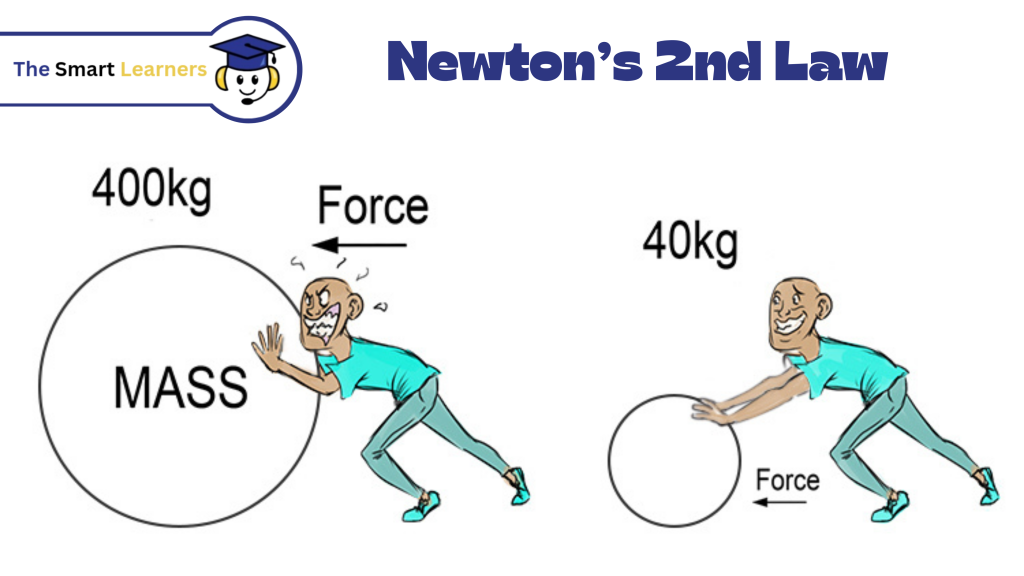
“The acceleration of an object depends on the net force acting on it and its mass (F = ma).”
What It Means:
If an unbalanced Force (F) act on an object it causes acceleration (a).
The more mass (m) an object has, the more force is needed to accelerate it.
Formula Breakdown:
F = m×a
F = Force (measured in Newtons, N)
m = Mass (measured in kilograms, kg)
a = Acceleration (measured in meters per second squared, m/s²)
Real-Life Example:
Pushing a shopping cart: A lighter cart accelerates faster with less force than a heavily loaded one.
Newton’s Third Law: The Law of Action-Reaction
Statement:
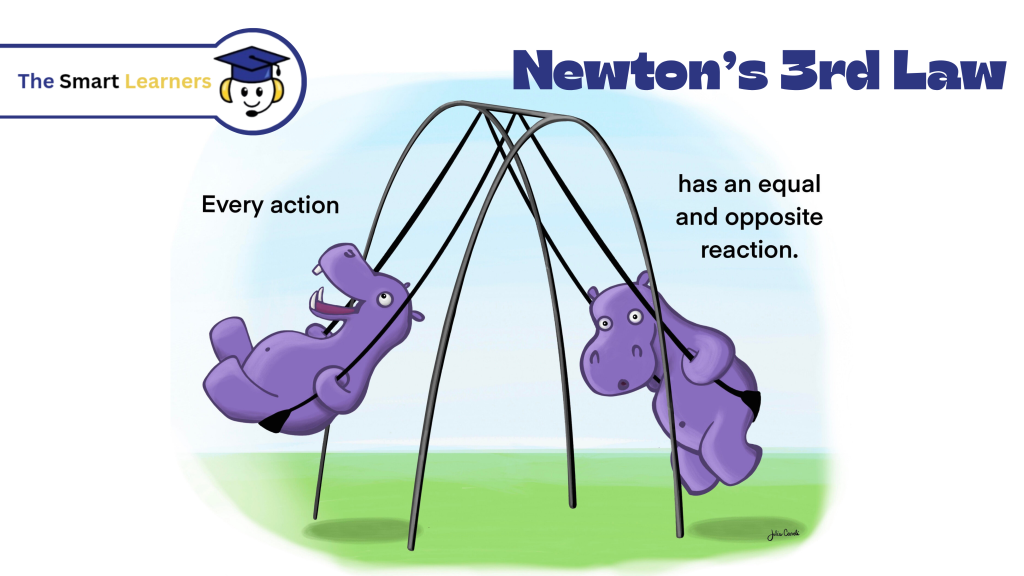
“For every action, there is an equal and opposite reaction.”
What It Means:
Forces always occur in pairs.
If Object A exerts a force on Object B, Object B exerts an equal and opposite force on Object A.
Real-Life Example:
Walking: Your foot pushes backward on the ground (action), and the ground pushes you forward (reaction).
Scroll to Top
WhatsApp
The Smart Learners
Welcome to The Smart Learners. Let's ask me how can I help you?