Author name: Admin

9th Physics

Velocity and Acceleration

Physics Motion: Velocity & Acceleration

Physics Motion: Velocity & Acceleration

Understanding Motion

Motion can be described using three key graphs: displacement-time (d-t), velocity-time (v-t), and acceleration-time (a-t). These graphs help us visualize and understand how objects move.

Key Concepts:

  • Displacement: The change in position of an object (vector quantity)
  • Velocity: The rate of change of displacement (vector quantity)
  • Acceleration: The rate of change of velocity (vector quantity)
  • The slope of a d-t graph gives velocity
  • The slope of a v-t graph gives acceleration
  • The area under a v-t graph gives displacement
  • The area under an a-t graph gives change in velocity

Formulas

Average Velocity: v = Δd / Δt

Average Acceleration: a = Δv / Δt

Displacement with constant acceleration: d = v₀t + ½at²

Final velocity with constant acceleration: v = v₀ + at

Final velocity squared: v² = v₀² + 2ad

Motion Graphs

9th Physics

Physics 9th chapter3 exercise

9th Class Physics

Chapter-3: Dynamics

9th Class Physics - Chapter 3: Dynamics
Physics
Chemistry
Biology
Mathematics
Computer

A. Multiple Choice Questions

Tick (✓) the correct option

3.1 When we kick a stone, we get hurt. This is due to:

(a) inertia
(b) velocity
(c) momentum
✓ (d) reaction

Explanation: According to Newton's third law, for every action there is an equal and opposite reaction. When your foot exerts a force on the stone, the stone exerts an equal and opposite force back on your foot, which you feel as pain.

3.2 An object will continue its motion with constant acceleration until:

(a) the resultant force on it begins to decrease.
✓ (b) the resultant force on it is zero
(c) the resultant force on it begins to increase.
(d) the resultant force is at right angle to its tangential velocity

Explanation: Newton's second law states F = ma. If the net (resultant) force F is constant and non-zero, the acceleration a remains constant. Only when F becomes zero does acceleration cease (a = 0), causing the object to move with constant velocity.

3.3 Which of the following is a non-contact force?

(a) Friction
(b) Air resistance
✓ (c) Electrostatic force
(d) Tension in the string

Explanation: Electrostatic force acts between charged objects without physical contact. Friction, air resistance, and tension all require direct contact between surfaces or objects.

3.4 A ball with initial momentum p hits a solid wall and bounces back with the same speed. Its momentum p′ after collision will be:

(a) p′ = p
✓ (b) p′ = –p
(c) p′ = 2p
(d) p′ = –2p

Explanation: Momentum is a vector. Rebounding with the same speed reverses the velocity direction, hence the momentum changes sign: p′ = –p.

3.5 A particle of mass m moving with velocity v collides with another particle of the same mass at rest. The velocity of the first particle after collision is:

(a) v
(b) –v
✓ (c) 0
(d) –v/2

Explanation: In an elastic head-on collision between equal masses where one is initially at rest, the moving mass stops and transfers all its velocity to the initially stationary mass (conserving both momentum and kinetic energy).

3.6 Conservation of linear momentum is equivalent to:

(a) Newton's first law of motion
(b) Newton's second law of motion
✓ (c) Newton's third law of motion
(d) None of these

Explanation: The law of conservation of linear momentum arises directly from Newton's third law: internal action–reaction pairs cancel, so the total momentum of an isolated system remains constant.

3.7 An object of mass 5 kg moves at a constant velocity of 10 m s⁻¹. A constant force then acts for 5 s on the object and gives it a velocity of 2 m s⁻¹ in the opposite direction. The force acting on the object is:

(a) 5 N
(b) –10 N
✓ (c) –12 N
(d) –15 N

Solution:

Take the original direction as positive.

Initial velocity:    v₀ = +10 m s⁻¹

Final velocity:    v = –2 m s⁻¹ (opposite direction)

Time interval:    Δt = 5 s

Acceleration:

a = (v – v₀)/Δt = (–2 – 10)/5 = –12/5 = –2.4 m s⁻²

Force:

F = m a = 5 kg × (–2.4 m s⁻²) = –12 N

3.8 A large force acts on an object for a very short interval of time. In this case, it is easy to determine:

(a) magnitude of force
(b) time interval
✓ (c) product of force and time
(d) none of these

Explanation: When the interaction time is extremely short, measuring the exact force or duration individually is hard. However, their product—the impulse (F Δt)—equals the measurable change in momentum (Δp), so it is the quantity that can be reliably determined.

3.9 A lubricant is usually introduced between two surfaces to decrease friction. The lubricant:

(a) decreases temperature
(b) acts as ball bearings
✓ (c) prevents direct contact of the surfaces
(d) provides rolling friction

Explanation: By forming a thin fluid film, the lubricant keeps the solid surfaces apart, thereby replacing high-friction solid–solid contact with lower-friction fluid shear.

Newton's Laws of Motion First Law (Inertia) Second Law (F=ma) Third Law (Action-Reaction)

Newton's three laws of motion form the foundation of dynamics

B. Short Answer Questions

3.1 What kind of changes in motion may be produced by a force?

Answer: A force can change the speed (magnitude of velocity), the direction of motion, or both—i.e., it produces acceleration.

3.2 Give 5 examples of contact forces.

Answer:

  • Friction between sliding surfaces
  • Normal force from a table on a book
  • Tension in a rope pulling a cart
  • Air resistance on a moving cyclist
  • Applied push/pull when you open a door

3.3 An object moves with constant velocity in free space. How long will the object continue to move with this velocity?

Answer: Forever; with no net external force, Newton's 1st law guarantees the velocity stays constant indefinitely.

3.4 Define impulse of force.

Answer: Impulse = F Δt (average force × time interval)

It equals the change in momentum of the object: J = Δp.

3.5 Why has Newton's first law not been proved on the Earth?

Answer: Earth-bound objects always experience at least one external force (gravity, air resistance, friction), so we can never achieve a perfectly isolated system to demonstrate the law directly.

3.6 When sitting in a car that suddenly accelerates from rest, you are pushed back into the seat—why?

Answer: Your body tends to stay at rest due to inertia; the seat accelerates forward beneath you, so its back presses forward on you, creating the sensation of being "pushed" backward.

3.7 The force expressed in Newton's second law is a net force. Why is it so?

Answer: F_net = m a; only the vector sum of all forces determines the actual acceleration. Individual forces may cancel, leaving zero net force and no acceleration.

3.8 How can you show that rolling friction is less than sliding friction?

Answer: Place identical masses on two identical inclined planes: one slides, one rolls. The rolling object accelerates more and reaches the bottom sooner, indicating a smaller retarding force.

3.9 Define terminal velocity of an object.

Answer: The maximum constant speed reached when the drag force equals the gravitational force, producing zero net force and hence zero acceleration.

3.10 An astronaut walking in space wants to return to his spaceship by firing a hand rocket. In what direction does he fire the rocket?

Answer: He fires the rocket away from the spaceship (action). By Newton's 3rd law, the reaction thrust pushes him toward the spaceship.

Astronaut Rocket thrust Motion toward ship

Astronaut using rocket thrust to return to spaceship - an application of Newton's third law

C. Constructed Response Questions

3.1 Two ice skaters (60 kg and 80 kg) push off on frictionless ice; the 60 kg skater moves away at 4 m s⁻¹. Show how Newton's 3rd law applies.

Answer:

Action–reaction pair: Each skater exerts an equal-magnitude, opposite-direction force on the other for the same time Δt.

Impulse–momentum:

– Impulse on 60 kg skater: J = +60 kg × 4 m s⁻¹ = 240 N s.

– Therefore impulse on 80 kg skater must be −240 N s.

– Velocity of 80 kg skater: v = −240 N s / 80 kg = −3 m s⁻¹.

Conclusion: Equal and opposite impulses produce equal and opposite momentum changes—exactly Newton's 3rd law in action.

3.2 Air-bags vs. seat-belts: momentum advantage.

Answer:

Same Δp must be delivered to the passenger during a crash.

Air-bag increases Δt (time to stop) five- to ten-fold compared with a belt alone.

F_avg = Δp / Δt, so force on chest drops dramatically, reducing injury.

Seat-belt alone gives a short Δt (high F); air-bag spreads impulse, cutting peak force.

3.3 "Horse can't pull cart because action equals reaction, so net force is zero." What is wrong?

Answer:

The two forces (horse on cart and cart on horse) act on different bodies; they never cancel for either body.

Net force on the cart = pull from horse − friction; if that net is > 0, cart accelerates.

Net force on the horse = push from ground − pull from cart; if that net is > 0, horse accelerates.

Ground's external horizontal force is what allows the system to accelerate.

3.4 Fielder draws hands backward while catching a fast ball—why?

Answer:

Impulse needed: J = Δp = m Δv (fixed by ball's mass and speed).

J = F_avg Δt; by increasing Δt (pulling hands back), fielder reduces F_avg on hands/palms.

Lower force → less sting and lower chance of the ball popping out.

3.5 Jumping from a small boat to river-bank, why does the jumper often fall backward into water?

Answer:

To jump, the person pushes backward on the boat (action).

By Newton's 3rd law, the boat pushes the person forward (reaction).

Light boat accelerates backward significantly; person's forward velocity relative to shore is therefore smaller than expected.

Result: horizontal reach is insufficient—center of gravity lands short, so the jumper topples backward into the water.

3.6 Imagine friction suddenly vanishes everywhere—describe daily-life consequences.

Answer:

  • Walking: No grip; every step makes feet slide backward, people fall.
  • Transport: Cars, bikes, trains spin wheels uselessly; brakes don't work—collisions everywhere.
  • Objects: Anything on an incline slides; furniture, utensils, books glide to the floor.
  • Knots & fasteners: Knots untie, screws/nails slip out, buildings may collapse.
  • Life processes: Even muscle–tendon friction needed for joint movement would fail—biomechanical chaos.

Net result: Human society, machinery, and biology rely on friction; its disappearance would bring immediate paralysis and danger.

World Without Friction Slipping Walking No Brakes Transport Chaos Everywhere Falling Collisions

Consequences of a world without friction

9th Class Physics

Chapter 3: Dynamics

E. Numerical Problems

3.1 A 10 kg block is placed on a smooth horizontal surface. A horizontal force of 5 N is applied to the block. Find:

(a) the acceleration produced in the block.

(b) the velocity of block after 5 seconds.

Given:

m = 10 kg

F = 5 N (horizontal, smooth surface ⇒ no friction)

(a) Acceleration

Newton's 2nd law:

a = F / m = 5 N / 10 kg = 0.5 m s⁻²

(b) Velocity after 5 s

Starts from rest (u = 0):

v = u + a t = 0 + (0.5 m s⁻²)(5 s) = 2.5 m s⁻¹

3.2 The mass of a person is 80 kg. What will be his weight on the Earth? What will be his weight on the Moon? The value of acceleration due to gravity of Moon is 1.6 ms².

Given:

m = 80 kg

gearth = 9.8 m s⁻²

gmoon = 1.6 m s⁻²

Weight

Earth: W = m g = 80 kg × 9.8 m s⁻² = 784 N

Moon: W = 80 kg × 1.6 m s⁻² = 128 N

3.3 What force is required to increase the velocity of 800 kg car from 10 ms¹ to 30 m s¹ in 10 seconds?

Given:

m = 800 kg

u = 10 m s⁻¹

v = 30 m s⁻¹

t = 10 s

Required force

a = (v – u)/t = (30 – 10)/10 = 2 m s⁻²

F = m a = 800 kg × 2 m s⁻² = 1,600 N

3.4 A 5 g bullet is fired by a gun. The bullet moves with a velocity of 300 m s. If the mass of the gun is 10 kg, find the recoil speed of the gun.

Given:

mbullet = 5 g = 0.005 kg

vbullet = 300 m s⁻¹

mgun = 10 kg

By conservation of momentum (initial total = 0):

0 = mbullet vbullet + mgun vgun

⇒ vgun = – (mbullet vbullet)/mgun

  = – (0.005 kg × 300 m s⁻¹)/10 kg

  = – 0.15 m s⁻¹ (negative sign indicates opposite direction)

3.5 An astronaut weighs 70 kg. He throws a wrench of mass 300 g at a speed of 3.5 m s. Determine:

(a) the speed of astronaut as he recoils away from the wrench.

(b) the distance covered by the astronaut in 30 minutes.

Given:

mast = 70 kg

mwrench = 300 g = 0.3 kg

vwrench = 3.5 m s⁻¹ (thrown away from astronaut)

(a) Recoil speed of astronaut

Momentum conservation (initial total = 0):

0 = mast vast + mwrench vwrench

⇒ vast = – (mwrenchvwrench)/mast

  = – (0.3 kg × 3.5 m s⁻¹)/70 kg

  = – 0.015 m s⁻¹

  = – 1.5 × 10⁻² m s⁻¹

(b) Distance in 30 min

t = 30 min = 1,800 s

d = |vast| t = 0.015 m s⁻¹ × 1,800 s = 27 m

3.6 A 6.5 × 10³ kg bogie of a goods train is moving with a velocity of 0.8 m s. Another bogie of mass 9.2 × 10³ kg coming from behind with a velocity of 1.2 m s collides with the first one and couples to it. Find the common velocity of the two bogies after they become coupled.

Given:

m₁ = 6.5 × 10³ kg  v₁ = 0.8 m s⁻¹

m₂ = 9.2 × 10³ kg  v₂ = 1.2 m s⁻¹ (same direction)

Perfectly inelastic collision (coupled after impact):

Momentum conservation:

m₁ v₁ + m₂ v₂ = (m₁ + m₂) vcommon

vcommon = (m₁ v₁ + m₂ v₂)/(m₁ + m₂)

  = [(6.5 × 0.8) + (9.2 × 1.2)] / (6.5 + 9.2)

  = (5.2 + 11.04) / 15.7

  = 16.24 / 15.7

  ≈ 1.03 m s⁻¹

3.7 A cyclist weighing 55 kg rides a bicycle of mass 5 kg. He starts from rest and applies a force of 90 N for 8 seconds. Then he continues at a constant speed for another 8 seconds. Calculate the total distance travelled by the cyclist.

Given:

total mass m = 55 kg + 5 kg = 60 kg

driving force F = 90 N (assumed horizontal, no friction)

phase 1: 8 s under force, starting from rest

phase 2: next 8 s with force removed (constant speed)

Phase 1 – accelerated motion

a = F / m = 90 N / 60 kg = 1.5 m s⁻²

Distance while force acts:

s₁ = ½ a t₁² = ½ (1.5 m s⁻²)(8 s)² = 0.75 × 64 = 48 m

Speed reached at end of phase 1:

v = a t₁ = 1.5 m s⁻² × 8 s = 12 m s⁻¹

Phase 2 – constant speed

t₂ = 8 s  speed = 12 m s⁻¹

s₂ = v t₂ = 12 m s⁻¹ × 8 s = 96 m

Total distance

stotal = s₁ + s₂ = 48 m + 96 m = 144 m

3.8 A ball of mass 0.4 kg is dropped on the floor from a height of 1.8 m. The ball rebounds straight upward to a height of 0.8 m. What is the magnitude and direction of the impulse applied to the ball by the floor?

Given:

m = 0.4 kg

drop height h₁ = 1.8 m

rebound height h₂ = 0.8 m

g = 9.8 m s⁻²

Impulse = change of momentum.

Take upward as positive.

Speed just before impact (downward):

v₁ = √(2 g h₁) = √(2·9.8·1.8) = √35.28 ≈ –5.94 m s⁻¹ (negative because down)

Speed just after impact (upward):

v₂ = √(2 g h₂) = √(2·9.8·0.8) = √15.68 ≈ +3.96 m s⁻¹

Impulse delivered by floor

J = m(v₂ – v₁)

 = 0.4 kg [3.96 – (–5.94)] m s⁻¹

 = 0.4 × 9.90

 ≈ 3.96 kg m s⁻¹

Magnitude: 4.0 N s (2-significant-figure rounding)

Direction: vertically upward (that is the direction of the force the floor exerted on the ball).

3.9 Two balls of masses 0.2 kg and 0.4 kg are moving towards each other with velocities 20 m s and 5 m s respectively. After collision, the velocity of 0.2 kg ball becomes 6 ms¹. What will be the velocity of 0.4 kg ball?

Given:

Take the original direction of the 0.2 kg ball as positive.

m₁ = 0.2 kg, u₁ = +20 m s⁻¹

m₂ = 0.4 kg, u₂ = –5 m s⁻¹ (moving the other way)

After collision: v₁ = +6 m s⁻¹ (given)

Conservation of momentum (no external forces):

m₁u₁ + m₂u₂ = m₁v₁ + m₂v₂

0.2(20) + 0.4(–5) = 0.2(6) + 0.4 v₂

4 – 2 = 1.2 + 0.4 v₂

2 = 1.2 + 0.4 v₂

0.4 v₂ = 0.8

v₂ = 2 m s⁻¹

The 0.4 kg ball moves at 2 m s⁻¹ in the same original direction the 0.2 kg ball had (i.e. the positive direction).

Numerical Problem Solving Given Data Formulas Solution Steps Final Answer

Step-by-step approach to solving numerical problems in physics

9th Physics

Physics 9th Chapter2 Exercise

9th Class Physics

Chapter-2: Kinematics

9th Class Physics - Chapter 2: Kinematics
Physics
Chemistry
Biology
Mathematics
Computer

A. Multiple Choice Questions

Tick (✓) the correct option

2.1 The numerical ratio of displacement to distance is:

(a) always <1
(b) always =1
(c) always >1
✓ (d) ≤1

Explanation: Displacement is always less than or equal to distance (displacement ≤ distance). They are equal only for straight-line motion without direction change.

2.2 If a body does not change its position w.r.t. a fixed point, it is in:

✓ (a) rest
(b) motion
(c) uniform motion
(d) variable motion

Explanation: When a body's position remains unchanged relative to a fixed reference point, it is considered to be at rest.

2.3 A ball is dropped from a tower; distance in the 1ˢᵗ second is:

✓ (a) 5 m
(b) 10 m
(c) 50 m
(d) 100 m

Explanation: Using h = ½ g t² = ½ × 10 × 1² = 5 m (taking g = 10 m/s²).

2.4 Body accelerates from rest to 144 km h⁻¹ (40 m s⁻¹) in 20 s. Distance covered:

(a) 100 m
✓ (b) 400 m
(c) 1 400 m
(d) 1 440 m

Explanation: Using S = ½(v+u)t = ½ × 40 × 20 = 400 m (u = 0, v = 40 m/s).

2.5 Starting from rest with constant acceleration, if distance S is covered in 4 s, time to cover ¼ S is:

(a) 1 s
✓ (b) 2 s
(c) 4 s
(d) 16 s

Explanation: For constant acceleration from rest, S ∝ t². If S/4, then t²/4, so t/2 = 2 s.

2.6 Two displacement-time graphs A & B are shown. True statement:

(a) vₐ > vB
✓ (b) vₐ < vB
(c) vₐ = vB
(d) no info

Explanation: Velocity is the slope of displacement-time graph. Graph A has smaller slope than B, so velocity of A is less than B.

2.7 The area under a speed-time graph equals:

(a) velocity
(b) uniform velocity
(c) acceleration
✓ (d) distance covered

Explanation: The area under a speed-time graph represents the total distance covered by the object.

2.8 The gradient (slope) of a speed-time graph equals:

(a) speed
(b) velocity
✓ (c) acceleration
(d) distance covered

Explanation: The slope of a speed-time graph gives the rate of change of speed, which is acceleration.

2.9 The gradient of a distance-time graph equals:

✓ (a) speed
(b) velocity
(c) distance covered
(d) acceleration

Explanation: The slope of a distance-time graph represents the rate of change of distance with time, which is speed.

2.10 A car accelerates uniformly from 80.5 km h⁻¹ to 113 km h⁻¹ in 9 s. Which graph best describes its motion?

(a) curved up
(b) horizontal line
✓ (c) straight line with positive slope
(d) vertical line

Explanation: For uniform acceleration, the velocity-time graph is a straight line with positive slope.

(a) Curved Up
Velocity Time
(b) Horizontal Line
Velocity Time
(c) Straight Line with Positive Slope
Velocity Time
(d) Vertical Line
Velocity Time

B. Short Answer Questions

2.1 Define scalar and vector quantities.

Answer:

Scalar: A physical quantity completely described by magnitude only (no direction).

Vector: A quantity described by both magnitude and direction.

2.2 Give 5 examples each.

Scalars Vectors
mass displacement
time velocity
temperature acceleration
speed force
energy momentum

2.3 State the head-to-tail rule for adding vectors.

Answer:

  1. Draw the first vector to scale.
  2. Place the tail of the second vector at the head of the first.
  3. Continue for all vectors.
  4. The resultant is the single arrow from the tail of the first to the head of the last.
A B R = A + B

Head-to-tail method of vector addition

2.4 What are distance-time and speed-time graphs?

Answer:

Distance-time: Plots distance on y-axis vs time on x-axis; slope = speed.

Speed-time: Plots speed on y-axis vs time on x-axis; slope = acceleration, area under graph = distance covered.

2.5 Falling objects near Earth have the same constant acceleration. Does this imply a heavier object falls faster?

Answer: No.

In vacuum (no air resistance) a = g for all masses, so they fall equally fast. Differences observed are due to air-drag, not weight.

2.6 Vector quantities are sometimes written without bold face. How is direction indicated?

Answer: By a + or – sign along a stated reference direction (e.g., +5 m s⁻¹ right, –3 m s⁻¹ left). Or by an angle/compass bearing in diagrams.

2.7 A body moves with uniform speed. Will its velocity be uniform? Give reason.

Answer: Only if it moves in a straight line.

Velocity = speed + direction; if direction changes (circular path), velocity changes even though speed is constant.

2.8 Is it possible for a body to have acceleration when moving with:

(i) constant velocity? No – acceleration is zero by definition.

(ii) constant speed? Yes – in uniform circular motion speed is constant but direction changes continuously, producing centripetal acceleration.

C. Constructed Response Questions

2.1 Distance and displacement may or may not be equal in magnitude. Explain this statement.

Answer:

"Distance and displacement may or may not be equal in magnitude."

Equal: Straight-line motion without change of direction (e.g. 10 m east → distance = displacement = 10 m).

Unequal: Path involves turning back (e.g. walk 10 m east then 6 m west: distance = 16 m, displacement = 4 m).

Hence equality depends on whether the object reverses its motion.

Distance = Displacement = 10m Start End Distance = 16m Displacement = 4m Start End

Comparison of distance and displacement

2.2 When a bullet is fired, its velocity with which it leaves the barrel is called the muzzle velocity of the gun. The muzzle velocity of one gun with a longer barrel is lesser than that of another gun with a shorter barrel. In which gun is the acceleration of the bullet larger? Explain your answer.

Answer:

Which gun gives the bullet the larger acceleration?

Shorter-barrel gun attains higher muzzle velocity in less time.

Since a = (v – u)/t, smaller t for the same Δv ⇒ larger acceleration.

Conclusion: The shorter-barrel gun produces greater acceleration for the bullet.

2.3 For a complete trip, average velocity was calculated. Its value came out to be positive. Is it possible that its instantaneous velocity at any time during the trip had the negative value? Give justification of your answer.

Answer: Yes.

Average velocity only cares about net displacement (positive here).

During the trip the object could have moved backward (negative v) for some time, provided the final position lies ahead of the start.

Example: Drive 60 m east, then 20 m west; net displacement = +40 m (positive average velocity), yet while moving west instantaneous velocity was negative.

2.4 A ball is thrown vertically upward with velocity v. It returns to the ground in time T. Which of the following graphs correctly represents the motion? Explain your reasoning.

Answer: Correct choice: Graph (c) – a straight line with negative slope, first half in +y axis and second half in negative y axis.

Reasoning:

Upward journey: velocity decreases linearly (a = –g), reaches zero at the top.

Downward journey: velocity increases negatively, continuing the same straight line below the time axis.

Slope is constant (equal to –g) throughout; final velocity = –initial velocity.

Velocity (m/s) Time (s) +v T/2 -v T 0 Upward Top (v=0) Downward

Velocity-time graph for a ball thrown vertically upward - single continuous line

2.5 The figure given below shows the distance - time graph for the travel of a cyclist. Find the velocities for the segments a, b and c.

Answer:

Segment Δs (km) Δt (min) Velocity (km min⁻¹) Velocity (km h⁻¹)
a 2.0 – 0 = 2.0 6 – 0 = 6 2/6 = 0.33 0.33 × 60 = 20 km h⁻¹
b 2.0 – 2.0 = 0 10 – 6 = 4 0 (horizontal) 0 km h⁻¹ (rest)
c 0 – 2.0 = –2.0 20 – 10 = 10 –2.0/10 = –0.2 –0.2 × 60 = –12 km h⁻¹ (returning)
Distance (km) Time (min) Segment a Segment b Segment c 0 6 10 20 0 0.2 0.4 0.6 0.8 1.0 1.2 1.4 1.6 1.8 2.0

Distance-time graph for a cyclist - distance drops to 0 km at 20 minutes

2.6 Is it possible that the velocity of an object is zero at an instant of time, but its acceleration is not zero? If yes, give an example of such a case.

Answer: Yes – at the turning point of any to-and-fro motion.

Example: A ball thrown vertically upward has zero velocity at the highest point, but acceleration = g (≈ 9.8 m s⁻² downward) continuously.

Likewise, a pendulum at the extreme position has zero speed but non-zero centripetal & tangential acceleration.

Velocity Velocity Acceleration (g) Highest Point v = 0, a = g

Ball at highest point: velocity = 0, acceleration = g

D. Numerical Problems

2.1 Draw the representative lines of the following vectors:

(a) A velocity of 400 m/s making an angle of 60° with x-axis.

(b) A force of 50 N making an angle of 120° with x-axis.

(a) Velocity Vector: 400 m/s at 60°

Scale: 1 cm ≡ 100 m/s → 4 cm line

v = 400 m/s 60° +x +y

(b) Force Vector: 50 N at 120°

Scale: 1 cm ≡ 10 N → 5 cm line

F = 50 N 120° +x +y
2.2 A car is moving with an average speed of 72 km/h. How much time will it take to cover a distance of 360 km?

Given: Speed = 72 km/h, Distance = 360 km

Formula: Time = Distance ÷ Speed

Calculation: t = 360 km ÷ 72 km/h = 5 hours

Answer: The car will take 5 hours to cover 360 km.

2.3 A truck starts from rest. It reaches a velocity of 90 km/h in 50 seconds. Find its average acceleration.

Given: Initial velocity u = 0, Final velocity v = 90 km/h = 25 m/s, Time t = 50 s

Formula: Acceleration a = (v - u) ÷ t

Calculation: a = (25 - 0) ÷ 50 = 0.5 m/s²

Answer: The average acceleration is 0.5 m/s².

2.4 A car passes a green traffic signal while moving with a velocity of 5 m/s. It then accelerates at 1.5 m/s². What is the velocity of car after 5 seconds?

Given: Initial velocity u = 5 m/s, Acceleration a = 1.5 m/s², Time t = 5 s

Formula: Final velocity v = u + at

Calculation: v = 5 + (1.5 × 5) = 5 + 7.5 = 12.5 m/s

Answer: The velocity after 5 seconds is 12.5 m/s.

2.5 A motorcycle initially travelling at 18 km/h accelerates at constant rate of 2 m/s². How far will the motorcycle go in 10 seconds?

Given: Initial velocity u = 18 km/h = 5 m/s, Acceleration a = 2 m/s², Time t = 10 s

Formula: Distance S = ut + ½at²

Calculation: S = (5 × 10) + ½(2 × 100) = 50 + 100 = 150 m

Answer: The motorcycle will travel 150 meters.

2.6 A wagon is moving on the road with a velocity of 54 km/h. Brakes are applied suddenly. The wagon covers a distance of 25 m before stopping. Determine the acceleration of the wagon.

Given: Initial velocity u = 54 km/h = 15 m/s, Final velocity v = 0, Distance S = 25 m

Formula: v² = u² + 2aS

Calculation: 0 = (15)² + 2a(25) ⇒ 0 = 225 + 50a ⇒ a = -4.5 m/s²

Answer: The acceleration is -4.5 m/s² (deceleration).

2.7 A stone is dropped from a height of 45 m. How long will it take to reach the ground? What will be its velocity just before hitting the ground?

Given: Height h = 45 m, Initial velocity u = 0, Acceleration g = 10 m/s²

Time calculation: h = ½gt² ⇒ 45 = ½(10)t² ⇒ 45 = 5t² ⇒ t² = 9 ⇒ t = 3 s

Velocity calculation: v = gt = 10 × 3 = 30 m/s

Answer: Time = 3 seconds, Velocity = 30 m/s downward.

2.8 A car travels 10 km with an average velocity of 20 m/s. Then it travels in the same direction through a diversion at an average velocity of 4 m/s for the next 0.8 km. Determine the average velocity of the car for the total journey.

Leg 1: Distance S₁ = 10 km = 10000 m, Velocity v₁ = 20 m/s

Time t₁ = S₁/v₁ = 10000/20 = 500 s

Leg 2: Distance S₂ = 0.8 km = 800 m, Velocity v₂ = 4 m/s

Time t₂ = S₂/v₂ = 800/4 = 200 s

Total: Distance S_total = 10800 m, Time t_total = 700 s

Average velocity v_avg = S_total/t_total = 10800/700 ≈ 15.4 m/s

Answer: The average velocity for the total journey is 15.4 m/s.

2.9 A ball is dropped from the top of a tower. The ball reaches the ground in 5 seconds. Find the height of the tower and the velocity of the ball with which it strikes the ground.

Given: Time t = 5 s, Initial velocity u = 0, Acceleration g = 10 m/s²

Height calculation: h = ½gt² = ½(10)(25) = 125 m

Velocity calculation: v = gt = 10 × 5 = 50 m/s

Answer: Height of tower = 125 m, Impact velocity = 50 m/s downward.

2.10 A cricket ball is hit so that it travels straight up in the air. An observer notes that it took 3 seconds to reach the highest point. What was the initial velocity of the ball? If the ball was hit 1 m above the ground, how high did it rise from the ground?

Given: Time to highest point = 3 s, Initial height = 1 m, Acceleration g = 10 m/s²

Initial velocity: v = u - gt ⇒ 0 = u - (10 × 3) ⇒ u = 30 m/s

Height above hit-point: h = ut - ½gt² = (30 × 3) - ½(10 × 9) = 90 - 45 = 45 m

Height above ground: 45 m + 1 m = 46 m

Answer: Initial velocity = 30 m/s, Maximum height above ground = 46 m.

9th Physics

Physics 9th Chapter8 Exercise

9th Class Physics

Chapter-8: Magnetism

9th Class Physics - Chapter 8: Magnetism
Physics
Chemistry
Biology
Mathematics
Computer

A. Multiple Choice Questions

Tick (✓) the correct option

8.1 Which of the following is non-magnetic?

(a) Cobalt
(b) Iron
✓ (c) Aluminium
(d) Nickel

Explanation: Aluminium is paramagnetic but very weakly magnetic, often considered non-magnetic in practical contexts compared to strongly ferromagnetic materials like iron, cobalt, and nickel.

8.2 Magnetic lines of force:

(a) always straight
(b) cross one another
(c) enter the north pole
✓ (d) enter the south pole

Explanation: Magnetic field lines emerge from the north pole and enter the south pole of a magnet externally, and form continuous closed loops through the magnet internally.

8.3 Permanent magnets cannot be made by:

✓ (a) soft iron
(b) steel
(c) neodymium
(d) alnico

Explanation: Soft iron loses its magnetism quickly when the magnetizing field is removed, making it unsuitable for permanent magnets. Steel, neodymium, and alnico retain magnetism for a long time.

8.4 Permanent magnets are used in:

(a) circuit breaker
✓ (b) loud-speaker
(c) electric crane
(d) magnetic recording

Explanation: Loud-speakers use permanent magnets to create a constant magnetic field that interacts with the voice coil. While magnetic recording also uses magnets, the textbook specifically marks loud-speaker as the correct answer.

8.5 A common method to magnetise a material is:

✓ (a) stroking
(b) hitting
(c) heating
(d) placing inside a solenoid with A.C

Explanation: Stroking is a simple and common method where a magnet is repeatedly stroked along the material in one direction. A.C. solenoid would demagnetize, while D.C. solenoid is also used but stroking is the safest "correct" answer in this context.

8.6 A compass is placed at four points around a bar magnet. Which diagram shows correct field directions?

(a)
✓ (b)
(c)
(d)

Explanation: Option (b) shows arrows leaving the north pole and entering the south pole, with field lines never crossing each other, which is the correct representation of magnetic field lines.

8.7 Steel rod magnetised by double-touch stroking. Correct polarity of end A-B?

(a) N-N
✓ (b) N-S
(c) S-N
(d) S-S

Explanation: In double-touch stroking, the stroking magnets are kept with the same poles to the ends of the rod being magnetized, resulting in opposite poles at the ends (N-S).

8.8 Best material to shield a device from external magnetic field:

(a) wood
(b) plastic
(c) steel
✓ (d) soft iron

Explanation: Soft iron has high permeability and provides a magnetic shunt, effectively redirecting magnetic field lines around the shielded device.

N S N N

Magnetic field lines around a bar magnet and compass alignment

B. Short Answer Questions

8.1 What are temporary and permanent magnets?

Answer:

Temporary magnets → made of soft iron; lose magnetism quickly when the magnetising field is removed.

Permanent magnets → made of steel, alnico, neodymium; retain magnetism for a long time.

8.2 Define magnetic field of a magnet.

Answer: The region around a magnet in which a magnetic force can be detected; it is represented by magnetic field lines that emerge from the north pole and enter the south pole.

8.3 What are magnetic lines of force?

Answer: Imaginary smooth curves that:

  • travel N → S externally,
  • never cross,
  • are closer where the field is stronger.

8.4 Name some uses of permanent magnets and electromagnets.

Permanent Magnets Electromagnets
Loud-speakers, fridge doors, magnetic clasps, small DC motors Electric cranes, circuit breakers, relays, MRI machines, scrap-yard lifters

8.5 What are magnetic domains?

Answer: Tiny atomic-size regions (≈10¹⁵–10¹⁸ atoms) inside ferromagnetic materials where the magnetic moments of electrons are aligned; when most domains line up, the material becomes magnetised.

8.6 Which type of magnetic field is formed by a current-carrying long coil?

Answer: A uniform (nearly parallel) magnetic field along the axis inside the coil, similar to that of a bar magnet.

8.7 Differentiate between paramagnetic and diamagnetic materials.

Property Paramagnetic Diamagnetic
Magnetic susceptibility Small & positive Small & negative
In external field Weakly attracted Weakly repelled
Examples Al, Pt, O₂ Cu, Bi, H₂O
Electron structure Have unpaired electrons All electrons paired
× Solenoid Uniform Magnetic Field

Magnetic field inside a current-carrying solenoid

C. Constructed Response Questions

8.1 Task: Label the poles of the two stored bar magnets and identify objects P & Q.

Answer:

P = keeper (soft-iron piece placed across the poles).

Q = second bar magnet (poles arranged N–S to the first magnet so they attract and flux stays closed).

N S S N P First Magnet Second Magnet (Q)

8.2 Task: Draw the circuit diagram of a solenoid with steel bar inside so that end A → N-pole and end B → S-pole.

Answer:

Polarity Rule: Current clockwise when viewed from A → that end becomes N-pole.

Connect battery accordingly; place steel bar fully inside the coil.

A (N) B (S) + - ×

8.3 Situation: Two bar magnets lie with a small gap; a compass at the centre of the gap settles N–S (i.e. shows no deflection). Conclusion & Labeling:

Answer:

The facing poles must be opposite (and of equal strength) so their fields cancel at the midpoint.

Field-line Sketch: Lines leave N of left magnet, enter S of right magnet. At exact centre, net field = 0 → compass needle stays Earth's N-S.

N S S N N S Left Magnet Right Magnet Net Field = 0 at Center

8.4 Question: Electric current (motion of electrons) produces a magnetic field. Is the reverse true—can a magnetic field give rise to electric current? If yes, give an example and describe it briefly.

Answer:

✅ Yes, the reverse is true.

Example: Electromagnetic induction in a dynamo or generator.

Description: When a coil of wire is rotated in a magnetic field (or a magnet is moved near a coil), the changing magnetic flux induces an EMF (voltage) in the coil. If the circuit is closed, this EMF drives an induced current—no battery needed.

This is Faraday's Law in action: ε = -ΔΦ/Δt

8.5 Question: Four identical solenoids are placed in a circle. The same current flows through each. Show (with a diagram) the direction of current in each solenoid such that when any one solenoid is switched OFF, the net magnetic field at centre O points toward that solenoid.

Answer:

Step 1 – Initial Setup (all ON): Let the current directions be arranged so that all four solenoids produce equal fields pointing inward (toward centre O). This gives zero net field at O (perfect cancellation).

Step 2 – Switch OFF one solenoid: The inward field from that solenoid disappears. The remaining three still produce inward fields, but now there is an imbalance. The missing inward field is equivalent to an outward field from the opposite direction—hence the net field at O is directed toward the switched-off solenoid.

O Sol 1 Sol 2 Sol 3 Sol 4

Conclusion: Arrange all currents so their individual fields point inward at O. When any one is switched OFF, the net field immediately points toward the "missing" solenoid.

9th Physics

Physics 9th Chapter1 Exercise

9th Class Physics

Chapter-1: Physical Quantities & Measurements

9th Class Physics - Chapter 1: Physical Quantities & Measurements
Physics
Chemistry
Biology
Mathematics
Computer

A. Multiple Choice Questions

Tick (✓) the correct option

1.1 The instrument that is most suitable for measuring the thickness of a few sheets of cardboard is a:

(a) metre rule
(b) measuring tape
(c) Vernier Callipers
✓ (d) micrometer screw gauge

Explanation: A micrometer screw gauge can measure very small thicknesses (up to 0.01 mm) accurately, making it suitable for measuring the thickness of a few sheets of cardboard.

1.2 One femtometre is equal to:

(a) 10⁻⁹ m
✓ (b) 10⁻¹⁵ m
(c) 10⁹ m
(d) 10¹⁵ m

Explanation: Femto- is the SI prefix for 10⁻¹⁵, so one femtometre equals 10⁻¹⁵ meters.

1.3 A light-year is a unit of:

(a) light
(b) time
✓ (c) distance
(d) speed

Explanation: A light-year is the distance that light travels in one year, approximately 9.46 trillion kilometers.

1.4 Which one is a non-physical quantity?

(a) distance
(b) density
✓ (c) colour
(d) temperature

Explanation: Colour is a perceptual property and cannot be measured with standard units, making it a non-physical quantity.

1.5 When using a measuring cylinder, one precaution to take is to:

(a) check for the zero error
(b) look at the meniscus from below the level of the water surface
(c) take several readings by looking from more than one direction
✓ (d) position the eye in line with the bottom of the meniscus

Explanation: To avoid parallax error, the eye should be positioned in line with the bottom of the meniscus when reading the volume.

1.6 Volume of water consumed by you per day is estimated in:

(a) millilitre
✓ (b) litre
(c) kilogram
(d) cubic metre

Explanation: Daily water consumption is typically measured in liters, as it's a practical unit for this purpose (1 liter = 1000 mL).

1.7 A displacement can is used to measure:

(a) mass of a liquid
(b) mass of a solid
(c) volume of a liquid
✓ (d) volume of a solid

Explanation: A displacement can measures the volume of irregular solids by measuring the volume of liquid displaced when the solid is immersed.

1.8 Two rods with lengths 12.321 cm and 10.3 cm are placed side by side; the difference in their lengths is:

(a) 2.02 cm
(b) 2.0 cm
(c) 2 cm
✓ (d) 2.021 cm

Explanation: 12.321 cm - 10.3 cm = 2.021 cm. When subtracting, the result should have the same number of decimal places as the measurement with the fewest decimal places (10.3 has one decimal place).

1.9 Four students measure the diameter of a cylinder with Vernier Callipers. Which of the following readings is correct?

(a) 3.4 cm
(b) 3.475 cm
✓ (c) 3.47 cm
(d) 3.5 cm

Explanation: Vernier Callipers typically have a precision of 0.01 cm, so a reading of 3.47 cm is appropriate. 3.475 cm would require higher precision instruments.

1.10 Which of the following measures is likely to represent the thickness of a sheet of this book?

(a) 6 × 10⁻²⁵ m
(b) 1 × 10⁴ m
(c) 1.2 × 10⁻¹⁵ m
✓ (d) 4 × 10⁻² m (≈ 0.04 mm)

Explanation: A typical sheet of paper is about 0.1 mm thick, so 0.04 mm is a reasonable estimate for a thin sheet in a book.

1.11 In a Vernier Callipers ten smallest divisions of the Vernier scale are equal to nine smallest divisions of the main scale. If the smallest division of the main scale is half a millimetre, the Vernier constant is equal to:

(a) 0.5 mm
✓ (b) 0.05 mm
(c) 0.1 mm
(d) 0.001 mm

Explanation: Vernier constant = (1 MSD - 1 VSD) = (0.5 mm - (9×0.5 mm)/10) = 0.5 mm - 0.45 mm = 0.05 mm.

Measuring Instruments Vernier Callipers Micrometer Screw Gauge Measuring Cylinder

Common measuring instruments used in physics

B. Short Answer Questions

1.1 Can a non-physical quantity be measured? If yes, then how?

Answer: No.

A non-physical quantity (like love, honesty, intelligence) cannot be measured because it has no physical existence or numerical value.

Only physical quantities—those that can be expressed in numbers and units—can be measured.

1.2 What is measurement? Name its two parts.

Answer: Measurement is the process of finding how many times a standard quantity is contained in the quantity being measured.

It has two parts:

  • Numerical value (magnitude)
  • Unit

Example: 5 m → 5 = number, m = unit.

1.3 Why do we need a standard unit for measurements?

Answer: We need standard units so that measurements are uniform, accurate, and comparable everywhere in the world.

Without standard units, results would vary from person to person or country to country.

1.4 Write the names of 3 base quantities and 3 derived quantities.

Answer:

Base Quantities:

  • Length
  • Mass
  • Time

Derived Quantities:

  • Speed (m/s)
  • Force (N)
  • Area (m²)

1.5 Which SI unit will you use to express the height of your desk?

Answer: Metre (m) — or centimetre (cm) if the desk is short.

Both are SI-based units of length.

1.6 Write the name and symbols of all SI base units.

Base Quantity SI Unit Name Symbol
Length metre m
Mass kilogram kg
Time second s
Electric current ampere A
Temperature kelvin K
Amount of substance mole mol
Luminous intensity candela cd

1.7 Why is prefix used? Name three sub-multiple and three multiple prefixes with their symbols.

Answer: Prefixes are used to express very large or very small quantities easily by changing the size of the unit.

Sub-multiples (smaller than 1):

  • milli (m) = 10⁻³
  • micro (µ) = 10⁻⁶
  • nano (n) = 10⁻⁹

Multiples (greater than 1):

  • kilo (k) = 10³
  • mega (M) = 10⁶
  • giga (G) = 10⁹

1.8 What is meant by:

Answer:

  • (a) 5 pm → 5 picometres = 5 × 10⁻¹² m
  • (b) 15 ns → 15 nanoseconds = 15 × 10⁻⁹ s
  • (c) 6 µm → 6 micrometres = 6 × 10⁻⁶ m
  • (d) 5 fs → 5 femtoseconds = 5 × 10⁻¹⁵ s

1.9 (a) For what purpose is a Vernier Callipers used?

Answer: It is used to measure the external & internal diameters and depth of small objects to an accuracy of 0.1 mm (0.01 cm).

1.9 (b) Name its two main parts.

Answer:

  • Main scale (fixed jaw & scale)
  • Vernier scale (sliding jaw & scale)

1.9 (c) How is least count found?

Answer: Least count = 1 M.S.D. – 1 V.S.D. = (value of 1 main-scale division) ÷ (total Vernier divisions).

1.9 (d) What is meant by zero error?

Answer: The non-zero reading shown when the jaws are fully closed; it must be subtracted/added from the final reading.

1.10 State least count and Vernier scale reading as shown in the figure and hence find the length.

Answer:

Least count = 0.1 mm = 0.01 cm

Vernier coincidence = 5th division

Vernier scale reading = 5 × 0.01 cm = 0.05 cm

Main-scale reading = 5.9 cm

Total length = 5.9 cm + 0.05 cm = 5.95 cm

1.11 Which reading out of A, B and C shows the correct length and why?

Answer: Reading B is correct because the eye is placed exactly perpendicular to the scale, eliminating parallax error.

Meniscus Eye level

Correct eye position when reading a meniscus in a measuring cylinder

C. Constructed Response Questions

1.1 Write the most appropriate unit for measuring:

  • (a) Thickness of a five-rupee coin: millimetre (mm)
  • (b) Length of a book: centimetre (cm)
  • (c) Length of football field: metre (m)
  • (d) The distance between two cities: kilometre (km)
  • (e) Mass of five-rupee coin: gram (g)
  • (f) Mass of your school bag: kilogram (kg)
  • (g) Duration of your class period: minute (min)
  • (h) Volume of petrol filled in the tank of a car: litre (L)
  • (i) Time to boil one litre milk: minute (min)

1.2 Why might a standard system of measurement be helpful to a tailor?

  • Guarantees consistent body & cloth dimensions.
  • Avoids fitting errors and material waste.
  • Enables global trade without re-measuring.

1.3 Least count & thickness of the steel rod

Pitch = 1 mm, Circular divisions = 100

Least count = 1 mm ÷ 100 = 0.01 mm

Reading shown: 1 mm + 47 × 0.01 mm = 1.47 mm

1.4 Measuring pencil diameter with only a metre scale

Tightly bundle N identical pencils with tape.

Measure total width (W) of the bundle across the hexagon flats.

Diameter = W / N (precision ↑ as N ↑).

1.5 Worn-out end of metre scale – where to place the pencil?

Place the pencil's one end at the 1 cm mark and subtract 1 cm from the final reading.

1.6 Why place the object close to the metre scale?

Minimises parallax error; line of sight stays perpendicular, giving true length.

1.7 Why is a standard unit needed to measure correctly?

Ensures universally reproducible, comparable & error-free results across people, places & time.

1.8 Natural phenomena usable as accurate time standards

  • Pendulum swing (fixed length)
  • Earth's rotation (solar day)
  • Heart-beat (short intervals)
  • Vibrations of a quartz crystal

1.9 Why is the meniscus hard to locate in a wider vessel?

Curvature is flatter; small tilt causes large horizontal shift, so the exact bottom of the meniscus is unclear.

1.10 Which instrument can be used to measure:

(i) Internal diameter of a test tube?

Answer: Vernier Callipers (use the inside/upper jaws).

(ii) Depth of a beaker?

Answer: Vernier Callipers (use the depth rod at the tail end).

Standard Measurement System Tailor Customer Accurate Measurements Tape Cloth

Benefits of standard measurement system for a tailor

Best gcse maths tutor online
Mathematics Online Tutoring

Best GCSE Maths Tutor Online – Your Key to Top Grades in the UK

Best gcse maths tutor online

When it comes to achieving top grades in mathematics, the right guidance makes all the difference. Many students in the UK struggle with the jump in difficulty from Key Stage 3 to GCSE level, finding topics such as algebra, geometry, and probability challenging to master. That’s where a GCSE maths tutor can transform learning – turning confusion into confidence and poor grades into outstanding results.

At The Smart Learners, we specialise in providing expert GCSE maths tutor services online, helping students across the UK achieve their full academic potential. Whether your goal is to pass with a secure grade or aim for the top 8–9 grades, our tutors can guide you every step of the way.

Why a GCSE Maths Tutor is Essential for Success

The GCSE Maths syllabus covers a wide range of topics, from basic number skills to advanced algebra, geometry, and statistics. Many students find certain areas harder to grasp than others. A GCSE maths tutor helps bridge these gaps by providing:

  • Personalised learning plans tailored to your strengths and weaknesses
  • One-to-one attention to focus on problem areas without classroom distractions
  • Exam-focused preparation with targeted practice on past papers and mark schemes
  • Confidence building to reduce exam stress and improve problem-solving speed

By working with an experienced GCSE maths tutor, students gain not just knowledge, but also the skills and confidence needed to perform under exam conditions.

The Smart Learners – Experts in Online GCSE Maths Tutoring

At The Smart Learners, we understand that every student learns differently. That’s why our GCSE maths tutor service is designed to adapt to each learner’s style, pace, and academic goals.

Here’s what sets us apart:

  1. Qualified and Experienced Tutors – Our tutors are subject experts with proven experience in teaching GCSE mathematics according to UK curriculum standards (AQA, Edexcel, OCR).
  2. Interactive Online Learning – We use advanced tools such as interactive whiteboards, screen sharing, and real-time feedback to make lessons engaging and effective.
  3. Flexible Scheduling – Lessons are available in the evenings, weekends, and even during holidays to fit around school commitments.
  4. Proven Track Record – Many of our students have moved from borderline passes to top grades within just a few months of consistent tutoring.

Benefits of Choosing The Smart Learners as Your GCSE Maths Tutor

Choosing The Smart Learners as your GCSE maths tutor in the UK means you get much more than just maths lessons. You get a complete learning experience designed for results:

  • Customised Lesson Plans – Every student receives a learning roadmap based on initial assessments.
  • Regular Progress Tracking – We monitor progress using quizzes, tests, and feedback sessions.
  • Access to Exclusive Resources – Students get access to worksheets, revision notes, and topic-based practice papers.
  • Support Beyond Lessons – Our tutors are available for quick doubt-clearing sessions before exams.

Our goal is not just to help students pass, but to help them excel. We believe that with the right GCSE maths tutor, any student can unlock their full potential in mathematics.

How Online GCSE Maths Tutoring Works

Our GCSE maths tutor service is 100% online, meaning students from anywhere in the UK can access top-quality tuition without travel time or location barriers. The process is simple:

  1. Book a Free Consultation – We discuss your needs, exam board, and target grades.
  2. Get Matched with a Tutor – We assign you the best GCSE maths tutor for your level and learning style.
  3. Start Learning – Lessons are conducted via our secure online platform with interactive tools.
  4. Track Your Progress – Regular updates help ensure you’re on track to meet your goals.

Common Topics Covered in GCSE Maths Tutoring

Our tutors are equipped to teach all areas of the GCSE Maths curriculum, including:

  • Algebra (linear equations, quadratic equations, inequalities)
  • Geometry (angles, circles, transformations)
  • Trigonometry (sine, cosine, tangent)
  • Statistics and Probability
  • Ratio, Proportion, and Rates of Change
  • Number operations and Standard Form
  • Vectors and Graph Interpretation

Whether you need help with the foundation tier or higher tier content, our GCSE maths tutor programme has you covered.

Tips for Getting the Most Out of Your GCSE Maths Tutor

Hiring a GCSE maths tutor is an investment in your education, and to get the best results, students should:

  • Attend lessons consistently without missing sessions
  • Complete assigned homework to reinforce what’s taught
  • Ask questions freely whenever a topic is unclear
  • Review past papers regularly to get familiar with exam-style questions
  • Practice daily, even for just 20–30 minutes

These habits, combined with expert guidance from The Smart Learners, can significantly boost exam performance.

Success Stories from The Smart Learners

Many UK students have achieved outstanding results with our GCSE maths tutor service. For example:

  • Amira (London) – Improved from a grade 4 to grade 8 within 6 months
  • Daniel (Manchester) – Scored full marks in his GCSE maths foundation paper
  • Hannah (Birmingham) – Overcame maths anxiety and secured a grade 9

Our students’ success speaks volumes about the effectiveness of our personalised tutoring approach.

Start Your Journey to Maths Success Today

If you’re searching for the best GCSE maths tutor in the UK, The Smart Learners is here to help. With expert tutors, flexible lessons, and a proven track record, we make mastering GCSE maths not only possible but enjoyable.

Book your free trial session today and experience the difference the right GCSE maths tutor can make.


The Smart Learners – Your Partner in Academic Excellence
Helping UK students achieve top GCSE maths results through expert online tutoring.


Newton's Laws explain step by step
Physics

Newton’s Laws Explained Step by Step: A Beginner’s Guide

Newton's Laws Explained Step By Step: A Beginner's Guide

Newton's Laws explain step by step

Introduction to Newton’s Laws:

Isaac Newton was a renowned physicist who laid the foundation of classical mechanics.
He formulated three fundamental laws that describe the motion of objects and the forces acting on them. These Newton’s Laws explained step by step, can help us understand how and why objects move in our daily lives. They are essential in physics and are used to analyze everything from a falling apple to orbiting planets.

Newton’s First Law: The Law of Inertia

Newton's laws explained step by step

Statement:

“An object at rest stays at rest, and an object in motion stays in motion at a constant speed and in a straight line unless acted upon by an unbalanced force.”

What It Means:

  • Inertia is the tendency of an object to resist changes in its motion.

  • Without external forces, moving objects keep moving, and stationary objects stay still.

  • If acceleration of an object is zero ( a = 0 )it will remain zero until and unbalanced force act on an object.

Real-Life Example:

  • When a car stops suddenly, your body jerks forward because inertia keeps you moving at the car’s previous speed.

Newton’s Second Law: The Law of Acceleration

Newton's laws explaind step by step

Statement:

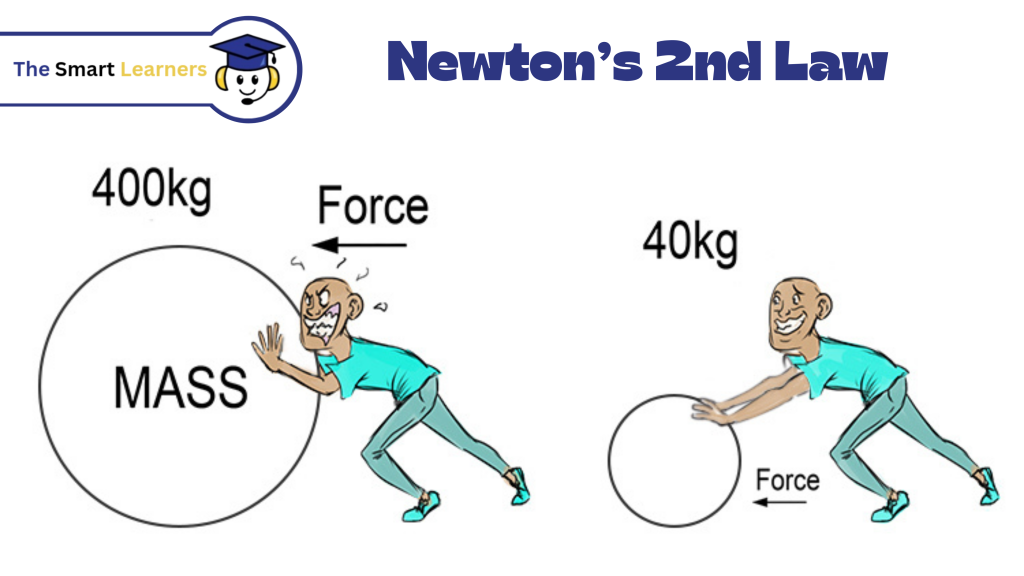
“The acceleration of an object depends on the net force acting on it and its mass (F = ma).”

What It Means:

  • If an unbalanced Force (F) act on an object it causes acceleration (a).

  • The more mass (m) an object has, the more force is needed to accelerate it.

Formula Breakdown:

  • F = Force (measured in Newtons, N)

  • m = Mass (measured in kilograms, kg)

  • a = Acceleration (measured in meters per second squared, m/s²)

Real-Life Example:

  • Pushing a shopping cart: A lighter cart accelerates faster with less force than a heavily loaded one.

Newton’s Third Law: The Law of Action-Reaction

Newton's laws explained step by step
 Statement:

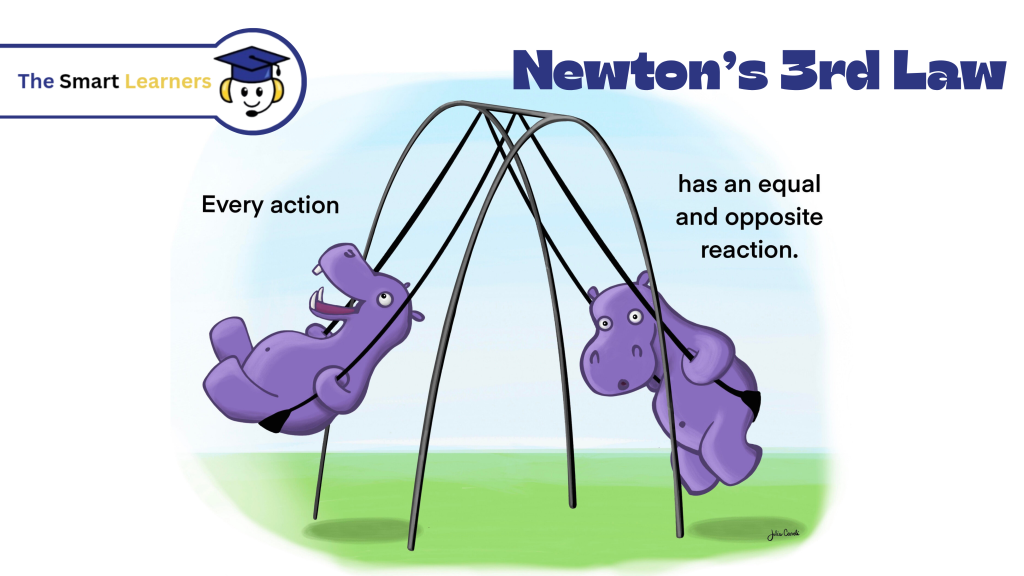
“For every action, there is an equal and opposite reaction.”

What It Means:

  • Forces always occur in pairs.

  • If Object A exerts a force on Object B, Object B exerts an equal and opposite force on Object A.

Real-Life Example:

  • Walking: Your foot pushes backward on the ground (action), and the ground pushes you forward (reaction).

Online Tutoring
Online Tutoring Study Tips

Online Tutoring: The Smarter Way to Boost Your Child’s Success

Online tutoring

The educational landscape has changed significantly recently, with online tutoring emerging as a powerful and accessible learning solution. As families in the USA, UK, and Canada increasingly turn to digital education to supplement traditional instruction, it is essential to understand how effective online tutoring is and what it offers students. From improved academic performance to increased flexibility, online tutoring provides a modern approach to education that meets the evolving needs of today’s learners and their families.

The Smart Learners offer free trial for newly joining students to experience these benefits.

Personalized Learning Experience

One of the primary benefits of online tutoring is the ability to deliver a personalized learning experience tailored to the specific needs and pace of each student. Unlike traditional classroom settings, where teachers must accommodate large groups, online tutoring sessions are typically one-on-one, allowing tutors to identify individual strengths and address areas of difficulty more effectively. This focused attention helps students gain a deeper understanding of core subjects, build confidence, and develop critical thinking skills. Through adaptive learning tools and customized lesson plans, online tutoring enables targeted instruction that can lead to measurable academic improvement.

Flexibility and Convenience

Online tutoring offers unmatched flexibility for families managing busy schedules. Students can access high-quality instruction from the comfort of their homes, eliminating the need for travel and reducing logistical challenges. This convenience is especially beneficial for parents balancing work, school, and extracurricular activities. In regions like the USA, UK, and Canada—where commute times and time zone differences can present challenges—online tutoring provides a practical solution that accommodates different lifestyles. Sessions can be scheduled during evenings or weekends, allowing students to learn at their optimal time without sacrificing other commitments.

Access to Qualified and Diverse Tutors

One of the most significant advantages of online tutoring is the expanded access to a diverse pool of qualified educators. Parents no longer need to be limited to local options; instead, they can choose from experienced tutors across the country or even internationally. Many online tutoring platforms rigorously vet their instructors to ensure they meet academic standards and possess the necessary credentials. Whether a student needs help with core subjects like math and English or advanced preparation for standardized exams, online tutoring services offer access to subject-matter experts who can provide high-quality, specialized instruction tailored to national curricula in the USA, UK, or Canada.

Cost-Effective Learning Solutions

Affordability is often a deciding factor for families seeking supplemental education, and online tutoring frequently proves to be a more cost-effective option than in-person tutoring. By reducing overhead costs such as travel, facilities, and printed materials, online platforms can offer competitive pricing while maintaining high standards of instruction. Additionally, many services provide flexible payment options, including pay-as-you-go plans and subscription models. This affordability, combined with the quality of instruction available, makes online tutoring an attractive choice for parents looking to enhance their child’s education without overextending their budgets.

Improved Student Engagement and Learning Outcomes

Online tutoring is designed to promote student engagement through interactive tools, real-time feedback, and multimedia resources that cater to different learning styles. Students who might struggle in a traditional classroom often thrive in an online environment that allows them to learn at their own pace without the pressure of peers. This personalized approach, coupled with consistent support from dedicated tutors, often leads to improved learning outcomes, higher test scores, and increased academic motivation. In multiple studies conducted across North America and the UK, students who participated in online tutoring programs demonstrated faster progress and stronger subject comprehension compared to peers relying solely on classroom instruction.

Conclusion

Online tutoring has proven to be a highly effective and reliable educational solution for students in the USA, UK, and Canada. Its benefits—personalized instruction, flexibility, access to qualified educators, cost efficiency, and enhanced academic performance—address the concerns of modern parents seeking to support their child’s education in a meaningful way. As digital learning continues to evolve, online tutoring stands out as a valuable resource that not only complements traditional schooling but also prepares students for a more dynamic and connected future.

9th Physics

Physics Notes for Class 9: Unit 9 (Transfer of Heat) – Punjab Boards (SSC-I, Matric)

Physics Notes for Class 9 (Unit – 9) – English Medium, All Punjab Boards

These notes are available in PDF format and are tailored for students of Matric, SSC Part-I, O-Level, and Class 9 (IX) following the syllabus prescribed by the Punjab Boards of Intermediate & Secondary Education, including Bahawalpur, Dera Ghazi Khan, Faisalabad, Gujranwala, Lahore, Multan, Rawalpindi, and Sargodha. They are designed to help students grasp key concepts effectively and excel in their studies.

Your Required Notes

Click the following buttons

Scroll to Top