December 2025

Physics

Elastic Potential Energy

Elastic Potential Energy | SmartLearners

Elastic Potential Energy

Understanding stored energy in stretched or compressed objects - springs, rubber bands, and more for GCSE, Grade 9-10, Year 9-10

What is Elastic Potential Energy?

Elastic potential energy (EPE) is the energy stored in elastic materials when they are stretched or compressed. This energy is 'potential' because it has the potential to do work when the material returns to its original shape.

Spring Constant (k)

The stiffness of the spring. Higher k means a stiffer spring that's harder to stretch.

Extension (x)

How far the spring is stretched or compressed from its natural length.

Energy Stored (EPE)

EPE increases with the square of extension. Double extension = 4× energy!

Key Concept

Elastic potential energy is stored when work is done to deform an elastic object. When the force is removed, this stored energy is released as the object returns to its original shape. This is described by Hooke's Law for materials within their elastic limit.

The EPE Formula

Elastic Potential Energy Formula

EPE = ½ × k × x²

Where elastic potential energy (EPE) equals one-half times spring constant (k) times extension squared (x²)

EPE
Elastic Potential Energy (joules, J)
k
Spring constant (N/m)
x
Extension/compression (meters, m)
½
Constant factor (one-half)

Hooke's Law Connection

Elastic potential energy is related to Hooke's Law, which states: F = k × x, where:

  • F = Force applied to stretch/compress the spring (N)
  • k = Spring constant (N/m)
  • x = Extension/compression (m)

The EPE formula (½kx²) comes from calculating the work done to stretch the spring, which is the area under the force-extension graph.

Derivation of the Formula

The EPE formula comes from calculating the work done to stretch a spring. Since the force needed increases as the spring stretches, we need to use integration or calculate the area under the force-extension graph.

Derivation Steps

1

Hooke's Law

The force needed to stretch a spring is proportional to the extension: F = k × x

F = k × x
2

Work Done

Work done (W) = average force × distance. For a changing force, work is the area under the force-extension graph.

W = Area under F-x graph
3

Force-Extension Graph

The graph of F = kx is a straight line through the origin. The area under this line to extension x is a triangle.

Area = ½ × base × height
4

Calculate Area

Base = extension (x), Height = force at full extension (kx)

Area = ½ × x × (k × x)
5

Simplify

This area equals the work done to stretch the spring, which is stored as elastic potential energy.

EPE = ½ × k × x²

Important Note

The EPE formula only applies when the material obeys Hooke's Law (within the elastic limit). Beyond this limit, the material may be permanently deformed or break, and the formula doesn't apply.

Interactive Spring System Simulation

Explore how mass, spring constant, and gravity affect elastic potential energy in a hanging spring-mass system.

0.5 kg
50 N/m
9.8 N/kg

Spring System Calculations

Extension (x)
0.098 m
x = mg/k
Force (F)
4.9 N
F = mg
EPE Stored
0.24 J
EPE = ½kx²

The mass stretches the spring until the spring force (kx) equals the weight (mg). At equilibrium: kx = mg, so x = mg/k.

Graphical Representation

EPE increases with the square of extension, creating a parabolic relationship. The force-extension graph is linear (Hooke's Law).

EPE vs. Extension

EPE increases with extension squared. Double extension = 4× EPE!

Force vs. Extension (Hooke's Law)

Force increases linearly with extension. Slope = spring constant (k).

Real-World Examples of EPE

Elastic potential energy is all around us. Here are some common examples:

Archery Bows

When an archer pulls back the bowstring, they store EPE in the bent bow. Releasing transfers this energy to the arrow as kinetic energy.

Calculation: For k = 200 N/m bow pulled back 0.3 m: EPE = ½ × 200 × (0.3)² = 9 J

Car Suspension

Springs in car suspension store EPE when compressed by bumps. This energy is then gradually released, giving a smoother ride.

Calculation: For k = 20,000 N/m spring compressed 0.05 m: EPE = ½ × 20000 × (0.05)² = 25 J

Trampolines

When you jump on a trampoline, the springs stretch and store EPE. This energy then pushes you back up on the next bounce.

Calculation: For k = 1000 N/m trampoline stretched 0.2 m: EPE = ½ × 1000 × (0.2)² = 20 J

Solved Example Problems (GCSE Level)

Example 1: Basic EPE Calculation

GCSE Foundation

A spring has a spring constant of 80 N/m. It is stretched by 0.15 m from its natural length. Calculate the elastic potential energy stored in the spring.

Step 1: Write the formula

EPE = ½ × k × x²

Step 2: Identify known values

k = 80 N/m, x = 0.15 m

Step 3: Substitute values into formula

EPE = ½ × 80 × (0.15)²

Step 4: Calculate extension squared

(0.15)² = 0.15 × 0.15 = 0.0225

EPE = ½ × 80 × 0.0225

Step 5: Perform multiplication

½ × 80 = 40

40 × 0.0225 = 0.9

Step 6: State the answer with units

EPE = 0.9 J

Example 2: Finding Spring Constant from EPE

GCSE Higher

A spring stores 2.0 J of elastic potential energy when stretched by 0.1 m. Calculate the spring constant of the spring.

Step 1: Write the formula

EPE = ½ × k × x²

Step 2: Rearrange to solve for k

k = (2 × EPE) ÷ x²

Step 3: Identify known values

EPE = 2.0 J, x = 0.1 m

Step 4: Substitute values into formula

k = (2 × 2.0) ÷ (0.1)²

Step 5: Calculate numerator and denominator

2 × 2.0 = 4.0

(0.1)² = 0.01

k = 4.0 ÷ 0.01

Step 6: Perform division

4.0 ÷ 0.01 = 400

Step 7: State the answer with units

Spring constant = 400 N/m

Example 3: Energy Conversion - Spring Launcher

Grade 10

A spring with constant 500 N/m is compressed 0.08 m and used to launch a 0.02 kg ball horizontally. Assuming all EPE converts to kinetic energy, calculate the speed of the ball as it leaves the spring.

Step 1: Calculate EPE stored in spring

EPE = ½ × k × x² = ½ × 500 × (0.08)²

EPE = ½ × 500 × 0.0064 = 1.6 J

Step 2: Set EPE equal to kinetic energy

Assuming all EPE converts to KE: EPE = KE = ½ × m × v²

1.6 = ½ × 0.02 × v²

Step 3: Rearrange to solve for v²

v² = (2 × EPE) ÷ m = (2 × 1.6) ÷ 0.02

v² = 3.2 ÷ 0.02 = 160

Step 4: Take square root to find v

v = √160 ≈ 12.65

Step 5: State the answer with units

Speed = 12.7 m/s (to 3 significant figures)

Step 6: Interpretation

The compressed spring stores 1.6 J of EPE, which converts to kinetic energy, launching the ball at 12.7 m/s.

Practice Problems (Unsolved)

Test your understanding with these GCSE-level problems. Try to solve them yourself before checking the answers!

Problem 1: Rubber Band Energy

GCSE Foundation

A rubber band has a spring constant of 40 N/m. It is stretched by 0.25 m. Calculate the elastic potential energy stored in the rubber band.

Problem 2: Finding Extension from EPE

GCSE Higher

A spring with constant 200 N/m stores 6.25 J of elastic potential energy. Calculate the extension of the spring.

Problem 3: Spring-Mass System

Grade 10 Challenge

A 0.8 kg mass hangs from a spring with constant 160 N/m. Calculate:

  1. The extension of the spring at equilibrium (use g = 10 N/kg)
  2. The elastic potential energy stored in the spring at this extension

EPE Calculator

Use this calculator to solve for any variable in the EPE equation (EPE = ½ × k × x²).

Solve EPE Problems

Result:

0

EPE Resources

Related Topics

Real-World Applications

Free Demo Class

Master EPE calculations and spring systems with our expert tutors in an interactive online session

Book Free Demo

Limited spots available for Year 9-10 students

Quick Tip: Extension Squared

Remember that EPE depends on extension squared. This means if you double the extension, EPE increases by a factor of 4. If you triple the extension, EPE increases by a factor of 9!

Units Check

Always ensure your units are consistent: spring constant in N/m, extension in m, and energy in joules (J). 1 J = 1 N·m.

Elastic Limit

The EPE formula only applies within the elastic limit. Beyond this point, the material won't return to its original shape and may break.
Physics

Gravitational Potential Energy

Gravitational Potential Energy | SmartLearners

Gravitational Potential Energy

Understanding stored energy due to height - formula, derivation, and real-world applications for GCSE, Grade 9-10, Year 9-10

What is Gravitational Potential Energy?

Gravitational potential energy (GPE) is the energy stored in an object when it is raised above the ground. This energy is 'potential' because it has the potential to do work when the object falls.

Mass (m)

The heavier the object, the more GPE it has at the same height.

Height (h)

The higher the object, the more GPE it has. GPE is directly proportional to height.

Gravity (g)

GPE depends on gravitational field strength. On Earth, g ≈ 9.8 N/kg.

Key Concept

Gravitational potential energy is energy stored due to an object's position in a gravitational field. When the object falls, this stored energy is converted to kinetic energy.

The GPE Formula

Gravitational Potential Energy Formula

GPE = m × g × h

Where gravitational potential energy (GPE) equals mass (m) times gravitational field strength (g) times height (h)

GPE
Gravitational Potential Energy (joules, J)
m
Mass (kilograms, kg)
g
Gravitational field strength (N/kg)
h
Height (meters, m)

Important Note

On Earth, we often use g = 9.8 N/kg for accurate calculations or g = 10 N/kg for simpler calculations. Remember that g varies on different planets:

  • Earth: 9.8 N/kg (≈10 N/kg for approximation)
  • Moon: 1.6 N/kg
  • Mars: 3.7 N/kg
  • Jupiter: 24.8 N/kg

Derivation of the Formula

The GPE formula comes from the work done against gravity to lift an object. Let's derive it step by step:

Derivation Steps

1

Work Done Against Gravity

When lifting an object, we do work against gravity. Work done (W) = force (F) × distance (d).

W = F × d
2

Force Required to Lift

To lift an object at constant velocity, we need to apply a force equal to its weight.

F = m × g
3

Distance is Height

The distance moved against gravity is the height (h) the object is lifted.

d = h
4

Substitute into Work Formula

Substitute F = m × g and d = h into the work formula:

W = (m × g) × h
5

Work Done = GPE Gained

The work done against gravity is stored as gravitational potential energy in the object.

GPE = m × g × h

Graphical Representation

GPE increases linearly with both mass and height when other factors are constant.

GPE vs. Height

GPE increases linearly with height. Double the height = double the GPE (for same mass).

GPE vs. Mass

GPE increases linearly with mass. Double the mass = double the GPE (at same height).

Real-World Examples of GPE

Gravitational potential energy is all around us. Here are some common examples:

Hydroelectric Dams

Water stored at height in reservoirs has GPE. When released, it flows down through turbines, converting GPE to kinetic energy, then to electrical energy.

Calculation: 1000 kg water at 50 m height has GPE = 1000 × 10 × 50 = 500,000 J

Pile Drivers

A heavy weight is lifted to gain GPE, then dropped to drive piles into the ground. The GPE converts to kinetic energy to do work.

Calculation: 500 kg weight at 10 m height has GPE = 500 × 10 × 10 = 50,000 J

Ski Slopes

Skiers at the top of a slope have GPE. As they ski down, GPE converts to kinetic energy, making them go faster.

Calculation: 70 kg skier at 100 m height has GPE = 70 × 10 × 100 = 70,000 J

Interactive GPE Simulation

Adjust the mass, height, and gravity to see how they affect gravitational potential energy in real-time.

5 kg
10 m
9.8 N/kg
10 m
5 kg

Calculated Gravitational Potential Energy

490 J

GPE = 5 kg × 9.8 N/kg × 10 m

When you drop the object, its GPE converts to kinetic energy. The total energy remains constant (conservation of energy).

Solved Example Problems (GCSE Level)

Example 1: Basic GPE Calculation

GCSE Foundation

A 2 kg book is placed on a shelf 1.5 m above the ground. Calculate the gravitational potential energy of the book. (Use g = 10 N/kg)

Step 1: Write the formula

GPE = m × g × h

Step 2: Identify known values

m = 2 kg, g = 10 N/kg, h = 1.5 m

Step 3: Substitute values into formula

GPE = 2 × 10 × 1.5

Step 4: Calculate

2 × 10 = 20

20 × 1.5 = 30

Step 5: State the answer with units

GPE = 30 J

Example 2: Finding Height from GPE

GCSE Higher

A 500 g mass has 20 J of gravitational potential energy. Calculate its height above the ground. (Use g = 10 N/kg)

Step 1: Write the formula

GPE = m × g × h

Step 2: Rearrange to solve for height (h)

h = GPE ÷ (m × g)

Step 3: Convert mass to kg and identify values

500 g = 0.5 kg, GPE = 20 J, g = 10 N/kg

Step 4: Substitute values into formula

h = 20 ÷ (0.5 × 10)

Step 5: Calculate denominator

0.5 × 10 = 5

h = 20 ÷ 5

Step 6: Perform division

20 ÷ 5 = 4

Step 7: State the answer with units

Height = 4 m

Example 3: GPE on Different Planets

Grade 10

A 10 kg object is raised to a height of 5 m on Earth (g = 9.8 N/kg) and on the Moon (g = 1.6 N/kg). Calculate the difference in GPE between the two locations.

Step 1: Calculate GPE on Earth

GPEEarth = m × gEarth × h = 10 × 9.8 × 5

GPEEarth = 490 J

Step 2: Calculate GPE on the Moon

GPEMoon = m × gMoon × h = 10 × 1.6 × 5

GPEMoon = 80 J

Step 3: Find the difference

Difference = GPEEarth - GPEMoon = 490 - 80

Step 4: Calculate difference

490 - 80 = 410

Step 5: State the answer with units

Difference in GPE = 410 J

Step 6: Interpretation

The same object at the same height has much less GPE on the Moon because the Moon's gravity is weaker.

Practice Problems (Unsolved)

Test your understanding with these GCSE-level problems. Try to solve them yourself before checking the answers!

Problem 1: Water in a Tank

GCSE Foundation

A water tank contains 200 kg of water stored at a height of 8 m. Calculate the gravitational potential energy of the water. (Use g = 10 N/kg)

Problem 2: Finding Mass from GPE

GCSE Higher

A rock has 735 J of gravitational potential energy when it is 15 m above the ground. Calculate the mass of the rock. (Use g = 9.8 N/kg)

Problem 3: Energy Conversion

Grade 10 Challenge

A 0.4 kg ball is dropped from a height of 20 m. Calculate its speed just before it hits the ground. (Assume all GPE converts to kinetic energy, g = 10 N/kg, and ignore air resistance).

Hint: First calculate GPE, then use KE = ½mv² where KE = GPE.

GPE Calculator

Use this calculator to solve for any variable in the GPE equation (GPE = m × g × h).

Solve GPE Problems

Result:

0

GPE Resources

Related Topics

Real-World Applications

Free Demo Class

Master GPE calculations with our expert tutors in an interactive online session

Book Free Demo

Limited spots available for Year 9-10 students

Quick Tip: Reference Point

Remember that GPE is always measured relative to a reference point (usually the ground). The height (h) is the vertical distance above this reference point.

Units Check

Always ensure your units are consistent: mass in kg, height in m, gravity in N/kg, and energy in joules (J). 1 J = 1 N·m = 1 kg·m²/s².

Common Mistake

Don't confuse GPE (mgh) with kinetic energy (½mv²). GPE depends on height, while kinetic energy depends on speed squared.

Thesmartlearners.online/kinetic-energy Online tutoring
Physics

Kinetic Energy

Kinetic Energy: Formula & Calculations

Understanding the energy of motion - its formula, derivation, and practical applications

What is Kinetic Energy?

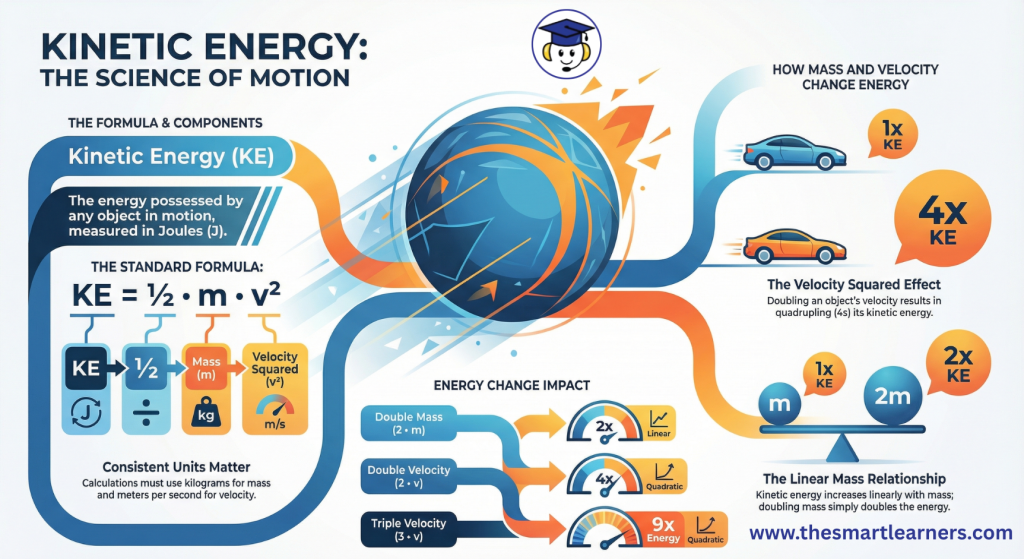
Kinetic energy is the energy possessed by an object due to its motion. Any object that is moving has kinetic energy. The amount of kinetic energy depends on two factors:

Mass (m)

The heavier the object, the more kinetic energy it has when moving at the same speed.

Velocity (v)

The faster the object moves, the more kinetic energy it has. Note: KE depends on velocity squared!

The Kinetic Energy Formula

Kinetic Energy Formula

KE = ½ × m × v²

Where kinetic energy (KE) equals one-half times the mass (m) times the square of the velocity (v)

KE
Kinetic Energy (in joules, J)
m
Mass (in kilograms, kg)
v
Velocity (in meters per second, m/s)
½
Constant factor (one-half)

Derivation of the Formula

The kinetic energy formula can be derived from the work-energy theorem, which states that the work done on an object equals its change in kinetic energy.

Derivation Steps

1

Start with Work Done

Work done (W) on an object equals force (F) times displacement (s) in the direction of the force:

W = F × s
2

Apply Newton's Second Law

Force equals mass times acceleration (F = m × a). Substitute into the work equation:

W = (m × a) × s
3

Use Kinematics Equation

From kinematics, for constant acceleration starting from rest: v² = u² + 2as, where u=0, so v² = 2as, therefore a = v²/(2s):

W = m × (v²/(2s)) × s
4

Simplify the Equation

The displacement (s) cancels out:

W = m × v² / 2
5

Work Equals Change in Kinetic Energy

By the work-energy theorem, work done equals change in kinetic energy. Starting from rest, this gives us the kinetic energy formula:

KE = ½ × m × v²

Graphical Representation

The relationship between kinetic energy and velocity is quadratic, while the relationship with mass is linear.

Kinetic Energy vs. Velocity

KE increases with the square of velocity. Doubling velocity quadruples kinetic energy!

Kinetic Energy vs. Mass

KE increases linearly with mass. Doubling mass doubles kinetic energy (at constant velocity).

Interactive Kinetic Energy Demo

Adjust the mass and velocity sliders to see how they affect kinetic energy in real-time.

10 kg
10 m/s

Calculated Kinetic Energy

500 J

KE = ½ × 10 kg × (10 m/s)²

Example Problems

Example 1: Calculating Kinetic Energy

A car with a mass of 800 kg is traveling at a speed of 25 m/s. Calculate its kinetic energy.

Step 1: Write the formula

KE = ½ × m × v²

Step 2: Substitute known values

m = 800 kg, v = 25 m/s

KE = ½ × 800 × (25)²

Step 3: Calculate velocity squared

(25)² = 25 × 25 = 625

KE = ½ × 800 × 625

Step 4: Perform multiplication

½ × 800 = 400

400 × 625 = 250,000

Step 5: State the answer

KE = 250,000 J or 250 kJ

Example 2: Finding Mass from Kinetic Energy

A car has a kinetic energy store of 64,800 J. It is travelling at a speed of 12 m/s. Calculate its mass.

Step 1: Write the formula

KE = ½ × m × v²

Step 2: Rearrange to solve for mass (m)

m = (2 × KE) / v²

Step 3: Substitute known values

KE = 64,800 J, v = 12 m/s

m = (2 × 64,800) / (12)²

Step 4: Calculate denominator

(12)² = 12 × 12 = 144

m = (129,600) / 144

Step 5: Perform division

129,600 ÷ 144 = 900

Step 6: State the answer

Mass = 900 kg

Example 3: Finding Velocity from Kinetic Energy

A 0.5 kg ball has 100 J of kinetic energy. Calculate its velocity.

Step 1: Write the formula

KE = ½ × m × v²

Step 2: Rearrange to solve for velocity (v)

v² = (2 × KE) / m

v = √[(2 × KE) / m]

Step 3: Substitute known values

KE = 100 J, m = 0.5 kg

v = √[(2 × 100) / 0.5]

Step 4: Calculate numerator

2 × 100 = 200

v = √[200 / 0.5]

Step 5: Perform division

200 ÷ 0.5 = 400

v = √400

Step 6: Calculate square root

√400 = 20

Step 7: State the answer

Velocity = 20 m/s

Kinetic Energy Calculator

Use this calculator to solve for any variable in the kinetic energy equation.

Solve Kinetic Energy Problems

Result:

0

Kinetic Energy Resources

Related Topics

Real-World Applications

Free Demo: Kinetic Energy

Master kinetic energy calculations with our interactive demo class

Book Demo Class

Quick Tip: Velocity Squared

Remember that kinetic energy depends on velocity squared. This means if you double the speed, kinetic energy increases by a factor of 4. If you triple the speed, KE increases by a factor of 9!

Units Check

Always ensure your units are consistent: mass in kg, velocity in m/s, and energy in joules (J). 1 J = 1 kg·m²/s².

Physics

Examples of Energy Transfers

Examples of Energy Transfers

Understanding energy measurement in joules and the fundamental principle of energy conservation

Measuring Energy: The Joule

Energy is a quantity that is measured in joules, J. The joule is the SI unit of energy, named after the English physicist James Prescott Joule. Large quantities of energy are measured in kilojoules (kJ), and megajoules (MJ).

Joule (J)

1 J

The basic unit of energy

Approximately the energy needed to lift an apple 1 meter against Earth's gravity

Kilojoule (kJ)

1 kJ

Equal to 1,000 joules

1 kJ = 1,000 J (10³ J)

Megajoule (MJ)

1 MJ

Equal to 1,000,000 joules

1 MJ = 1,000,000 J (10⁶ J)

Energy Scale Examples

Small Apple (100g)

~200,000 J

Chemical energy stored

Light Bulb (60W) for 1 hour

216,000 J

Electrical energy used

Car Battery (12V, 50Ah)

2.16 MJ

Total energy storage

The Principle of Conservation of Energy

The reason that energy is so important to us is that there is always the same energy at the end of a process as there was at the beginning.

The principle of conservation of energy states that the amount of energy always remains the same. There are various stores of energy. In any process energy can be transferred from one store to another, but energy cannot be destroyed or created.

Key Insight

Energy is never "used up" - it simply transfers from one store to another. The total energy in a closed system remains constant.

Real-World Energy Transfer Examples

These examples show how energy transfers from one store to another while the total amount of energy remains constant.

Hydroelectric Power Plant

Potential energy of water in a dam converts to electrical energy through turbines and generators.

Gravitational Potential Kinetic Electrical

Total energy remains constant throughout the process

Photosynthesis in Plants

Plants convert light energy from the sun into chemical energy stored in glucose.

Light Energy Chemical Energy

Energy is conserved: Light energy = Chemical energy + Heat

Electric Room Heater

Electrical energy from the grid converts to thermal energy that warms a room.

Electrical Thermal

All electrical energy converts to heat (assuming 100% efficiency)

Human Metabolism

Chemical energy from food converts to kinetic energy for movement and thermal energy to maintain body temperature.

Chemical Kinetic + Thermal

Energy conserved: Food energy = Movement + Heat + Waste

Energy Conversion Calculator

Use this interactive calculator to convert between different energy units and see the principle of conservation in action.

Energy Unit Converter

Interactive Conservation Demonstration

Drag the sliders to see how energy redistributes between different stores while the total remains constant.

Kinetic Energy 500 J
Potential Energy 500 J
Thermal Energy 0 J

Total Energy (Conserved)

1000 J

The total energy remains constant at 1000 J regardless of how it's distributed between stores.

Explore Energy Topics

Energy Fundamentals

Practical Applications

Free Demo: Energy Calculations

Join our interactive demo class to master energy calculations and conservation problems

Book Demo Class

Quick Tip: Energy Conservation

When solving energy problems, always start by writing the conservation equation: Initial Energy = Final Energy. This helps track energy transfers between different stores.

Historical Note

The principle of conservation of energy was first proposed in the early 19th century by several scientists including Julius von Mayer, James Joule, and Hermann von Helmholtz.

Physics

Energy Stores and Transfers

Energy Stores and Transfers

Understanding energy through studying changes in the way energy is stored when a system changes.

Introduction to Energy Systems

A 'system' is an object or a group of objects that interact. In physics, we can understand energy by studying changes in the way energy is stored when a system changes.

Energy Stores in Everyday Events

Throwing an Object Upwards

When you throw a ball upwards, just after the ball leaves your hand it has a store of kinetic energy. When the ball reaches its highest point, it has a store of gravitational potential energy. Just before you catch it again, it has a store of kinetic energy.

Energy Transfer: Kinetic → Gravitational Potential → Kinetic

Boiling Water in a Kettle

When you turn on your electric kettle, the water in the kettle gets hotter. There is now more internal (or thermal) energy stored in the hot water than there was in the cold water.

Energy Transfer: Electrical → Internal (Thermal) Energy

A Car Using Brakes to Slow Down

A moving car has a store of kinetic energy. When the car slows to a halt, it has lost this store of kinetic energy. The brakes exert a frictional force on the wheels, and the brakes get hot. The store of kinetic energy in the car has been transferred to a store of thermal energy in the brakes.

Energy Transfer: Kinetic → Thermal (Internal)

Holding Two Magnets with North Poles Facing

When you hold two magnets with like poles facing, you can feel a force which repels the magnets from each other. When the magnets are close together there is a store of magnetic potential energy. When you release the magnets, they move apart. The magnets' store of magnetic potential energy has reduced and their store of kinetic energy has increased.

Energy Transfer: Magnetic Potential → Kinetic

Types of Energy Stores

We use the following labels to describe the stores of energy you will meet:

Kinetic

Energy of motion

Chemical

Energy stored in chemical bonds

Internal

Thermal energy stored in objects

Gravitational Potential

Energy due to height in gravity field

Magnetic

Energy in magnetic fields

Elastic

Energy stored in stretched/compressed objects

Energy Transfer Methods

Light, sound and electricity are useful, but they are not stores of energy. They are ways of transferring energy from one store to a different energy store.

Example: A Torch

In a torch, the chemical energy stored in the battery causes an electric current (a flow of charge). The electric current causes the temperature of the bulb to increase so much that the bulb lights up. The light cannot be stored but it is useful. When the light strikes an object and is absorbed, the internal energy of the object increases.

Chemical Energy

Electrical Transfer

Light & Heat

Explore More Resources

Physics Topics

Other Sciences

Learning Levels

KS3 (11-14 yrs) GCSE (14-16 yrs) A-Level (16-18 yrs) IB Diploma AP Physics Beginner Intermediate Advanced

Free Online Demo Class

Experience our interactive teaching method with a free demo class on Energy Systems

Book Your Demo

Study Tip

When studying energy transfers, always identify both the starting and ending energy stores. This helps understand how energy is conserved during transfers.

Scroll to Top