
power
Power
Understanding the rate of energy transfer - from light bulbs to power plants
P = E/t = W/t = VIWhat is Power?
Definition
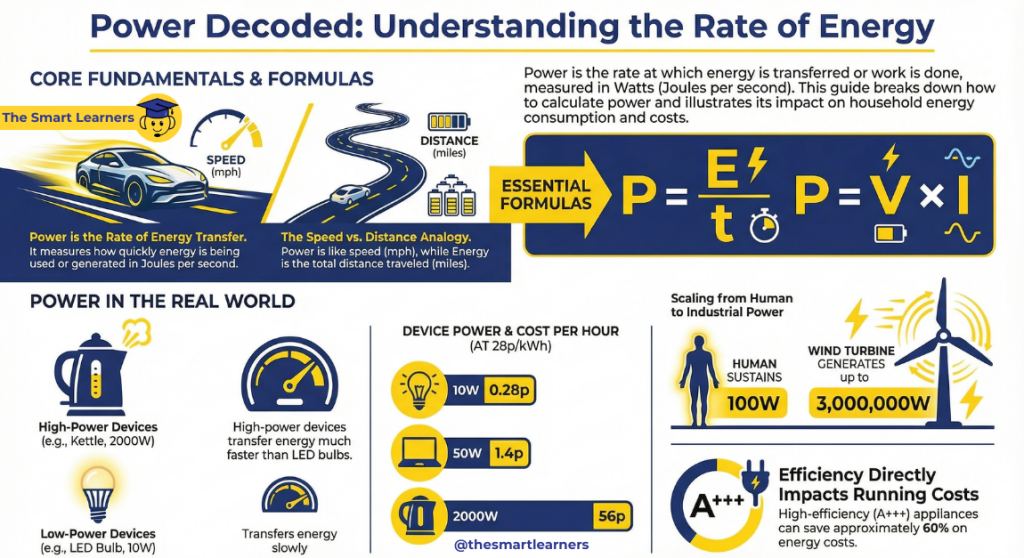
Power is the rate at which energy is transferred or work is done. It tells us how quickly energy is being used or generated.
Key Concept
A high power device transfers energy quickly, while a low power device transfers energy slowly.
Unit
Power is measured in watts (W). 1 watt = 1 joule per second (1 W = 1 J/s)
Real-World Understanding
A 100W light bulb converts 100 joules of electrical energy into light and heat every second. A 2000W kettle converts 2000 joules per second - that's why it heats water much faster!
Power Formulas
Basic Power Formula
Work Formula
Electrical Power
Alternative Electrical
Formula Rearrangements
Interactive Power Calculator
Adjust the sliders to see how power, energy, and time are related:
Energy Transfer Simulator
Power (Watts)
Time (seconds)
Energy Used
Energy Transfer Rate
Your device transfers 100 joules of energy every second
Household Appliance Power Ratings
Different appliances have different power ratings - see how they compare:
LED Light Bulb
- Uses 10 J/s
- Cost: ~£0.03 per day
- 100 hours on 1 kWh
Laptop
- Uses 50 J/s
- Cost: ~£0.15 per day
- 20 hours on 1 kWh
LED TV (50")
- Uses 100 J/s
- Cost: ~£0.30 per day
- 10 hours on 1 kWh
Refrigerator
- Uses 150 J/s (avg)
- Cost: ~£0.45 per day
- Runs 30% of time
Kettle
- Uses 2000 J/s
- Cost: ~£0.10 per boil
- 30 minutes on 1 kWh
Electric Shower
- Uses 9000 J/s
- Cost: ~£0.45 per 10 mins
- 6.7 minutes on 1 kWh
Key Point: High power appliances (like kettles and showers) transfer energy very quickly, which is why they heat things rapidly but also cost more to run.
Real-World Power Examples
Typical residential solar panel produces about 300W of power in full sunlight.
A typical family car engine produces around 100,000W (100kW) of power.
Modern wind turbines can generate up to 3,000,000W (3MW) of power.
An average healthy human can sustain about 100W of mechanical power output.
Energy Efficiency & Cost
Appliance Energy Cost Calculator
Daily Running Cost
Monthly: £16.80 | Yearly: £204.40
Efficiency Ratings (A+++ to G)
Solved Examples
Example 1: Energy Transfer
Question: A 2.5kW kettle is used for 3 minutes. How much energy does it transfer?
Step 1: Write the formula: E = P × t
Step 2: Convert units: P = 2.5kW = 2500W, t = 3 minutes = 180s
Step 3: Substitute: E = 2500 × 180
Step 4: Calculate: E = 450,000 J = 450 kJ
Answer: 450,000 J or 450 kJ
Example 2: Electrical Power
Question: A hairdryer operates at 230V and draws a current of 4.35A. Calculate its power and the energy used in 5 minutes.
Step 1: Use P = V × I
Step 2: P = 230 × 4.35 = 1000.5W ≈ 1000W
Step 3: Time = 5 minutes = 300 seconds
Step 4: Energy = P × t = 1000 × 300 = 300,000 J
Power = 1000W (1kW), Energy = 300,000J (0.083 kWh)
Example 3: Cost Calculation
Question: A 2kW electric heater runs for 4 hours daily. If electricity costs 28p per kWh, calculate the weekly running cost.
Step 1: Energy per day = Power × Time = 2kW × 4h = 8 kWh
Step 2: Daily cost = 8 kWh × 28p = 224p = £2.24
Step 3: Weekly cost = £2.24 × 7 = £15.68
Weekly running cost = £15.68
Power Calculator
Solve Power Problems
Result:
Power Rating Comparison
| Device | Typical Power | Energy in 1 hour | Cost per hour* |
|---|---|---|---|
| LED Light Bulb | 10W | 0.01 kWh | 0.28p |
| Laptop | 50W | 0.05 kWh | 1.4p |
| LED TV (50") | 100W | 0.1 kWh | 2.8p |
| Fridge Freezer | 150W | 0.15 kWh | 4.2p |
| Desktop Computer | 300W | 0.3 kWh | 8.4p |
| Microwave | 800W | 0.8 kWh | 22.4p |
| Kettle | 2000W | 2.0 kWh | 56p |
| Electric Shower | 9000W | 9.0 kWh | £2.52 |
*Based on 28p per kWh electricity rate
Power Resources
Quick Facts
Related Topics
- Electrical Power
- Energy Efficiency
- Renewable Power
- Mechanical Power
- Household Electricity
- Industrial Power
Quick Tip
Remember: Power is the RATE of energy transfer. A 100W bulb uses energy 10 times faster than a 10W LED, which is why it's brighter but costs more to run!
Handy Formula
P = V × I
Power = Voltage × Current
Common Power Ratings
Common Mistake
Don't confuse power (watts) with energy (joules or kWh)! Power is how FAST you use energy, energy is HOW MUCH you use.
Analogy: Power is like speed (mph), Energy is like distance (miles).