IGCSE MAth

factorizing methods online tutoring the smart learners mathematics
Mathematics

Deciding the Factorization Method

Deciding the Factorization Method - GCSE Mathematics | The Smart Learners

Deciding the Factorization Method

GCSE Mathematics

🧩 How to Choose the Right Method

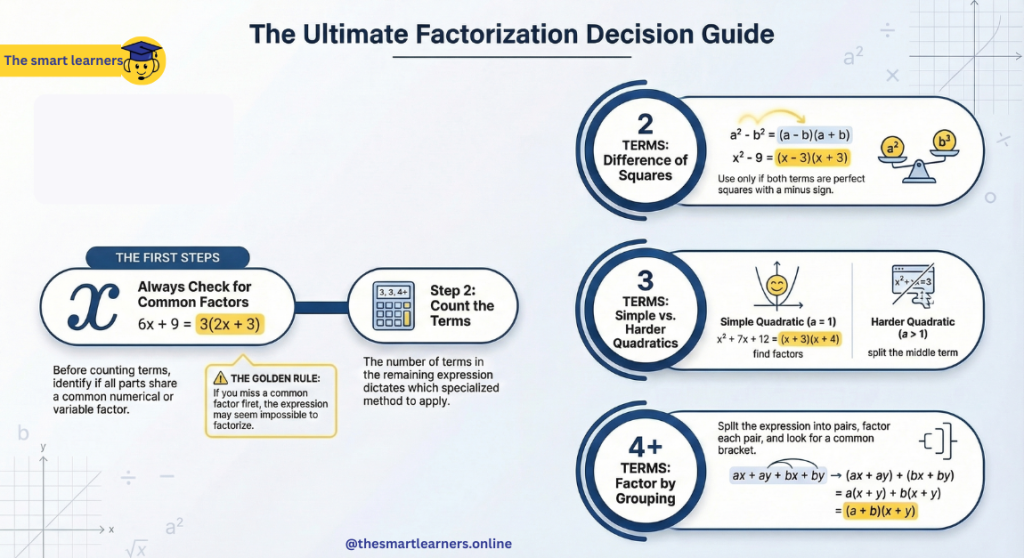
Not all expressions factorize the same way. The method you choose depends on the number of terms, the signs, and the coefficients. This page will help you decide which factorization method to use for any given expression.

Key Questions to Ask:
1. How many terms?
2. Is there a common factor?
3. Is it a difference of squares?
4. Is it a quadratic?
5. Is the coefficient of x² greater than 1?

🌳 Factorization Decision Tree

Start: Algebraic Expression
Step 1: Common factor?
Check if all terms share a common factor

Example: 6x + 9 = 3(2x + 3)

Example: 4x² - 8x = 4x(x - 2)

Always check for common factors FIRST!

Step 2: How many terms?
2 terms, 3 terms, or 4+ terms
2 terms?
3 terms?
4+ terms?
2 Terms
Check for difference of squares

Difference of squares: a² - b² = (a-b)(a+b)

Example: x² - 9 = (x-3)(x+3)

Sum of squares: a² + b² does NOT factorize

3 Terms
Quadratic: x² + bx + c or ax² + bx + c

Simple quadratic (a=1): Find factors of c that add to b

Example: x² + 7x + 12 = (x+3)(x+4)

Harder quadratic (a>1): Split middle term

Example: 2x² + 7x + 3 = (x+3)(2x+1)

4+ Terms
Try grouping in pairs

Factor by grouping: Group in pairs, factor each pair, look for common bracket

Example: x³ + 3x² + 2x + 6 = (x+3)(x²+2)

📋 Summary of Factorization Methods

1️⃣ Common Factor

When to use: All terms share a common factor

6x + 9 = 3(2x + 3)
4x² - 8x = 4x(x - 2)

12x² + 18x = 6x(2x + 3)

15x³ - 10x² = 5x²(3x - 2)

-3x - 6 = -3(x + 2)

2️⃣ Difference of Squares

When to use: Two terms, minus sign, both perfect squares

x² - 9 = (x - 3)(x + 3)
4x² - 25 = (2x - 5)(2x + 5)

16x² - 49y² = (4x - 7y)(4x + 7y)

x⁴ - 16 = (x² - 4)(x² + 4) = (x-2)(x+2)(x²+4)

9x² - 1/4 = (3x - ½)(3x + ½)

3️⃣ Simple Quadratics (a = 1)

When to use: x² + bx + c form

x² + 7x + 12 = (x + 3)(x + 4)
x² - 5x + 6 = (x - 2)(x - 3)

x² + 8x + 15 = (x + 3)(x + 5)

x² - 7x + 12 = (x - 3)(x - 4)

x² + 2x - 15 = (x - 3)(x + 5)

4️⃣ Harder Quadratics (a > 1)

When to use: ax² + bx + c with a > 1

2x² + 7x + 3 = (x + 3)(2x + 1)
3x² + 10x + 8 = (x + 2)(3x + 4)

6x² + 13x + 5 = (2x + 1)(3x + 5)

4x² - 11x - 3 = (4x + 1)(x - 3)

2x² - 9x - 5 = (2x + 1)(x - 5)

5️⃣ Factor by Grouping

When to use: Four or more terms

x³ + 3x² + 2x + 6 = (x + 3)(x² + 2)
x³ - 2x² + 3x - 6 = (x - 2)(x² + 3)

2x³ + 4x² + 3x + 6 = (x + 2)(2x² + 3)

x³ + 2x² - 4x - 8 = (x + 2)(x² - 4) = (x+2)(x-2)(x+2)

6️⃣ Multiple Methods

When to use: Need to apply more than one method

2x² - 18 = 2(x² - 9) = 2(x - 3)(x + 3)
4x³ - 36x = 4x(x² - 9) = 4x(x - 3)(x + 3)

3x³ - 12x = 3x(x² - 4) = 3x(x - 2)(x + 2)

2x⁴ - 32 = 2(x⁴ - 16) = 2(x² - 4)(x² + 4) = 2(x-2)(x+2)(x²+4)

🤔 Interactive Method Decider

Enter an expression and we'll help you choose the right method!

📊 Quick Decision Flowchart

Start
Common factor?
YES
Factor it out first
NO
How many terms?
2 terms
Check: Difference of squares?
YES → (a-b)(a+b)
NO → Cannot factorize
3 terms
Quadratic
a = 1?
YES → Find factors of c
NO → Split middle term
4+ terms
Try grouping
Group in pairs
Look for common bracket

🎯 Practice: Choose the Correct Method

For the expression: x² + 7x + 12

Which factorization method should you use?

Common Factor
Difference of Squares
Simple Quadratic (a=1)
Harder Quadratic (a>1)
Factor by Grouping
Multiple Methods
Correct choices: 0/0

📋 Method Comparison Table

Method When to Use Example
Common Factor All terms share a factor 6x + 9 = 3(2x + 3)
Difference of Squares Two terms, minus, perfect squares x² - 9 = (x-3)(x+3)
Simple Quadratic x² + bx + c (a=1) x² + 7x + 12 = (x+3)(x+4)
Harder Quadratic ax² + bx + c (a>1) 2x² + 7x + 3 = (x+3)(2x+1)
Grouping Four or more terms x³ + 3x² + 2x + 6 = (x+3)(x²+2)
Multiple Methods Need to apply >1 method 2x² - 18 = 2(x-3)(x+3)
Difference of two squares the smart learners online tutoring mathematics
Mathematics

Difference of two squares

Difference of Two Squares - GCSE Mathematics | The Smart Learners

Difference of Two Squares

GCSE Mathematics

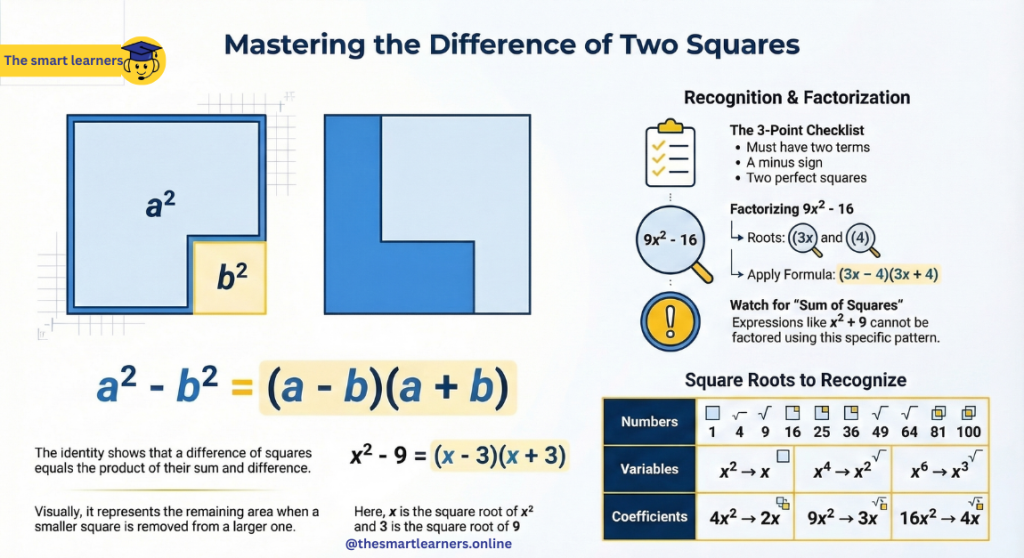
🔲 What is the Difference of Two Squares?

Difference of two squares is a special pattern in algebra where we have one perfect square subtracted from another perfect square. It factorizes in a unique way: the product of the sum and difference of the square roots.

a² - b² = (a - b)(a + b)

Example: x² - 9 = (x - 3)(x + 3)

🎨 Visual Explanation

x² (large square)

x
x
x
x
x
x
x
x
x
x
x
x
x
x
x
x
x
x
x
x
x
x
x
x
x

3² (small square)

3
3
3
3
3
3
3
3
3
The remaining area = (x - 3)(x + 3)

📐 The Formula

a² - b² = (a - b)(a + b)

First term

Must be a perfect square

Minus sign

Must be subtraction

Second term

Must be a perfect square

📚 Types of Difference of Squares

🔢 Simple Number Squares

Basic examples with numbers.

Example 1: x² - 9

3² = 9

Step 1: Identify a and b

a² = x² → a = x

b² = 9 → b = 3 (since 3² = 9)

Step 2: Apply formula: a² - b² = (a - b)(a + b)

Step 3: x² - 9 = (x - 3)(x + 3)

Check: (x-3)(x+3) = x² + 3x - 3x - 9 = x² - 9 ✓

Example 2: x² - 25

5² = 25

Step 1: a = x, b = 5

Step 2: (x - 5)(x + 5)

Example 3: x² - 49

7² = 49

Step 1: a = x, b = 7

Step 2: (x - 7)(x + 7)

🔤 With Variables

Both terms may contain variables.

Example 1: x² - y²

Step 1: a = x, b = y

Step 2: (x - y)(x + y)

Check: (x-y)(x+y) = x² + xy - xy - y² = x² - y² ✓

Example 2: 4x² - 9y²

Step 1: Recognize as (2x)² - (3y)²

a = 2x, b = 3y

Step 2: (2x - 3y)(2x + 3y)

Example 3: 16a² - 25b²

Step 1: (4a)² - (5b)²

Step 2: (4a - 5b)(4a + 5b)

🔢 With Coefficients

Numbers in front of variables.

Example 1: 9x² - 16

Step 1: (3x)² - 4²

a = 3x, b = 4

Step 2: (3x - 4)(3x + 4)

Check: (3x-4)(3x+4) = 9x² + 12x - 12x - 16 = 9x² - 16 ✓

Example 2: 25x² - 36

Step 1: (5x)² - 6²

Step 2: (5x - 6)(5x + 6)

Example 3: 49x² - 64y²

Step 1: (7x)² - (8y)²

Step 2: (7x - 8y)(7x + 8y)

🔄 Multiple Factors

Sometimes you need to factor out a common factor first.

Example 1: 2x² - 18

Step 1: First factor out common factor 2

2x² - 18 = 2(x² - 9)

Step 2: Now factor x² - 9 as difference of squares

x² - 9 = (x - 3)(x + 3)

Step 3: 2(x - 3)(x + 3)

Example 2: 3x² - 12

Step 1: Factor out 3: 3(x² - 4)

Step 2: x² - 4 = (x - 2)(x + 2)

Step 3: 3(x - 2)(x + 2)

Example 3: 4x³ - 36x

Step 1: Factor out common factor 4x

4x³ - 36x = 4x(x² - 9)

Step 2: x² - 9 = (x - 3)(x + 3)

Step 3: 4x(x - 3)(x + 3)

📏 Fractions & Decimals

Working with fractions and decimals.

Example 1: x² - ¼

Step 1: Recognize ¼ = (½)²

x² - ¼ = x² - (½)²

Step 2: (x - ½)(x + ½)

Example 2: 9x² - 1/4

Step 1: (3x)² - (½)²

Step 2: (3x - ½)(3x + ½)

Example 3: x² - 0.25

Step 1: 0.25 = (0.5)²

Step 2: (x - 0.5)(x + 0.5)

📊 Common Perfect Squares

Numbers

1² = 1

2² = 4

3² = 9

4² = 16

5² = 25

6² = 36

7² = 49

8² = 64

9² = 81

10² = 100

11² = 121

12² = 144

Variables

x² = (x)²

4x² = (2x)²

9x² = (3x)²

16x² = (4x)²

25x² = (5x)²

36x² = (6x)²

49x² = (7x)²

x⁴ = (x²)²

x⁶ = (x³)²

Fractions

¼ = (½)²

1/9 = (⅓)²

1/16 = (¼)²

4/9 = (⅔)²

9/16 = (¾)²

0.25 = (0.5)²

0.36 = (0.6)²

0.49 = (0.7)²

13² = 169

14² = 196

15² = 225

16² = 256

17² = 289

18² = 324

19² = 361

20² = 400

25² = 625

🧮 Interactive Difference of Squares Calculator

Enter an expression and see if it's a difference of squares!

✏️ Practice Difference of Squares

Factorize: x² - 9

Correct: 0 Attempted: 0

🌍 Real-World Applications

📐 Area of a Frame

Outer square: side = x

Inner square: side = 5

Frame area = x² - 25

= (x - 5)(x + 5)

⚡ Physics: Relativity

E² = (mc²)² + (pc)²

Difference of squares appears in energy-momentum relation

📊 Statistics

Variance formula involves squared differences

(x - μ)² appears in standard deviation

⚠️ Common Mistakes

❌ Wrong: Forgetting it's DIFFERENCE

x² + 9 cannot be factored (sum of squares)

Must be subtraction: x² - 9 ✓

✅ Correct: Check for perfect squares

4x² - 25 = (2x)² - 5² = (2x - 5)(2x + 5)

❌ Wrong: Incorrect square roots

9x² - 16 = (9x - 4)(9x + 4) ❌

Correct: (3x - 4)(3x + 4) ✓

⚠️ Forgetting to factor out common factors first

2x² - 18 = 2(x² - 9) = 2(x - 3)(x + 3)

factorizing simple quadratics online tutoring the smart learners mathematics
Mathematics

Factorizing Simple Quadratics

Factorizing Simple Quadratics - GCSE Mathematics | The Smart Learners

Factorizing Simple Quadratics

GCSE Mathematics

📐 What are Simple Quadratics?

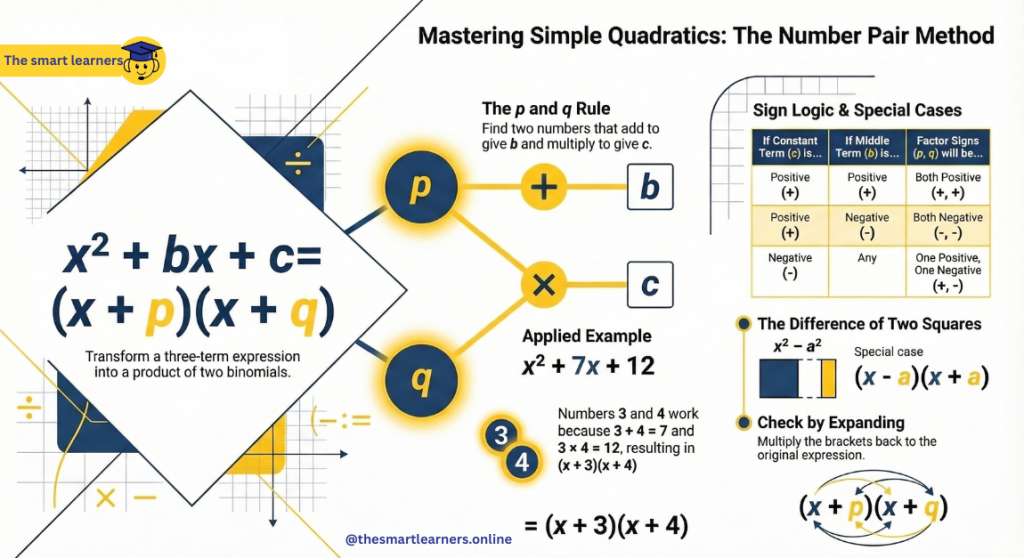
Simple quadratics are expressions of the form x² + bx + c where the coefficient of x² is 1. Factorizing means writing it as a product of two brackets: (x + p)(x + q) where p + q = b and p × q = c.

General form: x² + bx + c = (x + p)(x + q)
where: p + q = b and p × q = c
Example: x² + 7x + 12 = (x + 3)(x + 4)
Check: 3 + 4 = 7 ✓, 3 × 4 = 12 ✓

🎨 The Number Pair Method

x² + 7x + 12
↓ Find two numbers that:
Add to give b = 7
3 + 4 = 7
&
Multiply to give c = 12
3 × 4 = 12
(x + 3)(x + 4)

📚 Types of Simple Quadratics

➕ Both numbers positive

When b and c are both positive, both p and q are positive.

Example 1: x² + 5x + 6

Step 1: Find factors of 6 that add to 5

Factors of 6: 1×6, 2×3

Step 2: Check which pair adds to 5: 2 + 3 = 5 ✓

Step 3: Write as: (x + 2)(x + 3)

Check: (x+2)(x+3) = x² + 3x + 2x + 6 = x² + 5x + 6 ✓

Example 2: x² + 7x + 12

Step 1: Find factors of 12 that add to 7

Factors of 12: 1×12, 2×6, 3×4

Step 2: Check pairs: 3 + 4 = 7 ✓

Step 3: Write as: (x + 3)(x + 4)

Example 3: x² + 8x + 15

Step 1: Find factors of 15 that add to 8

Factors of 15: 1×15, 3×5

Step 2: 3 + 5 = 8 ✓

Step 3: (x + 3)(x + 5)

➖ One number negative

When c is negative, one factor is positive and one is negative.

Example 1: x² + 2x - 15

Step 1: Find factors of -15 that add to +2

Factor pairs of 15: 1×15, 3×5

Since product is negative, one factor positive, one negative

Step 2: Try pairs: (-3,5): -3+5=2 ✓, (-5,3): -5+3=-2 ✗

Step 3: (x - 3)(x + 5)

Check: (x-3)(x+5) = x² + 5x - 3x -15 = x² + 2x -15 ✓

Example 2: x² - 4x - 12

Step 1: Find factors of -12 that add to -4

Factor pairs of 12: 1×12, 2×6, 3×4

Step 2: Try pairs: (-6,2): -6+2=-4 ✓, (-4,3): -4+3=-1 ✗

Step 3: (x - 6)(x + 2)

Example 3: x² - x - 20

Step 1: Find factors of -20 that add to -1

Factor pairs of 20: 1×20, 2×10, 4×5

Step 2: Try (-5,4): -5+4=-1 ✓

Step 3: (x - 5)(x + 4)

➖➖ Both numbers negative

When b is negative and c is positive, both numbers are negative.

Example 1: x² - 7x + 12

Step 1: Find factors of +12 that add to -7

Factor pairs of 12: 1×12, 2×6, 3×4

Since sum is negative, both factors must be negative

Step 2: Try pairs: (-3,-4): -3-4=-7 ✓

Step 3: (x - 3)(x - 4)

Check: (x-3)(x-4) = x² - 4x - 3x +12 = x² -7x +12 ✓

Example 2: x² - 8x + 15

Step 1: Factors of 15 that add to -8: (-3,-5)

Step 2: (x - 3)(x - 5)

Example 3: x² - 9x + 20

Step 1: Factors of 20 that add to -9: (-4,-5)

Step 2: (x - 4)(x - 5)

🔄 Difference of Two Squares

Special case: x² - a² = (x - a)(x + a)

Example 1: x² - 9

Step 1: Recognize as difference of squares: x² - 3²

Step 2: (x - 3)(x + 3)

Check: (x-3)(x+3) = x² + 3x - 3x - 9 = x² - 9 ✓

Example 2: x² - 25

Step 1: x² - 5²

Step 2: (x - 5)(x + 5)

Example 3: x² - 16

Step 1: x² - 4²

Step 2: (x - 4)(x + 4)

📊 Common Factor Pairs

c (constant term) Factor Pairs Sum (b)
6 (1,6), (2,3) 7, 5
12 (1,12), (2,6), (3,4) 13, 8, 7
20 (1,20), (2,10), (4,5) 21, 12, 9
-6 (-1,6), (1,-6), (-2,3), (2,-3) 5, -5, 1, -1
c (constant term) Factor Pairs Sum (b)
8(1,8), (2,4)9, 6
10(1,10), (2,5)11, 7
18(1,18), (2,9), (3,6)19, 11, 9
24(1,24), (2,12), (3,8), (4,6)25, 14, 11, 10

🧮 Interactive Quadratic Factorizer

Enter a quadratic and see how it factorizes step-by-step!

✏️ Practice Factorizing Quadratics

Factorize: x² + 7x + 12

Correct: 0 Attempted: 0

⚠️ Common Mistakes

❌ Wrong: Mixing up signs

x² - 5x + 6 = (x - 2)(x - 3) ✓

x² - 5x + 6 = (x + 2)(x + 3) ❌ (gives +5x)

✅ Correct: Check signs carefully

If c positive and b negative → both factors negative

If c negative → one factor positive, one negative

❌ Wrong: Wrong factor pair

x² + 7x + 12 = (x + 2)(x + 6) ❌ (2×6=12 but 2+6=8, not 7)

Correct: (x + 3)(x + 4) ✓

⚠️ Forgetting the difference of squares

x² - 16 = (x - 4)(x + 4), not (x - 4)²

🌍 Where Quadratics Appear

📐 Area Problems

A rectangle has area x² + 5x + 6

Length = x + 3, Width = x + 2

Area = (x+3)(x+2) = x² + 5x + 6

🎯 Projectile Motion

Height = -5t² + 20t + 25

Factor to find when height = 0

💰 Profit Maximization

Profit = -x² + 100x - 2400

Factor to find break-even points

factorizing by grouping the smart learners online tutoring mathematics
Mathematics

Factorizing by Grouping

Factorizing by Grouping - GCSE Mathematics | The Smart Learners

Factorizing by Grouping

GCSE Mathematics (Higher)

🤝 What is Factorizing by Grouping?

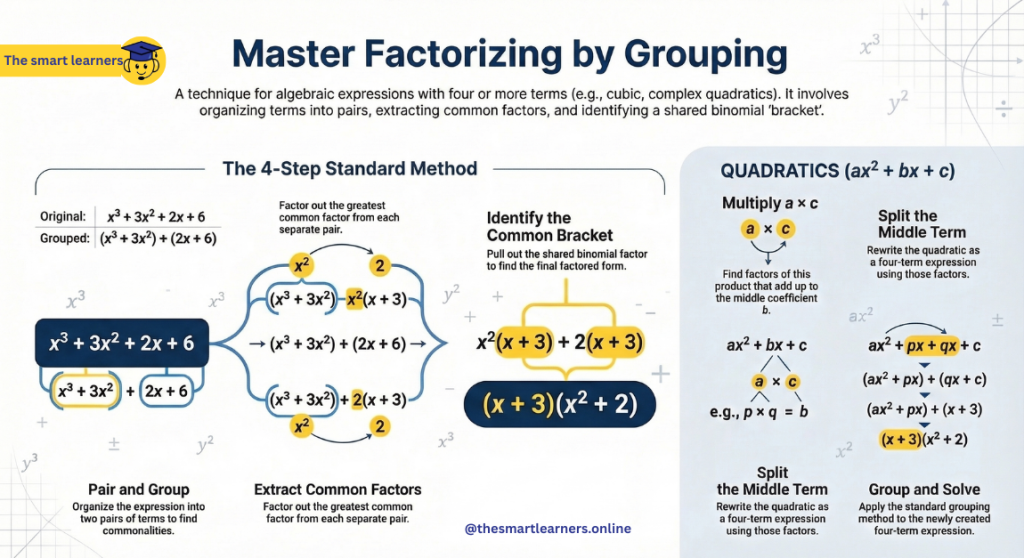
Factorizing by grouping is a method used when an expression has four or more terms. We group terms in pairs, factor out common factors from each pair, and then look for a common bracket that appears in both groups. This method is especially useful for cubic expressions and quadratics where the coefficient of x² is greater than 1.

Example: x³ + 2x² + 3x + 6
= (x³ + 2x²) + (3x + 6)
= x²(x + 2) + 3(x + 2)
= (x + 2)(x² + 3)

🎨 Visualizing Grouping

x³ + 2x² + 3x + 6
↓ Group into pairs ↓

First Group

(x³ + 2x²)

Factor out x²

x²(x + 2)

Second Group

(3x + 6)

Factor out 3

3(x + 2)
↓ Notice common factor (x + 2) ↓
(x + 2)(x² + 3)

📚 Types of Grouping

4️⃣ Four Terms - Basic Grouping

Group the first two terms and last two terms, then factor each group.

Example 1: x³ + 3x² + 2x + 6

Step 1: Group terms: (x³ + 3x²) + (2x + 6)

Step 2: Factor each group:

First group: x²(x + 3)

Second group: 2(x + 3)

Step 3: Notice common factor (x + 3)

Step 4: Write as: (x + 3)(x² + 2)

Check: (x + 3)(x² + 2) = x³ + 2x + 3x² + 6 = x³ + 3x² + 2x + 6 ✓

Example 2: 2x³ + 4x² + 3x + 6

Step 1: Group terms: (2x³ + 4x²) + (3x + 6)

Step 2: Factor each group:

First group: 2x²(x + 2)

Second group: 3(x + 2)

Step 3: Notice common factor (x + 2)

Step 4: Write as: (x + 2)(2x² + 3)

Example 3: x³ + x² + 4x + 4

Step 1: Group terms: (x³ + x²) + (4x + 4)

Step 2: Factor each group:

First group: x²(x + 1)

Second group: 4(x + 1)

Step 3: Notice common factor (x + 1)

Step 4: Write as: (x + 1)(x² + 4)

📐 Quadratic Expressions (ax² + bx + c where a > 1)

For quadratics like 2x² + 7x + 3, we split the middle term and then group.

Example 1: 2x² + 7x + 3

Step 1: Multiply a × c = 2 × 3 = 6

Step 2: Find factors of 6 that add to 7: 6 and 1

Step 3: Split middle term: 2x² + 6x + 1x + 3

Step 4: Group: (2x² + 6x) + (x + 3)

Step 5: Factor each group:

First group: 2x(x + 3)

Second group: 1(x + 3)

Step 6: Common factor (x + 3): (x + 3)(2x + 1)

Example 2: 3x² + 10x + 8

Step 1: Multiply a × c = 3 × 8 = 24

Step 2: Find factors of 24 that add to 10: 6 and 4

Step 3: Split middle term: 3x² + 6x + 4x + 8

Step 4: Group: (3x² + 6x) + (4x + 8)

Step 5: Factor each group:

First group: 3x(x + 2)

Second group: 4(x + 2)

Step 6: Common factor (x + 2): (x + 2)(3x + 4)

Example 3: 6x² + 13x + 5

Step 1: Multiply a × c = 6 × 5 = 30

Step 2: Find factors of 30 that add to 13: 10 and 3

Step 3: Split middle term: 6x² + 10x + 3x + 5

Step 4: Group: (6x² + 10x) + (3x + 5)

Step 5: Factor each group:

First group: 2x(3x + 5)

Second group: 1(3x + 5)

Step 6: Common factor (3x + 5): (3x + 5)(2x + 1)

📦 Cubic Expressions

Cubics often factorize nicely by grouping pairs.

Example 1: x³ - 2x² + 3x - 6

Step 1: Group terms: (x³ - 2x²) + (3x - 6)

Step 2: Factor each group:

First group: x²(x - 2)

Second group: 3(x - 2)

Step 3: Notice common factor (x - 2)

Step 4: Write as: (x - 2)(x² + 3)

Example 2: 2x³ + 4x² - 3x - 6

Step 1: Group terms: (2x³ + 4x²) + (-3x - 6)

Step 2: Factor each group:

First group: 2x²(x + 2)

Second group: -3(x + 2) [since -3x - 6 = -3(x + 2)]

Step 3: Notice common factor (x + 2)

Step 4: Write as: (x + 2)(2x² - 3)

Example 3: x³ + 2x² - 4x - 8

Step 1: Group terms: (x³ + 2x²) + (-4x - 8)

Step 2: Factor each group:

First group: x²(x + 2)

Second group: -4(x + 2)

Step 3: Notice common factor (x + 2)

Step 4: Write as: (x + 2)(x² - 4)

Step 5: Notice x² - 4 is difference of squares: (x - 2)(x + 2)

Final: (x + 2)(x - 2)(x + 2) = (x + 2)²(x - 2)

➖ Working with Negatives

Be careful when grouping terms with negative signs.

Example 1: x³ - 3x² - 2x + 6

Step 1: Group terms: (x³ - 3x²) + (-2x + 6)

Step 2: Factor each group:

First group: x²(x - 3)

Second group: -2(x - 3) [since -2x + 6 = -2(x - 3)]

Step 3: Notice common factor (x - 3)

Step 4: Write as: (x - 3)(x² - 2)

Example 2: 2x³ - 4x² - 3x + 6

Step 1: Group terms: (2x³ - 4x²) + (-3x + 6)

Step 2: Factor each group:

First group: 2x²(x - 2)

Second group: -3(x - 2)

Step 3: Notice common factor (x - 2)

Step 4: Write as: (x - 2)(2x² - 3)

Example 3: x³ - 2x² - 4x + 8

Step 1: Group terms: (x³ - 2x²) + (-4x + 8)

Step 2: Factor each group:

First group: x²(x - 2)

Second group: -4(x - 2)

Step 3: Notice common factor (x - 2)

Step 4: Write as: (x - 2)(x² - 4)

Step 5: x² - 4 = (x - 2)(x + 2)

Final: (x - 2)(x - 2)(x + 2) = (x - 2)²(x + 2)

🧮 Interactive Grouping Calculator

Enter an expression and see how to factorize by grouping!

✏️ Practice Factorizing by Grouping

Factorize by grouping: x³ + 3x² + 2x + 6

Correct: 0 Attempted: 0

⚠️ When Grouping Doesn't Work

Sometimes expressions can't be factorized by simple grouping. Try:

  • Reordering the terms differently
  • Looking for common factors in all terms first
  • Using other methods (quadratic formula, factor theorem)

Example: x³ + 2x² + 3x + 5

Try grouping: (x³ + 2x²) + (3x + 5)

= x²(x + 2) + (3x + 5) ← No common factor

Try different grouping: (x³ + 3x) + (2x² + 5)

= x(x² + 3) + (2x² + 5) ← Still no common factor

This expression doesn't factorize nicely by grouping.

🌍 Why Grouping Matters

🧮 Solving Higher Degree Equations

x³ + 2x² - 4x - 8 = 0

Group: (x³ + 2x²) + (-4x - 8) = 0

= x²(x + 2) - 4(x + 2) = 0

= (x + 2)(x² - 4) = 0

= (x + 2)(x - 2)(x + 2) = 0

Solutions: x = -2, x = 2

📊 Calculus - Finding Turning Points

Derivative: f'(x) = 3x² + 6x - 9

Group: 3(x² + 2x - 3)

= 3(x + 3)(x - 1)

🔬 Physics - Volume Problems

Volume = x³ + 3x² + 2x

= x(x² + 3x + 2)

= x(x + 1)(x + 2)

Dimensions of a box

Factorizing out terms online tutoring the smart learners mathematics
Mathematics

Factorizing out terms

Factorizing Out Terms - GCSE Mathematics | The Smart Learners

Factorizing Out Terms

GCSE Mathematics

📦 What is Factorizing?

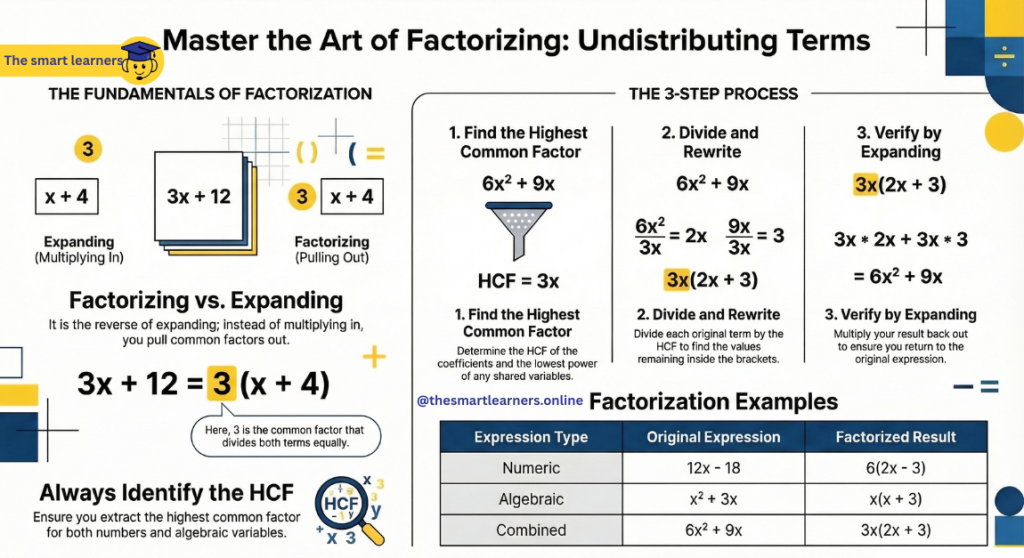
Factorizing (or factoring) is the opposite of expanding brackets. It means finding a common factor that divides all terms and writing the expression as a product of this factor and another expression. Think of it as "undistributing" or pulling out what's common.

Expanding: 3(x + 4) = 3x + 12
Factorizing: 3x + 12 = 3(x + 4)
Common factor: 3 divides both 3x and 12

🎨 Visualizing Factorization

6x + 9
3(2x + 3)

Step 1: Find HCF of 6 and 9

HCF = 3

Step 2: Divide each term by 3

6x ÷ 3 = 2x

9 ÷ 3 = 3

Step 3: Write as product

3(2x + 3)

📚 Types of Factorization

🔢 Factorizing Numeric Factors

Find the highest common factor (HCF) of the coefficients.

Example 1: 4x + 8

Step 1: Find HCF of 4 and 8 = 4

Step 2: Divide each term: 4x ÷ 4 = x, 8 ÷ 4 = 2

Step 3: Write as product: 4(x + 2)

Check: 4(x + 2) = 4x + 8 ✓

Example 2: 6x + 9

Step 1: Find HCF of 6 and 9 = 3

Step 2: Divide each term: 6x ÷ 3 = 2x, 9 ÷ 3 = 3

Step 3: Write as product: 3(2x + 3)

Check: 3(2x + 3) = 6x + 9 ✓

Example 3: 12x - 18

Step 1: Find HCF of 12 and 18 = 6

Step 2: Divide each term: 12x ÷ 6 = 2x, -18 ÷ 6 = -3

Step 3: Write as product: 6(2x - 3)

Check: 6(2x - 3) = 12x - 18 ✓

🔤 Factorizing Algebraic Factors

Find the common variable factor (lowest power of the variable).

Example 1: x² + 3x

Step 1: Find common variable factor: x (lowest power is x¹)

Step 2: Divide each term: x² ÷ x = x, 3x ÷ x = 3

Step 3: Write as product: x(x + 3)

Check: x(x + 3) = x² + 3x ✓

Example 2: 2y³ + 4y²

Step 1: Find common variable factor: y² (lowest power is y²)

Step 2: Divide each term: 2y³ ÷ y² = 2y, 4y² ÷ y² = 4

Step 3: Write as product: y²(2y + 4)

Check: y²(2y + 4) = 2y³ + 4y² ✓

Example 3: 5a⁴ - 10a³

Step 1: Find common variable factor: a³ (lowest power is a³)

Step 2: Divide each term: 5a⁴ ÷ a³ = 5a, -10a³ ÷ a³ = -10

Step 3: Write as product: a³(5a - 10)

Check: a³(5a - 10) = 5a⁴ - 10a³ ✓

🔢🔤 Both Numeric and Algebraic Factors

Find HCF of coefficients AND common variable factors.

Example 1: 6x² + 9x

Step 1: Find HCF of 6 and 9 = 3

Step 2: Find common variable: x (lowest power x¹)

Step 3: Common factor = 3x

Step 4: Divide each term: 6x² ÷ 3x = 2x, 9x ÷ 3x = 3

Step 5: Write as product: 3x(2x + 3)

Check: 3x(2x + 3) = 6x² + 9x ✓

Example 2: 12y³ - 8y²

Step 1: Find HCF of 12 and 8 = 4

Step 2: Find common variable: y² (lowest power y²)

Step 3: Common factor = 4y²

Step 4: Divide each term: 12y³ ÷ 4y² = 3y, -8y² ÷ 4y² = -2

Step 5: Write as product: 4y²(3y - 2)

Check: 4y²(3y - 2) = 12y³ - 8y² ✓

Example 3: 15a⁴ + 10a³ - 5a²

Step 1: Find HCF of 15, 10, and 5 = 5

Step 2: Find common variable: a² (lowest power a²)

Step 3: Common factor = 5a²

Step 4: Divide each term: 15a⁴ ÷ 5a² = 3a², 10a³ ÷ 5a² = 2a, -5a² ÷ 5a² = -1

Step 5: Write as product: 5a²(3a² + 2a - 1)

Check: 5a²(3a² + 2a - 1) = 15a⁴ + 10a³ - 5a² ✓

➖ Factorizing Negative Factors

Sometimes it's useful to factor out a negative to make the expression cleaner.

Example 1: -3x - 6

Option 1: Factor out -3

-3x - 6 = -3(x + 2)

Check: -3(x + 2) = -3x - 6 ✓

Option 2: Factor out 3

-3x - 6 = 3(-x - 2)

Example 2: -5x² + 10x

Factor out -5x:

-5x² + 10x = -5x(x - 2)

Check: -5x(x - 2) = -5x² + 10x ✓

🧮 Interactive Factor Finder

Enter an expression and find its factors step-by-step!

✏️ Practice Factorizing

Factorize completely: 6x + 9

Correct: 0 Attempted: 0

⚠️ Common Mistakes

❌ Wrong: Not taking out the highest common factor

6x + 9 = 3(2x + 3) ✓

6x + 9 = 2(3x + 4.5) ❌ (not fully factorized)

✅ Correct: Always take out the HCF

12x² - 8x = 4x(3x - 2) ✓

❌ Wrong: Forgetting the variable factor

x² + 3x = x(x + 3) ✓

x² + 3x = 3x(x/3 + 1) ❌ (not simplest form)

⚠️ Check your answer by expanding!

Always multiply back to check you get the original expression

❌ Wrong: Sign errors

-3x - 6 = -3(x + 2) ✓

-3x - 6 = 3(-x - 2) ✓ (also correct but less common)

🌍 Why Factorizing Matters

🧮 Solving Equations

x² + 5x = 0

Factor: x(x + 5) = 0

Solutions: x = 0 or x = -5

📊 Simplifying Fractions

(6x² + 9x) / (3x)

= 3x(2x + 3) / (3x)

= 2x + 3

📐 Finding Areas

Rectangle area = 4x² + 8x

= 4x(x + 2)

Length = 4x, Width = x + 2

The Smart Learners online tutoring triple brackets mathematics
Mathematics

Expanding Triple Brackets

Expanding Triple Brackets

GCSE Mathematics (Higher)

📦 What are Triple Brackets?

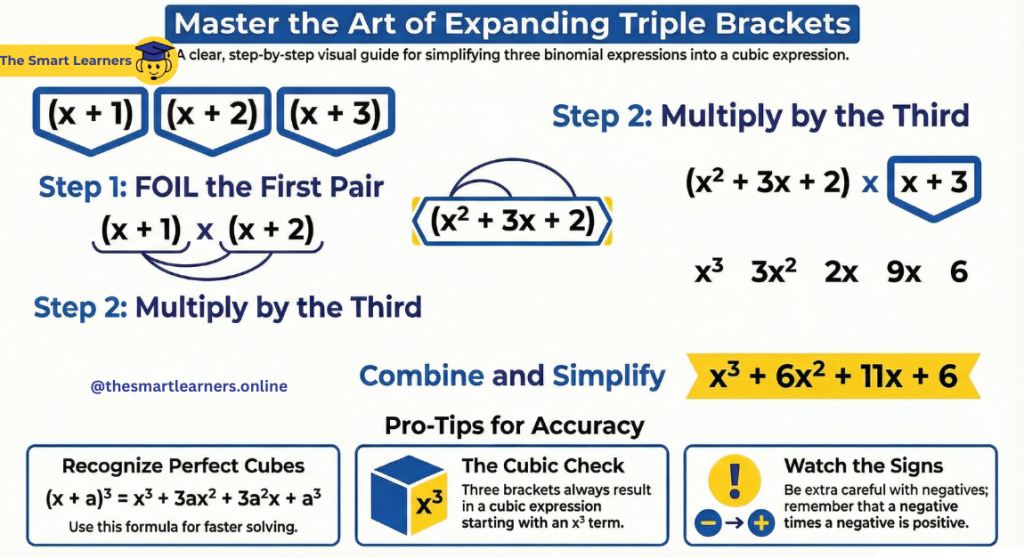
Expanding triple brackets means multiplying three binomial expressions together. The process involves expanding two brackets first, then multiplying the result by the third bracket. This topic is typically for Higher GCSE students.

Example: (x + 1)(x + 2)(x + 3)
Step 1: (x + 1)(x + 2) = x² + 3x + 2
Step 2: (x² + 3x + 2)(x + 3) = x³ + 6x² + 11x + 6

🔢 The Method: Step by Step

Step 1: Expand any two brackets first

Choose any two brackets to expand first using FOIL method.

(x + 1) × (x + 2) = x² + 3x + 2

FOIL expansion:

F: x × x = x²

O: x × 2 = 2x

I: 1 × x = 1x

L: 1 × 2 = 2

x² + 2x + 1x + 2 = x² + 3x + 2

Step 2: Multiply the result by the third bracket

Now multiply your quadratic by the remaining bracket.

(x² + 3x + 2) × (x + 3) = x³ + 6x² + 11x + 6

Multiply each term:

x² × (x + 3) = x³ + 3x²

3x × (x + 3) = 3x² + 9x

2 × (x + 3) = 2x + 6

Add like terms:

x³ + (3x² + 3x²) + (9x + 2x) + 6

= x³ + 6x² + 11x + 6

📚 Types of Triple Brackets

➕ All Brackets Positive

All terms are positive - the most straightforward type.

Example 1: (x + 1)(x + 2)(x + 3)

Step 1: (x + 1)(x + 2) = x² + 3x + 2

Step 2: (x² + 3x + 2)(x + 3)

= x³ + 3x² + 3x² + 9x + 2x + 6

= x³ + 6x² + 11x + 6

Example 2: (x + 2)(x + 3)(x + 4)

Step 1: (x + 2)(x + 3) = x² + 5x + 6

Step 2: (x² + 5x + 6)(x + 4)

= x³ + 4x² + 5x² + 20x + 6x + 24

= x³ + 9x² + 26x + 24

Example 3: (x + 1)(x + 3)(x + 5)

Step 1: (x + 1)(x + 3) = x² + 4x + 3

Step 2: (x² + 4x + 3)(x + 5)

= x³ + 5x² + 4x² + 20x + 3x + 15

= x³ + 9x² + 23x + 15

➖ With Negative Signs

Be careful with signs! Negative × Negative = Positive.

Example 1: (x - 1)(x + 2)(x + 3)

Step 1: (x - 1)(x + 2) = x² + 2x - x - 2 = x² + x - 2

Step 2: (x² + x - 2)(x + 3)

= x³ + 3x² + x² + 3x - 2x - 6

= x³ + 4x² + x - 6

Example 2: (x - 2)(x + 3)(x - 4)

Step 1: (x - 2)(x + 3) = x² + 3x - 2x - 6 = x² + x - 6

Step 2: (x² + x - 6)(x - 4)

= x³ - 4x² + x² - 4x - 6x + 24

= x³ - 3x² - 10x + 24

Example 3: (x - 1)(x - 2)(x - 3)

Step 1: (x - 1)(x - 2) = x² - 2x - x + 2 = x² - 3x + 2

Step 2: (x² - 3x + 2)(x - 3)

= x³ - 3x² - 3x² + 9x + 2x - 6

= x³ - 6x² + 11x - 6

🔢 With Coefficients

Multiply coefficients carefully and use index laws.

Example 1: (2x + 1)(x + 2)(x + 3)

Step 1: (2x + 1)(x + 2) = 2x² + 4x + x + 2 = 2x² + 5x + 2

Step 2: (2x² + 5x + 2)(x + 3)

= 2x³ + 6x² + 5x² + 15x + 2x + 6

= 2x³ + 11x² + 17x + 6

Example 2: (3x - 1)(x + 2)(2x - 3)

Step 1: (3x - 1)(x + 2) = 3x² + 6x - x - 2 = 3x² + 5x - 2

Step 2: (3x² + 5x - 2)(2x - 3)

= 6x³ - 9x² + 10x² - 15x - 4x + 6

= 6x³ + x² - 19x + 6

⬆️ Perfect Cubes

When all three brackets are the same: (x + a)³

Example 1: (x + 2)³

(x + 2)³ = (x + 2)(x + 2)(x + 2)

Step 1: (x + 2)(x + 2) = x² + 4x + 4

Step 2: (x² + 4x + 4)(x + 2)

= x³ + 2x² + 4x² + 8x + 4x + 8

= x³ + 6x² + 12x + 8

Formula: (x + a)³ = x³ + 3ax² + 3a²x + a³

Example 2: (x - 1)³

(x - 1)³ = (x - 1)(x - 1)(x - 1)

Step 1: (x - 1)(x - 1) = x² - 2x + 1

Step 2: (x² - 2x + 1)(x - 1)

= x³ - x² - 2x² + 2x + x - 1

= x³ - 3x² + 3x - 1

🧮 Interactive Triple Bracket Expander

Enter your own triple brackets and see them expand step-by-step!

✏️ Practice Triple Brackets

Expand: (x + 1)(x + 2)(x + 3)

Correct: 0 Attempted: 0

🎯 Common Patterns to Recognize

Pattern 1: Consecutive numbers

(x + n)(x + n+1)(x + n+2)

(x + 1)(x + 2)(x + 3) = x³ + 6x² + 11x + 6

The coefficients follow a pattern: 1, 6, 11, 6

Pattern 2: Symmetric brackets

(x + a)(x + b)(x + c) where a + b + c = constant

(x + 1)(x + 2)(x + 4) = x³ + 7x² + 14x + 8

Notice: 1 + 2 + 4 = 7 (coefficient of x²)

online tutoring the smart learners double brackets mathematics Math
Mathematics

Expanding Double Brackets

Expanding Double Brackets

GCSE Mathematics

📦 What are Double Brackets?

Expanding double brackets means multiplying two binomial expressions together. Every term in the first bracket must be multiplied by every term in the second bracket. The common method is FOIL: First, Outer, Inner, Last.

Formula: (a + b)(c + d) = ac + ad + bc + bd
Example: (x + 3)(x + 4) = x² + 4x + 3x + 12 = x² + 7x + 12

🌈 The FOIL Method

(x + 3)(x + 4)
First
x × x = x²
Outer
x × 4 = 4x
Inner
3 × x = 3x
Last
3 × 4 = 12
x² + 4x + 3x + 12 = x² + 7x + 12

📚 Types of Double Brackets

➕ Both Brackets Positive

All terms are positive - straightforward multiplication.

Example 1

(x + 2)(x + 5)

= x×x + x×5 + 2×x + 2×5

= x² + 5x + 2x + 10

= x² + 7x + 10

Example 2

(x + 3)(x + 7)

= x² + 7x + 3x + 21

= x² + 10x + 21

Example 3

(x + 4)(x + 6)

= x² + 6x + 4x + 24

= x² + 10x + 24

➖ With Negative Signs

Be careful with signs! Negative × Negative = Positive.

Example 1

(x - 2)(x + 5)

= x×x + x×5 + (-2)×x + (-2)×5

= x² + 5x - 2x - 10

= x² + 3x - 10

Example 2

(x + 3)(x - 4)

= x² - 4x + 3x - 12

= x² - x - 12

Example 3

(x - 3)(x - 5)

= x² - 5x - 3x + 15

= x² - 8x + 15

🔢 With Coefficients

Multiply coefficients together and use index laws for variables.

Example 1

(2x + 3)(x + 4)

= 2x×x + 2x×4 + 3×x + 3×4

= 2x² + 8x + 3x + 12

= 2x² + 11x + 12

Example 2

(3x - 2)(2x + 5)

= 3x×2x + 3x×5 + (-2)×2x + (-2)×5

= 6x² + 15x - 4x - 10

= 6x² + 11x - 10

Example 3

(4x - 1)(3x - 2)

= 4x×3x + 4x×(-2) + (-1)×3x + (-1)×(-2)

= 12x² - 8x - 3x + 2

= 12x² - 11x + 2

⬆️ Perfect Squares

When both brackets are the same: (a + b)² = a² + 2ab + b²

Example 1

(x + 3)²

= (x + 3)(x + 3)

= x² + 3x + 3x + 9

= x² + 6x + 9

Example 2

(2x - 5)²

= (2x - 5)(2x - 5)

= 4x² - 10x - 10x + 25

= 4x² - 20x + 25

Formula

(a + b)² = a² + 2ab + b²

(a - b)² = a² - 2ab + b²

🔄 Difference of Squares

When brackets are (a + b)(a - b): The middle terms cancel!

Example 1

(x + 3)(x - 3)

= x² - 3x + 3x - 9

= x² - 9

Example 2

(2x + 5)(2x - 5)

= 4x² - 10x + 10x - 25

= 4x² - 25

Formula

(a + b)(a - b) = a² - b²

🧮 Interactive Double Bracket Expander

Enter your own double brackets and see them expand step-by-step!

×

✏️ Practice Expanding Double Brackets

Expand and simplify: (x + 3)(x + 4)

Correct: 0 Attempted: 0

🌟 Challenge Questions

Expand and simplify: (2x + 3)(3x - 4)

Expand and simplify: (3x - 2)(2x - 5)

Expand and simplify: (4x + 3)²

⚠️ Common Mistakes

❌ Wrong: Only multiplying First and Last

(x + 3)(x + 4) = x² + 12 ❌

Correct: x² + 4x + 3x + 12 = x² + 7x + 12

✅ Correct: Use FOIL

First: x × x = x²

Outer: x × 4 = 4x

Inner: 3 × x = 3x

Last: 3 × 4 = 12

❌ Wrong: Sign errors

(x - 3)(x + 4) = x² + 4x - 3x - 12 ❌

Wait, that's actually correct! But some forget: (-3)×4 = -12

⚠️ Forgetting to simplify

Always combine like terms (the Outer and Inner terms)

❌ Wrong: Messing up coefficients

(2x + 3)(3x + 4) = 2x×3x + 2x×4 + 3×3x + 3×4

= 6x² + 8x + 9x + 12 = 6x² + 17x + 12

🌍 Where Double Brackets Are Used

📐 Area of Rectangle

Length = (x + 5), Width = (x + 3)

Area = (x + 5)(x + 3)

= x² + 3x + 5x + 15

= x² + 8x + 15

🏢 Building Design

Floor dimensions: (2x + 10) by (3x + 5)

Area = 6x² + 10x + 30x + 50

= 6x² + 40x + 50

💰 Profit Calculation

Profit = (price - cost) × quantity

If price = (x + 20), quantity = (x + 100)

Profit expands to quadratic

expanding single brackets online tutoring the smart learners mathematics
Mathematics

Expanding & Simplifying Single Brackets

Expanding & Simplifying Single Brackets - GCSE Mathematics | The Smart Learners

Expanding & Simplifying Single Brackets

GCSE Mathematics

📦 What is Expanding Brackets?

Expanding brackets (or multiplying out) means removing the brackets by multiplying everything inside the brackets by the term outside. It's like distributing items from a box to everyone - each term inside gets multiplied by the term outside.

Rule: a(b + c) = a × b + a × c = ab + ac
Example: 3(x + 4) = 3 × x + 3 × 4 = 3x + 12

🎨 Visualizing Expansion

3 ( x + 4 )

↓ Multiply each term inside by 3 ↓

3 × x = 3x
+
3 × 4 = 12
3x + 12

📚 Types of Brackets

➕ Positive Number Outside

Multiply the positive number by each term inside.

Example 1

4(x + 3)

= 4 × x + 4 × 3

= 4x + 12

Example 2

5(2x + 4)

= 5 × 2x + 5 × 4

= 10x + 20

Example 3

3(3x + 2y)

= 3 × 3x + 3 × 2y

= 9x + 6y

➖ Negative Number Outside

Be careful with signs! Negative × positive = negative, Negative × negative = positive.

Example 1

-3(x + 4)

= (-3) × x + (-3) × 4

= -3x - 12

Example 2

-2(3x - 5)

= (-2) × 3x + (-2) × (-5)

= -6x + 10

Example 3

-4(2x + 3y)

= (-4) × 2x + (-4) × 3y

= -8x - 12y

🔤 Variable Outside

Multiply the variable by each term inside (remember laws of indices).

Example 1

x(x + 5)

= x × x + x × 5

= x² + 5x

Example 2

2x(3x - 4)

= 2x × 3x + 2x × (-4)

= 6x² - 8x

Example 3

3y(2y + 4z)

= 3y × 2y + 3y × 4z

= 6y² + 12yz

🔢 Both Number & Variable

Multiply both the number and variable parts separately.

Example 1

3x(2x + 5)

= 3x × 2x + 3x × 5

= 6x² + 15x

Example 2

-2x(3x - 4y)

= (-2x) × 3x + (-2x) × (-4y)

= -6x² + 8xy

Example 3

4xy(2x + 3y)

= 4xy × 2x + 4xy × 3y

= 8x²y + 12xy²

🧮 Interactive Bracket Expander

Enter your own expression and see it expand step-by-step!

✏️ Practice Expanding Brackets

Expand and simplify: 3(x + 4)

Correct: 0 Attempted: 0

🔄 Expanding and Then Simplifying

Sometimes after expanding, you need to collect like terms:

Example 1

2(x + 3) + 3(x + 2)

Step 1: Expand both brackets

= 2x + 6 + 3x + 6

Step 2: Collect like terms

= (2x + 3x) + (6 + 6)

= 5x + 12

Example 2

4(x - 2) - 2(x + 1)

Step 1: Expand both brackets

= 4x - 8 - 2x - 2

Step 2: Collect like terms

= (4x - 2x) + (-8 - 2)

= 2x - 10

Example 3

3x(2x + 1) - 2x(x - 4)

Step 1: Expand both brackets

= 6x² + 3x - 2x² + 8x

Step 2: Collect like terms

= (6x² - 2x²) + (3x + 8x)

= 4x² + 11x

⚠️ Common Mistakes

❌ Wrong: Only multiplying the first term

3(x + 4) = 3x + 4 ❌

Correct: 3(x + 4) = 3x + 12

✅ Correct: Multiply every term inside

3(x + 4) = 3 × x + 3 × 4 = 3x + 12

❌ Wrong: Sign errors with negatives

-2(x - 3) = -2x - 6 ❌

Correct: -2(x - 3) = -2x + 6

⚠️ Remember: Negative × Negative = Positive

(-3) × (-4) = +12

❌ Wrong: Forgetting to multiply coefficients

2x(3x + 4) = 2x² + 8x ❌

Correct: 2x(3x + 4) = 6x² + 8x

🌍 Where Bracket Expansion is Used

📏 Area Calculation

Rectangle with length (x+3) and width 4:

Area = 4(x + 3) = 4x + 12

💰 Perimeter Problems

Rectangle with sides (x+2) and (x+1):

Perimeter = 2(x+2) + 2(x+1)

= 2x+4 + 2x+2 = 4x+6

📊 Cost Calculations

Buying x items at price (p+2) each:

Total = x(p+2) = xp + 2x

Exponents and Indices and powers the smart learners mathematics online tutoring
Mathematics

Algebraic Roots and indices

Algebraic Roots and Indices - GCSE Mathematics | The Smart Learners

Algebraic Roots and Indices

GCSE Mathematics

📐 What are Roots and Indices?

Indices (or exponents) show how many times a number is multiplied by itself. Roots are the inverse operation - finding which number multiplied by itself gives the original number. Together, they form the foundation of powers and surds in algebra.

Index (Power): 5³ = 5 × 5 × 5 = 125
Root: √25 = 5 (because 5 × 5 = 25)
Algebraic: x⁴ × x³ = x⁷

📏 Laws of Indices

✖️ Law 1: Multiplication (Add indices)

aᵐ × aⁿ = aᵐ⁺ⁿ

Example 1

x³ × x⁴ = x³⁺⁴ = x⁷

Example 2

y² × y⁵ = y²⁺⁵ = y⁷

Example 3

3x² × 2x⁴ = (3×2)x²⁺⁴ = 6x⁶

➗ Law 2: Division (Subtract indices)

aᵐ ÷ aⁿ = aᵐ⁻ⁿ

Example 1

x⁷ ÷ x³ = x⁷⁻³ = x⁴

Example 2

y⁶ ÷ y² = y⁶⁻² = y⁴

Example 3

12x⁵ ÷ 3x² = (12÷3)x⁵⁻² = 4x³

⬆️ Law 3: Power of a Power (Multiply indices)

(aᵐ)ⁿ = aᵐ×ⁿ

Example 1

(x³)² = x³×² = x⁶

Example 2

(y⁴)³ = y⁴׳ = y¹²

Example 3

(2x²)³ = 2³ × (x²)³ = 8x⁶

➖ Law 4: Negative Indices

a⁻ⁿ = 1/aⁿ

Example 1

x⁻³ = 1/x³

Example 2

2y⁻⁴ = 2/y⁴

Example 3

(2x)⁻² = 1/(2x)² = 1/(4x²)

0️⃣ Law 5: Zero Index

a⁰ = 1 (where a ≠ 0)

Example 1

x⁰ = 1

Example 2

5⁰ = 1

Example 3

(2x³)⁰ = 1

√ Roots and Surds

🔲 Square Roots

√a × √a = a

√16 = 4 (because 4² = 16)

√x⁶ = x³ (because (x³)² = x⁶)

📦 Cube Roots

∛a × ∛a × ∛a = a

∛27 = 3 (because 3³ = 27)

∛x⁹ = x³ (because (x³)³ = x⁹)

🔄 Fractional Indices

a^(1/n) = ⁿ√a

x^(1/2) = √x

x^(1/3) = ∛x

🧮 Interactive Indices Calculator

Enter expressions and see how indices laws work!

✏️ Practice Questions

Simplify: x³ × x⁴

Score: 0 Attempted: 0

🌟 Challenge Problems

Simplify: (2x³y²)⁴

Simplify: (8x⁶)^(1/3)

Simplify: (4x⁴)^(1/2) × x³

⚠️ Common Mistakes

❌ Wrong: Adding when multiplying powers

x³ × x⁴ = x¹² ❌

Correct: x³ × x⁴ = x⁷ (add indices)

✅ Correct: Remember the laws

Multiplication → Add indices

Division → Subtract indices

Power of power → Multiply indices

❌ Wrong: Forgetting about coefficients

2x³ × 3x⁴ = 5x⁷ ❌

Correct: 2x³ × 3x⁴ = 6x⁷

⚠️ Negative indices are reciprocals

x⁻³ = 1/x³, not -x³

🌍 Where Indices Are Used

💰 Compound Interest

A = P(1 + r)ⁿ

Where n is the number of years (index)

📏 Scientific Notation

3.2 × 10⁶ = 3,200,000

Powers of 10 make big numbers manageable

📊 Area and Volume

Area = length² (square units)

Volume = length³ (cubic units)

🧬 Exponential Growth

Bacteria growth: N = N₀ × 2ᵗ

Population doubles each hour

Study Tips

IGCSE Preparation guide

IGCSE Final Term Exams: Your Ultimate Preparation Guide

A Comprehensive 3-Phase Strategy for Academic Excellence

Introduction

Preparing for IGCSE final term exams can feel overwhelming, but with the right strategy and systematic approach, you can maximize your performance and achieve your academic goals. This comprehensive guide breaks down the preparation process into three strategic phases, each designed to build upon the last and ensure you're fully prepared for exam day.

Whether you're targeting top grades or looking to improve your understanding across multiple subjects, this evidence-based approach will help you study smarter, not just harder.

What You'll Learn

The 3-phase preparation framework for IGCSE success
Strategic planning techniques to maximize study efficiency
Subject-specific revision strategies for Math, Sciences, English, and Humanities
Active recall techniques proven to boost retention
Exam day essentials and common pitfalls to avoid

Phase 1: Strategize & Plan 📋

Success in IGCSE exams begins long before you open your textbooks. The foundation of effective preparation lies in strategic planning and understanding what you're working toward.

1. Understand the Exam Format

Before diving into content revision, invest time in thoroughly understanding your exam format. This foundational knowledge shapes how you prepare and what you prioritize.

Command words: Understand the difference between 'describe,' 'explain,' 'evaluate,' and 'analyze.'
Paper structures: Know exactly how many papers you'll sit, their duration, total marks, and weight.
Question types: Identify whether you'll face multiple-choice, short-answer, or extended response.
Mark schemes: Study mark schemes alongside past papers to understand what examiners look for.

2. Create a Revision Timetable

A well-structured revision timetable is your roadmap to success. It ensures comprehensive coverage of all subjects while preventing last-minute cramming and burnout.

Start early: Begin at least 8-12 weeks before your first exam.
Balance subjects: Allocate more time to challenging subjects.
Build in breaks: Use the Pomodoro Technique (25 min study, 5 min break).
Be realistic: Plan for 4-6 hours of effective study per day, not 12.

3. Use Active Recall Techniques

Research consistently shows that active recall—actively retrieving information from memory—is far more effective than passive reading or highlighting.

Flashcards: Create physical or digital flashcards for key concepts.
Mind maps: Visually organize information by topic, showing connections.
Past paper practice: Complete full papers under timed conditions.
Teach others: Explain concepts to a friend or family member.

Phase 2: Targeted Revision 🎯

With your foundation in place, Phase 2 focuses on deep, subject-specific revision. Different subjects require different approaches—what works for Mathematics won't necessarily work for English Literature.

Mathematics: Practice, Practice, Practice

Mathematics is fundamentally a skill-based subject. Understanding concepts is important, but the ability to apply formulas quickly and accurately under exam conditions comes only through extensive practice.

Master the formula sheet
Work through diverse problem types
Show your working clearly
Complete past papers under timed conditions

Sciences: Diagrams, Definitions, and Experimental Procedures

IGCSE Sciences (Biology, Chemistry, Physics) require a blend of factual knowledge, conceptual understanding, and practical application. Success comes from mastering all three components.

Practice drawing and labeling essential diagrams
Learn exact definitions for key terms
Memorize standard procedures for common experiments
Link concepts across different topics

English: Essay Structures and Text Analysis

English requires strong analytical skills, clear communication, and the ability to construct well-organized arguments. Whether tackling literature analysis or persuasive writing, structure is key.

Master standard essay structures
Practice identifying themes and analyzing language
Expand your academic vocabulary
Practice writing across different formats

Humanities: Timelines, Source Analysis, and Historical Context

Humanities subjects like History and Geography demand strong recall of facts, dates, and events, combined with the ability to analyze sources, evaluate arguments, and understand complex causal relationships.

Create visual timelines for key periods
Practice analyzing primary and secondary sources
Memorize detailed case studies with specific statistics
Master subject-specific vocabulary

Phase 3: Execute & Succeed 🏆

The final phase brings everything together. No matter how well you've prepared, exam day performance depends on physical readiness, mental preparation, and avoiding common mistakes.

Master Your Exam Day Essentials

Exam performance isn't just about knowledge—it's also about being in optimal physical and mental condition when it matters most.

Sleep 7-9 hours the night before
Prepare materials the evening before
Eat a balanced breakfast with protein and complex carbs
Arrive early to the exam venue

Avoid Common Pitfalls

Even well-prepared students lose marks through avoidable mistakes. Being aware of these pitfalls helps you navigate exams more successfully.

Don't cram last minute
Don't misread questions
Don't neglect weaker subjects
Don't ignore time management
Don't leave questions blank
Don't panic during the exam

Quick Reference: Your IGCSE Success Formula

Phase Key Actions
Phase 1: Strategize & Plan Understand exam formats, create revision timetable, establish active recall systems
Phase 2: Targeted Revision Subject-specific deep study: practice problems (Math), master diagrams (Sciences), essay structures (English), source analysis (Humanities)
Phase 3: Execute & Succeed Prioritize sleep and nutrition, prepare materials, manage exam day anxiety, avoid common pitfalls

Your Path to IGCSE Success

Success in IGCSE exams is not about innate talent or luck—it's about strategic preparation, consistent effort, and smart study techniques. By following this three-phase framework, you're equipping yourself with the same methods used by top-performing students worldwide.

Remember: Start early, stay organized, and practice actively. Balance intensive study with adequate rest. Target your weaker areas while maintaining your strengths. Most importantly, believe in your preparation—you've put in the work, and you're ready to succeed.

Consistent effort combined with smart strategies equals IGCSE success. Stay motivated, trust the process, and remember that your hard work will pay off.

Ready to Transform Your IGCSE Preparation?

Share this guide with fellow students preparing for their IGCSE exams. Connect with me to discuss study strategies, exam tips, and academic success techniques.

Scroll to Top