alevel

The Smart Learners online tutoring triple brackets mathematics
Mathematics

Expanding Triple Brackets

Expanding Triple Brackets

GCSE Mathematics (Higher)

📦 What are Triple Brackets?

Expanding triple brackets means multiplying three binomial expressions together. The process involves expanding two brackets first, then multiplying the result by the third bracket. This topic is typically for Higher GCSE students.

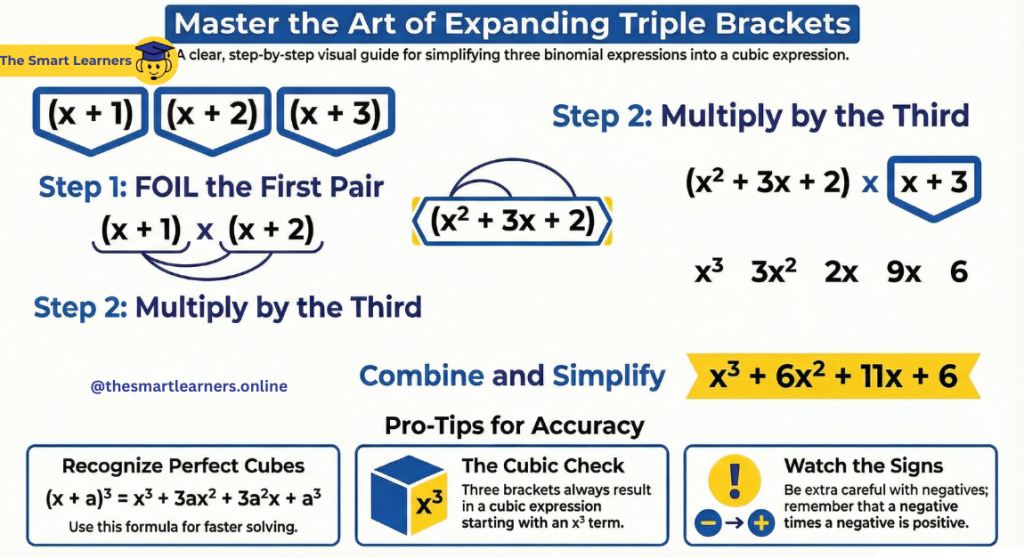
Example: (x + 1)(x + 2)(x + 3)
Step 1: (x + 1)(x + 2) = x² + 3x + 2
Step 2: (x² + 3x + 2)(x + 3) = x³ + 6x² + 11x + 6

🔢 The Method: Step by Step

Step 1: Expand any two brackets first

Choose any two brackets to expand first using FOIL method.

(x + 1) × (x + 2) = x² + 3x + 2

FOIL expansion:

F: x × x = x²

O: x × 2 = 2x

I: 1 × x = 1x

L: 1 × 2 = 2

x² + 2x + 1x + 2 = x² + 3x + 2

Step 2: Multiply the result by the third bracket

Now multiply your quadratic by the remaining bracket.

(x² + 3x + 2) × (x + 3) = x³ + 6x² + 11x + 6

Multiply each term:

x² × (x + 3) = x³ + 3x²

3x × (x + 3) = 3x² + 9x

2 × (x + 3) = 2x + 6

Add like terms:

x³ + (3x² + 3x²) + (9x + 2x) + 6

= x³ + 6x² + 11x + 6

📚 Types of Triple Brackets

➕ All Brackets Positive

All terms are positive - the most straightforward type.

Example 1: (x + 1)(x + 2)(x + 3)

Step 1: (x + 1)(x + 2) = x² + 3x + 2

Step 2: (x² + 3x + 2)(x + 3)

= x³ + 3x² + 3x² + 9x + 2x + 6

= x³ + 6x² + 11x + 6

Example 2: (x + 2)(x + 3)(x + 4)

Step 1: (x + 2)(x + 3) = x² + 5x + 6

Step 2: (x² + 5x + 6)(x + 4)

= x³ + 4x² + 5x² + 20x + 6x + 24

= x³ + 9x² + 26x + 24

Example 3: (x + 1)(x + 3)(x + 5)

Step 1: (x + 1)(x + 3) = x² + 4x + 3

Step 2: (x² + 4x + 3)(x + 5)

= x³ + 5x² + 4x² + 20x + 3x + 15

= x³ + 9x² + 23x + 15

➖ With Negative Signs

Be careful with signs! Negative × Negative = Positive.

Example 1: (x - 1)(x + 2)(x + 3)

Step 1: (x - 1)(x + 2) = x² + 2x - x - 2 = x² + x - 2

Step 2: (x² + x - 2)(x + 3)

= x³ + 3x² + x² + 3x - 2x - 6

= x³ + 4x² + x - 6

Example 2: (x - 2)(x + 3)(x - 4)

Step 1: (x - 2)(x + 3) = x² + 3x - 2x - 6 = x² + x - 6

Step 2: (x² + x - 6)(x - 4)

= x³ - 4x² + x² - 4x - 6x + 24

= x³ - 3x² - 10x + 24

Example 3: (x - 1)(x - 2)(x - 3)

Step 1: (x - 1)(x - 2) = x² - 2x - x + 2 = x² - 3x + 2

Step 2: (x² - 3x + 2)(x - 3)

= x³ - 3x² - 3x² + 9x + 2x - 6

= x³ - 6x² + 11x - 6

🔢 With Coefficients

Multiply coefficients carefully and use index laws.

Example 1: (2x + 1)(x + 2)(x + 3)

Step 1: (2x + 1)(x + 2) = 2x² + 4x + x + 2 = 2x² + 5x + 2

Step 2: (2x² + 5x + 2)(x + 3)

= 2x³ + 6x² + 5x² + 15x + 2x + 6

= 2x³ + 11x² + 17x + 6

Example 2: (3x - 1)(x + 2)(2x - 3)

Step 1: (3x - 1)(x + 2) = 3x² + 6x - x - 2 = 3x² + 5x - 2

Step 2: (3x² + 5x - 2)(2x - 3)

= 6x³ - 9x² + 10x² - 15x - 4x + 6

= 6x³ + x² - 19x + 6

⬆️ Perfect Cubes

When all three brackets are the same: (x + a)³

Example 1: (x + 2)³

(x + 2)³ = (x + 2)(x + 2)(x + 2)

Step 1: (x + 2)(x + 2) = x² + 4x + 4

Step 2: (x² + 4x + 4)(x + 2)

= x³ + 2x² + 4x² + 8x + 4x + 8

= x³ + 6x² + 12x + 8

Formula: (x + a)³ = x³ + 3ax² + 3a²x + a³

Example 2: (x - 1)³

(x - 1)³ = (x - 1)(x - 1)(x - 1)

Step 1: (x - 1)(x - 1) = x² - 2x + 1

Step 2: (x² - 2x + 1)(x - 1)

= x³ - x² - 2x² + 2x + x - 1

= x³ - 3x² + 3x - 1

🧮 Interactive Triple Bracket Expander

Enter your own triple brackets and see them expand step-by-step!

✏️ Practice Triple Brackets

Expand: (x + 1)(x + 2)(x + 3)

Correct: 0 Attempted: 0

🎯 Common Patterns to Recognize

Pattern 1: Consecutive numbers

(x + n)(x + n+1)(x + n+2)

(x + 1)(x + 2)(x + 3) = x³ + 6x² + 11x + 6

The coefficients follow a pattern: 1, 6, 11, 6

Pattern 2: Symmetric brackets

(x + a)(x + b)(x + c) where a + b + c = constant

(x + 1)(x + 2)(x + 4) = x³ + 7x² + 14x + 8

Notice: 1 + 2 + 4 = 7 (coefficient of x²)

online tutoring the smart learners double brackets mathematics Math
Mathematics

Expanding Double Brackets

Expanding Double Brackets

GCSE Mathematics

📦 What are Double Brackets?

Expanding double brackets means multiplying two binomial expressions together. Every term in the first bracket must be multiplied by every term in the second bracket. The common method is FOIL: First, Outer, Inner, Last.

Formula: (a + b)(c + d) = ac + ad + bc + bd
Example: (x + 3)(x + 4) = x² + 4x + 3x + 12 = x² + 7x + 12

🌈 The FOIL Method

(x + 3)(x + 4)
First
x × x = x²
Outer
x × 4 = 4x
Inner
3 × x = 3x
Last
3 × 4 = 12
x² + 4x + 3x + 12 = x² + 7x + 12

📚 Types of Double Brackets

➕ Both Brackets Positive

All terms are positive - straightforward multiplication.

Example 1

(x + 2)(x + 5)

= x×x + x×5 + 2×x + 2×5

= x² + 5x + 2x + 10

= x² + 7x + 10

Example 2

(x + 3)(x + 7)

= x² + 7x + 3x + 21

= x² + 10x + 21

Example 3

(x + 4)(x + 6)

= x² + 6x + 4x + 24

= x² + 10x + 24

➖ With Negative Signs

Be careful with signs! Negative × Negative = Positive.

Example 1

(x - 2)(x + 5)

= x×x + x×5 + (-2)×x + (-2)×5

= x² + 5x - 2x - 10

= x² + 3x - 10

Example 2

(x + 3)(x - 4)

= x² - 4x + 3x - 12

= x² - x - 12

Example 3

(x - 3)(x - 5)

= x² - 5x - 3x + 15

= x² - 8x + 15

🔢 With Coefficients

Multiply coefficients together and use index laws for variables.

Example 1

(2x + 3)(x + 4)

= 2x×x + 2x×4 + 3×x + 3×4

= 2x² + 8x + 3x + 12

= 2x² + 11x + 12

Example 2

(3x - 2)(2x + 5)

= 3x×2x + 3x×5 + (-2)×2x + (-2)×5

= 6x² + 15x - 4x - 10

= 6x² + 11x - 10

Example 3

(4x - 1)(3x - 2)

= 4x×3x + 4x×(-2) + (-1)×3x + (-1)×(-2)

= 12x² - 8x - 3x + 2

= 12x² - 11x + 2

⬆️ Perfect Squares

When both brackets are the same: (a + b)² = a² + 2ab + b²

Example 1

(x + 3)²

= (x + 3)(x + 3)

= x² + 3x + 3x + 9

= x² + 6x + 9

Example 2

(2x - 5)²

= (2x - 5)(2x - 5)

= 4x² - 10x - 10x + 25

= 4x² - 20x + 25

Formula

(a + b)² = a² + 2ab + b²

(a - b)² = a² - 2ab + b²

🔄 Difference of Squares

When brackets are (a + b)(a - b): The middle terms cancel!

Example 1

(x + 3)(x - 3)

= x² - 3x + 3x - 9

= x² - 9

Example 2

(2x + 5)(2x - 5)

= 4x² - 10x + 10x - 25

= 4x² - 25

Formula

(a + b)(a - b) = a² - b²

🧮 Interactive Double Bracket Expander

Enter your own double brackets and see them expand step-by-step!

×

✏️ Practice Expanding Double Brackets

Expand and simplify: (x + 3)(x + 4)

Correct: 0 Attempted: 0

🌟 Challenge Questions

Expand and simplify: (2x + 3)(3x - 4)

Expand and simplify: (3x - 2)(2x - 5)

Expand and simplify: (4x + 3)²

⚠️ Common Mistakes

❌ Wrong: Only multiplying First and Last

(x + 3)(x + 4) = x² + 12 ❌

Correct: x² + 4x + 3x + 12 = x² + 7x + 12

✅ Correct: Use FOIL

First: x × x = x²

Outer: x × 4 = 4x

Inner: 3 × x = 3x

Last: 3 × 4 = 12

❌ Wrong: Sign errors

(x - 3)(x + 4) = x² + 4x - 3x - 12 ❌

Wait, that's actually correct! But some forget: (-3)×4 = -12

⚠️ Forgetting to simplify

Always combine like terms (the Outer and Inner terms)

❌ Wrong: Messing up coefficients

(2x + 3)(3x + 4) = 2x×3x + 2x×4 + 3×3x + 3×4

= 6x² + 8x + 9x + 12 = 6x² + 17x + 12

🌍 Where Double Brackets Are Used

📐 Area of Rectangle

Length = (x + 5), Width = (x + 3)

Area = (x + 5)(x + 3)

= x² + 3x + 5x + 15

= x² + 8x + 15

🏢 Building Design

Floor dimensions: (2x + 10) by (3x + 5)

Area = 6x² + 10x + 30x + 50

= 6x² + 40x + 50

💰 Profit Calculation

Profit = (price - cost) × quantity

If price = (x + 20), quantity = (x + 100)

Profit expands to quadratic

Exponents and Indices and powers the smart learners mathematics online tutoring
Mathematics

Algebraic Roots and indices

Algebraic Roots and Indices - GCSE Mathematics | The Smart Learners

Algebraic Roots and Indices

GCSE Mathematics

📐 What are Roots and Indices?

Indices (or exponents) show how many times a number is multiplied by itself. Roots are the inverse operation - finding which number multiplied by itself gives the original number. Together, they form the foundation of powers and surds in algebra.

Index (Power): 5³ = 5 × 5 × 5 = 125
Root: √25 = 5 (because 5 × 5 = 25)
Algebraic: x⁴ × x³ = x⁷

📏 Laws of Indices

✖️ Law 1: Multiplication (Add indices)

aᵐ × aⁿ = aᵐ⁺ⁿ

Example 1

x³ × x⁴ = x³⁺⁴ = x⁷

Example 2

y² × y⁵ = y²⁺⁵ = y⁷

Example 3

3x² × 2x⁴ = (3×2)x²⁺⁴ = 6x⁶

➗ Law 2: Division (Subtract indices)

aᵐ ÷ aⁿ = aᵐ⁻ⁿ

Example 1

x⁷ ÷ x³ = x⁷⁻³ = x⁴

Example 2

y⁶ ÷ y² = y⁶⁻² = y⁴

Example 3

12x⁵ ÷ 3x² = (12÷3)x⁵⁻² = 4x³

⬆️ Law 3: Power of a Power (Multiply indices)

(aᵐ)ⁿ = aᵐ×ⁿ

Example 1

(x³)² = x³×² = x⁶

Example 2

(y⁴)³ = y⁴׳ = y¹²

Example 3

(2x²)³ = 2³ × (x²)³ = 8x⁶

➖ Law 4: Negative Indices

a⁻ⁿ = 1/aⁿ

Example 1

x⁻³ = 1/x³

Example 2

2y⁻⁴ = 2/y⁴

Example 3

(2x)⁻² = 1/(2x)² = 1/(4x²)

0️⃣ Law 5: Zero Index

a⁰ = 1 (where a ≠ 0)

Example 1

x⁰ = 1

Example 2

5⁰ = 1

Example 3

(2x³)⁰ = 1

√ Roots and Surds

🔲 Square Roots

√a × √a = a

√16 = 4 (because 4² = 16)

√x⁶ = x³ (because (x³)² = x⁶)

📦 Cube Roots

∛a × ∛a × ∛a = a

∛27 = 3 (because 3³ = 27)

∛x⁹ = x³ (because (x³)³ = x⁹)

🔄 Fractional Indices

a^(1/n) = ⁿ√a

x^(1/2) = √x

x^(1/3) = ∛x

🧮 Interactive Indices Calculator

Enter expressions and see how indices laws work!

✏️ Practice Questions

Simplify: x³ × x⁴

Score: 0 Attempted: 0

🌟 Challenge Problems

Simplify: (2x³y²)⁴

Simplify: (8x⁶)^(1/3)

Simplify: (4x⁴)^(1/2) × x³

⚠️ Common Mistakes

❌ Wrong: Adding when multiplying powers

x³ × x⁴ = x¹² ❌

Correct: x³ × x⁴ = x⁷ (add indices)

✅ Correct: Remember the laws

Multiplication → Add indices

Division → Subtract indices

Power of power → Multiply indices

❌ Wrong: Forgetting about coefficients

2x³ × 3x⁴ = 5x⁷ ❌

Correct: 2x³ × 3x⁴ = 6x⁷

⚠️ Negative indices are reciprocals

x⁻³ = 1/x³, not -x³

🌍 Where Indices Are Used

💰 Compound Interest

A = P(1 + r)ⁿ

Where n is the number of years (index)

📏 Scientific Notation

3.2 × 10⁶ = 3,200,000

Powers of 10 make big numbers manageable

📊 Area and Volume

Area = length² (square units)

Volume = length³ (cubic units)

🧬 Exponential Growth

Bacteria growth: N = N₀ × 2ᵗ

Population doubles each hour

Scroll to Top